Who has the X Factor?

cat vassOkay, I’m going to admit that I have been totally drawn into viewing the television talent show X Factor. The last time such a thing happened was a decade ago, with the very first series of Australian Idol (2003) won by Guy Sebastian. While I am thoroughly aggravated by the hype, drama, ad breaks and soapie-style formatting, I do simply enjoy hearing the people sing! (Especially Georgie, but he was eliminated tonight in the cut for the final 12! Can you believe it? I think he didn’t have the pop star physique they were looking for. Check out the video at the end – I assure you it will bring a smile to your dial, as they say!)

Yet each voice is like a fingerprint, a unique sound that each person owns and uses to bring new life to old melodies. Each person has been on a unique journey to arrive at a place where they feel comfortable and confident with their voices. I find this most intriguing. Though some of them try their best to sound like pop stars who already own fame, their unique vocal colour shines through.

And this leads me to contemplate the incredible gift of singing voices that God has given. Such a divine gift from the Creator, a gift greatly admired and applauded even by those who will not give credit to the Maker of the voice. And who can beat true emotion conveyed through sung lyrics? A pleasant, dynamic voice can pack a punch unmatched by any spoken rhetoric.

God has designed us with singing voices for many reasons, but perhaps above all, that we would praise Him!
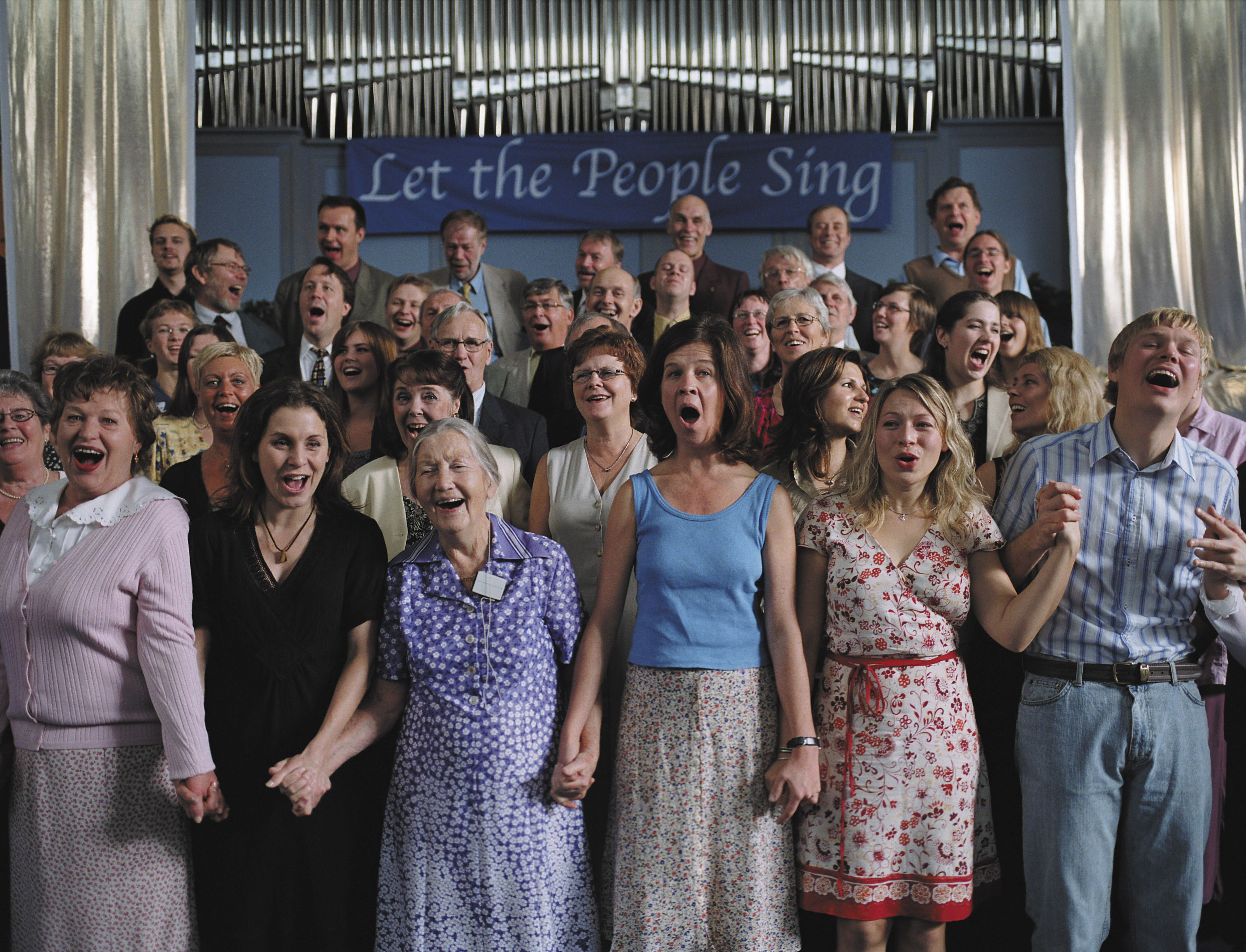
Oh that we could inspire our congregations to sing to God (and one another) with the conviction and energy of these X Factor hopefuls. Though these singers gather together to sing for their own fame (and supper), we gather together as Christ’s Body to praise Him. As we share the true Word of God together in song, surely we should be displaying equal or greater effort? We sing for the most famous One, the author of Life, the Saviour of the world, to declare His glory.  When we remember this purpose it can change our self-consciousness, often off-key, efforts into something mutually edifying. Praising God is so good for us. And so is singing!
Don’t you think?

And here’s Georgie (the full audition):

You may also like these posts:

10 Principles for Church Singing                         The wonderful mystery of Harmony singing
praise him pic cracking_the_harmony_2

10 Principles for church singing

praise him picKevin de Young is writing lots of great material over at the Gospel coalition. If you have never visited there I would encourage you to do so. Today I’m sharing a summary of his ‘Ten Principles for Church songs’ which has been published in two parts. I have included his introduction, and then a summary of his ten principles (with some teasers) – which I would thoroughly endorse! To read his full explanation of each point you will need to click through to the actual website. It would make great material to work through with the church leadership or your music team, to clarify issues, prevent problems and encourage one another:

When it comes to singing on Sundays, churches have more options than ever before. From hymnals to Hillsong to homegrown creations, pastors and worship leaders have thousands of songs to choose from. A nice problem to have. But still a problem. No music leader or pastor can keep up. No church can sing all the great hymns and all the latest greatest songs on the radio. No musician can excel in all the available styles. No leader can please all the people all the time. . . There are other questions too. What sort of instruments should we use? How much should cultural context come into play? Is there only one right kind of song to sing? If not, are there any wrong ways? I can’t possibly answer all those questions. But there are some general principles we can use to make wise decisions with our church music. Let me suggest ten principles for congregational singing.

1. Love is indispensable to church singing that pleases God.
Love is indispensable when we sing and when we are trying to discern what is best to sing.
2. Our church singing is for God’s glory and the edification of the Body of Christ.
Congregational song is part of the teaching ministry of the church.
3. We ought to sing to the Lord new songs.
Sometimes I want to ask to very conservative Christians: “Do you really think the last good song of praise to Jesus has been written?”
4. Church singing should swim in its own history of church singing.
We should swim in this big ocean of church music, an ocean that is continually receiving new streams.
5. Sing the Psalms
It’s strange, even though we are commanded to sing Psalms and even though Psalms have been at the center of the Church’s singing for centuries, still we easily ignore the 800 pound gorilla in the middle of our Bibles.
6. We should strive for excellence in the musicality and the poetry of the songs we sing.
Some songs are simply deep and some are deeply simple, but there is a way to do both well.  With so many songs to choose from, there’s no reason churches can’t make an effort to sing songs with some sense of poetry and musical integrity.
7. The main sound to be heard in the worship music is the sound of the congregation singing.
What people want to see in your worship is that you mean it. And no matter how chill or how reverent your worship is, if no one is singing, it’s lame.
8. The congregation should also be stretched from time to time to learn new songs and broaden its musical horizons.
Every church will have a musical center. You should not reinvent the center every week. But you should not be enslaved to it either.
9. The texts of our songs should be matched with fitting musicality and instrumentation.
Musical style is not neutral, but it is elastic. Music conveys something. Some melodies are too syrupy or too raucous or too romantic.
10. All of our songs should employ manifestly biblical lyrics.
In all our songs we want to be teaching people about God. If we aren’t learning good theology and biblical truth from our songs, then either we don’t care much about our songs or we don’t care much about rich biblical truth, or both.

I will boast in the Lord my God

Recently I noticed that many of the new songs we had introduced at church were lacking a little variety in terms of tempo! What was missing? The fast songs!
It probably takes a great degree of skill to build a singable song that isn’t slow – especially when we are singing such weighty words about the grace and riches of Christ!  But I have begun a quest: to find all the good, singable, fast songs! I’m digging back into my lists of possibilities from the last few years to see what missed out, and why, and what tempo they have. There’s nothing like a lively song to engage people and draw hearts together in praise.
Here is the first one I would like to share, “I will boast in the Lord my God” by Paul Baloche, 2006. I have not used it with a congregation, so I can’t say it is tried and tested . . . but hopefully!  (I’ll be using the key of Bb, capo 1 in A for guitar – or try key of C if you don’t mind it a little higher. Alternatively, use E major for a brighter verse, and sing the chorus down the octave if necessary, which it mostly will be for the women!)

There are at least two passages combined in the lyrics of the song:
Jeremiah 9:23-24

23 This is what the Lord says:

“Let not the wise boast of their wisdom
or the strong boast of their strength
or the rich boast of their riches,
24 but let the one who boasts boast about this:
that they have the understanding to know me,
that I am the Lord, who exercises kindness,
justice and righteousness on earth,
for in these I delight,”
declares the Lord.

Galatians 6:14

14 May I never boast except in the cross of our Lord Jesus Christ, through which the world has been crucified to me, and I to the world.

Here are the full lyrics:

I Will Boast

Let not the wise man boast in his wisdom
Or the strong man boast in his strength
Let not the rich man boast in his riches
But let the humble come and give thanks
To the One Who made us
The One Who saved us

I will boast in the Lord my God
I will boast in the One Who’s worthy
I will boast in the Lord my God
I will boast in the One Who’s worthy
He’s worthy

(Bridge)
I will make my boast in Christ alone

CCLI Song # 4662350 Paul Baloche © 2006 Integrity’s Hosanna! Music

If you want to hear more of Baloche, try my posts about 3 other songs:
My Hope in God’s Grace
The Same Love is Calling
A good blokey church song: The Kingdom of God

The wonderful mystery of harmony singing

cracking_the_harmony_2I absolutely love singing in harmony. It would have to be my most favourite thing to do. At church it takes lots of self-control to stop myself singing harmony all the time. (But I do refrain most of the time since it can seem a bit show-off-ish, and also off-putting if you are meant to be leading people in the melody up the front!)
But give me a few spare minutes and some other keen people, this is my preferred activity! There is just something totally mysterious, extraordinary and beautiful about the way harmonic notes blend together. When people ask me to write them some harmony parts for a song I rejoice at the challenge and opportunity to sit and fiddle with harmony for a few hours. (I’ve often wondered if this could be a lucrative business activity via the internet! What do you think?)
You may call me crazy for such harmonic enthusiasm, but this is what comes from being brought up on huge doses of harmony singing, at home, at school and church, in choirs and small a cappella groups. Yet despite my experience, when people ask me to teach them how to sing harmony I scratch my head and wonder? How do you teach someone what is a pretty complicated process in listening and anticipating?

“In the simplest style of vocal harmony, the main vocal melody is supported by a single backup vocal line, either at a pitch which is above or below the main vocal line, often in thirds or sixths which fit in with the chord progression used in the song. In more complex vocal harmony arrangements, different backup singers may sing two or even three other notes at the same time as each of the main melody notes, mostly with consonant, pleasing-sounding thirds, sixths, and fifths (although dissonant notes may be used as short passing notes)”. (So says Wikipedia)

You can now see why I say it is a pretty complicated process, especially if you are going to improvise!
I think the only way to learn to harmonise well it is to hear it, to hear someone do it, a lot, then try it! When you sing harmony you have to anticipate what’s coming, both in the melody and the chords that support it. You have to anticipate what will blend well with the note coming up. You have to hear the harmony in your head before you execute it, and then you need the courage to try it. Good harmony singing has to be “caught not taught”. I had about 17 years of ‘weekly lessons’ in harmony singing with my dad – well not formal ones, more just singing in the pew beside him each Sunday, listening to his improvised tenor line for every hymn in the book.

And are there any benefits of harmony singing, you may ask? Well for singers you have to listen to other people well, which has to be a good thing. It develops team work, and together you create something beautiful which one voice alone could not create. In performance it helps shift the focus from the glory of one person, to the team work of several. There are also benefits for the listener, as they hear the blend, the movement of sound, the tension and the resolution of different voices working together.
And of course there is a spiritual application here. Living in harmony with others requires the same practised skillful decision making. We must choose to listen to others, consider where they are heading (they may be walking in shoes very different from ours), and then choose grace over judgement. Again, these skills are often better caught than taught. Great harmony can be achieved from a group of people who are careful to keep in tune with God and each other, living selfless lives. The loving characteristics of our heavenly Father blend so well together. If we are reflecting his character and glory we cannot help but harmonise beautifully. He is the Father of all harmonies, both musically and between us.

2 Corinthians 13:11 NLT
“Dear brothers and sisters, I close my letter with these last words: Be joyful. Grow to maturity. Encourage each other. Live in harmony and peace. Then the God of love and peace will be with you.”

Here is a clip of some harmony singing I did with a friend (on melody) at a recent women’s conference. Oh the Deep Deep Love of Jesus.

You may also like:
Film review: As it is in Heaven
As it is in Heaven

Hymn lines that didn’t stand the test of time

Today’s post comes from a ‘Gathered Worship Director’ (I like that!) in New Zealand – the original article can be found here at Chong’s Worship: I think you’ll find it quite amusing, but at the same time remember that some lines of our modern hymns may sound equally as strange in a few hundred years time!

old hymnGod’s blessed the church with hundreds of memorable hymns of the faith. Christians and non-Christians alike recognise lines such as “Amazing Grace! How sweet the sound…”, “How Great Thou Art”, “Great is Thy Faithfulness”, and “Abide with me, fast falls the eventide…” (I’m sure you can think of many of your own examples).

For a bit of a laugh, here are a couple of examples of old hymn lyrics that, although theologically sound, have thankfully fallen out of use:

Stanza 6 in “How Firm A Foundation”:

Even down to old age all My people shall prove
My sovereign, eternal, unchangeable love;
And when hoary hairs shall their temples adorn,
Like lambs they shall still in My bosom be borne.

(Hoary means ancient, aged.)

Stanza 9 of Charles Wesley’s “Come Thou O Traveller Unknown”:

’Tis Love! ’tis Love! Thou diedst for me!
I hear Thy whisper in my heart;
The morning breaks, the shadows flee,
Pure, universal love Thou art;
To me, to all, Thy bowels move;
Thy nature and Thy Name is Love.

The term “bowels” used to mean the seat of one’s emotion (what we refer today as our heart).

The first line of Isaac Watt’s “Hark the Herald Angels Sing” was originally:

Hark! How all the welkin rings, ‘Glory to the King of Kings.”

(Welkin refers to the highest heavens.)

And from verse 3 of Joseph Hart’s hymn, “Salvation to the Lamb”:

When we incurred the wrath of God, Alas! what could we worse?
He came, and with his own heart’s blood Redeem’d us from the curse.
This paschal Lambour heav’nly meat, was roasted in the flame.
Repeat, ye ransomed souls, repeat, “Salvation to the Lamb!”

While I like Joseph Hart’s sincere attempt to link Jesus to the Passover lamb in Exodus, this particular imagery is um… hard to stomach (thankfully other people have tried rewriting it).

To fit the language

So why did these hymnwriters use those words? To fit the language of the people at that time, who would have understood the phrases and meanings without any hint of snickering.

Brian Wren in his book Praying Twice adds some helpful insight (p.297-8):

“… The need for change sometimes overrides the need for familiarity… In the Preface to his Hymns and Spiritual Songs, [Isaac Watts] says that “what is provided for public worship should give to sincere consciences as little vexation and disturbance as possible” However, “where any unpleasing word is found, he that leads the worship may substitute a better; for (Blessed be God) we are not confined to the words of any Man in our public solemnities.”

“However much we value our past, our present interest in congregational song is not antiquarian, but immediate. We sing to God from today, in lyrics which — whether ancient or recent — express today’s faith. When a lyric from the past gets too archaic to be understood, or too out of sync with today’s hope, faith, and issues to speak for us, it will eventually cease to be sung, or amended to keep it singable.

I was reflecting awhile back on whether Christians had to hang on to obscure hymn lyrics. Ultimately, I think Brian Wren is right – if a line is worth understanding and remembering, it will stay in use. And if it makes you think about your bowels, it’s probably not worth keeping!

Working for those moments of Joy

grow musicThe non-musician in our Christian gatherings often looks towards the musicians with a certain measure of (perhaps misguided) awe. One thing they find ‘awesome’ is that we even bother! We musicians put ourselves through many practices, where we must work closely with others, negotiating different opinions, and we put ourselves ‘out there’ and up front, where the criticism can sometimes sting. . .  a lot. (Luther didn’t call church music the War Department for nothing!)  And while some look with awe, others may look with disdain and consider most of our efforts simply for show and self-glory.
But there is one thing that keeps musicians (music directors in particular) in the job – and it’s not usually the pay grade!  It is the love for gathering people together in song, praising our great God! Corporate singing provides a unique opportunity to create joy as people praise God and sing out words of encouragement to each other. It gives people the opportunity to express publicly the joy, confidence and hope they have in Christ. These are things they may not find easy to say in everyday conversation.
Since God also delights in the praise of His people (which thwarts Satan’s best efforts at discouragement) we musicians experience much blessing and encouragement ourselves in leading people in something that has eternal, spiritual and cosmological impact!

When we put effort into selecting great sets of song, that are biblically true, Gospel-focused and singable for a group of people, there is the hope that the Word in song will challenge people’s hearts and teach them to know and love their Saviour more. The lyrics might even move people to great (or small) acts of love and service, bringing glory to God. Some may experience a lightbulb moment, as a difficult theological concept makes sense for the first time, in song. “Where the Word goes the Spirit goes” (John Piper) – so the more our songs are steeped in the Word, the more He works through them.
And while I admit that not everyone may be looking joyful as we lead them in praising God, it is the possibility for creating deep inner joy that keeps us coming back. This is what we love! We love to hear God’s praises! We love to see the joy that music brings, joy that encourages us all on our journey of faith.

“. . . . for the joy of the Lord is our strength.”
(Nehemiah 8:10)

You may also like:

How to encourage your music team                                            10 Principles for Church singing
praise-godtaintedcanvasdotcompraise him pic


Praying through the songs 500+ women will sing tomorrow

grow2013_bannerI’m spending some time reflecting on the 9 songs (titles in bold) I’ll be leading tomorrow at the GROW Women’s Conference at Brisbane’s Convention and Exhibition Centre. The cool thing is that as these women sing, they are also declaring God’s greatness to each other, and praying publicly to Him! I’ve just woven the nine titles into a prayer. May it also be your prayer today:

Dear Loving Heavenly Father
Blessed be Your Name! There is no other name given under heaven by which we can be saved. We have more than 10 000 Reasons to praise you for the blessings you have given us in Christ, the blessings that reveal your faithfulness to us, your trustworthy character, and the fact that you keep your promises. We See the Man, Jesus, the man you sent to reverse the curse we brought on ourselves by our disobedience to you. He is the man who destroys death and now reigns, the righteous one who died for the unrighteous, that we might know You. Jesus is all we need in this changing and uncertain world, because he is the unchanging promised Saviour. Help us to realise that all we need is Christ. Indeed, All I have is Christ! We cannot keep any of the glory this world offers. neither do we need it! Thankyou for this confidence! Whatever our circumstances you have taught us to say It is Well, It is well with my soul. We have this peace like a river, peace that we have come to know if we are in Christ. He is an anchor for our souls and we can say “it is well”, the victory is won. I will rise on eagle’s wings because Jesus has overcome the sin that kept us dead to you. Oh the Deep Deep love of Jesus which is vast, unmeasured, boundless and free! It is an ocean full of blessing in the midst of every test. You will bring us home to glory. Great is Thy Faithfulness – in fact, nothing can reach the end of your faithfulness. If all the plans I make go wrong your love stays the same. You light will guide me through every shadow, every storm. I will hold on to you because you are My Hope, a hope built on your great love and righteousness. Keep me walking in your way, keep me trusting your heart and trusting your name.

Amen.

95,000 Liverpool Fans Sing You’ll Never Walk Alone

If you have ever doubted the power of song, check out this enormous ‘choir’ singing in the stands at the MCG overnight. Men’s choirs are great!

http://balls.ie/football/95000-liverpool-fans-sing-youll-never-walk-alone-at-the-mcg/

Evolution of music – in song

This is a clever medley of songs across the last few centuries. Styles may change, but the desire remains constant, the desire to sing and harmonise, to express joy and emotions that otherwise would be difficult to say. Praise God for this unique gift he has given us.

C.S. Lewis on musical taste and grace

music tasteA few days ago I wrote about the way we can show grace to others by not demanding that they pander to our prideful ‘good taste’ (in a variety of areas).
Here C.S. Lewis talks about a related topic, musical taste. Disagreements over the ‘right’ or most godly church music have produced many hard-fought and rarely-won battles. While Lewis’ comments below are a bit of a challenge in terms of the language, it is worth the slog if you can get to his main point. Grace is the key! We must bear with one another in love, bear with things we dislike for the sake of others whom we are called to love, in Christ. If we are in music ministry and find ourselves filled with pride at our skill, or contempt and hostility to the congregation we serve, it’s probably time for a break! It’s probably time to re-examine our motives – and pray for God to work in us for His glory. Blessings!

Musical Taste

“There are two musical situations on which I think we can be confident that a blessing rests. One is where a priest or an organist, himself a man of trained and delicate taste, humbly and charitably sacrifices his own (aesthetically right) desires and gives the people humbler and coarser fare than he would wish, in a belief (even, as it may be, the erroneous belief) that he can thus bring them to God. The other is where the stupid and unmusical layman humbly and patiently, and above all silently, listens to music which he cannot, or cannot fully, appreciate, in the belief that it somehow glorifies God, and that if it does not edify him this must be his own defect. Neither such a High Brow nor such a Low Brow can be far out of the way. To both, Church Music will have been a means of grace; not the music they have liked, but the music they have disliked. They have both offered, sacrificed, their taste in the fullest sense. But where the opposite situation arises, where the musician is filled with the pride of skill or the virus of emulation and looks with contempt on the unappreciative congregation, or where the unmusical, complacently entrenched in their own ignorance and conservatism, look with the restless and resentful hostility of an inferiority complex on all who would try to improve their taste – there, we may be sure, all that both offer is unblessed and the spirit that moves them is not the Holy Ghost.”

This was taken from an essay entitled “On Church Music” by C. S. Lewis. It can be found in a current publication called Christian Reflections published by Wm. B. Eerdmans Publishing Co.; ISBN: 0802808697.

Ps. Today I celebrate my 150th Blog Post! Thanks for reading.
Read more about C.S.Lewis on this post: Our Glorious Capital C Church