Book Review: ‘One Forever’

One Forever‘ by Rory Shiner (Matthias Media 2012) One forever2
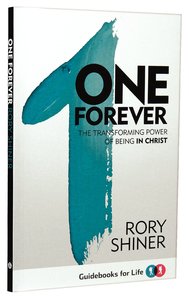
When you think of yourself being “in Christ” what do you think of? How would you explain this gospel truth? It is much easier to understand Christianity in terms of believing in Christ, or following Christ or knowing Christ. Yet this “in Christ” terminology is favoured by the New Testament writers, Paul especially. It is also packed with the wondrous grace of God shown in the gift of His Son.
If you want to understand better what it means to be IN Christ then this book is for you.
Published in 2012 and written by Australian pastor Rory Shiner One Forever: The Transforming Power of Being in Christ explores so many facets of what this phrase means, in just seven chapters. His writing is conversational and friendly, accessible to most adults and probably many youth. His illustrations are easy to understand, yet the concepts are deep and his pastoral heart is clear. Rory wants us to have the confidence and certainty of being IN Christ, even if our faith is small.
Here are some of the main ideas he explores:

1. To be a Christian is to be in Christ.
“To be a Christian is to put on the Lord Jesus Christ. It is to believe into him. It is to clothe yourself with him.” p40

2. The size of your faith does not matter. The power of the one you have faith in does.

3. Justification is not up to us or our efforts.
Justification is objective. “Justification was not achieved in my heart but on a cross outside Jerusalem”.
“Justification is one of the great joy factories of the Christian life”.
P46

4. We are united with Christ in his death and his righteousness and his resurrection.
If we only think of ourselves as following Christ or knowing Christ or being near Christ then we don’t capture what union captures. p58. “Union with Christ is our defence against the playground bullies of sins and temptation.” p56

5. We are right before God because we are in Christ and HE is right before God.
“To stand in Christ is to stand in a place where the wrath of God will never be felt because wrath of God has already been there.” p36

6. Christians aren’t just ‘not perfect but forgiven’, they ‘forgiven and they are united to christ . . . indwelt by the Spirit of God, and they are empowered by God to live a new life. p 62

7. Christ identifies so closely with the Church, His church is His body, He is the Church. When his church is persecuted Christ is persecuted p.70, 68, “Church is the most concrete expression of your union with Christ.” p.73.
“The distinction we make between how we treat Christ and how we treat his gathered people is not a distinction that Jesus makes” (p74).

8. In the case of the weakest and most broken members of our churches, their very brokenness is their gift to the church. They gift to the church their brokenness, and as we are drawn out of ourselves to serve them, we learn how to be the body of Christ. p.72

Now if that has not whet your appetite to better understand the treasure of what it means to be “in Christ”, check out the video below which is designed to explain a little more. And you can find the book at Matthias, Koorong, and Amazon. I hope it will be a blessing to you!

You may also like: 

Holding on to what we already have in Christ – Philippians 3:16


and

Stones or bricks: God lives in us together (1 Corinthians 3:16)

Living in 10000 little moments of change

defining-momentsOver at Paul Tripp Ministries he has been discussing the possibility of life-changing change, something we all entertain every January as we consider our resolutions! Sometimes we even have some success with such changes, but as Tripp says, it takes 10000 moments to create lasting change. As you look ahead, consider if you are able to create more opportunities for those little, quiet “moments” where change takes place:

“Is change important? Yes, it is for all of us in some way. Is commitment essential? Of course! There’s a way in which all our lives are shaped by the commitments we make. But biblical Christianity – which has the gospel of Jesus Christ at its heart – simply doesn’t rest its hope in big, dramatic moments of change.

The fact of the matter is that the transforming work of grace is more of a mundane process than it is a series of a few dramatic events. Personal heart and life change is always a process. And where does that process take place? It takes place where you and I live everyday. And where do we live? We all have the same address – the utterly mundane.

Most of us won’t be written up in history books. Most of us only make three or four momentous decisions in our lives, and several decades after we die, the people we leave behind will struggle to remember the events of our lives. You and I live in little moments, and if God doesn’t rule our little moments and doesn’t work to re-create us in the middle of them, then there’s no hope for us, because that’s where you and I live.

This is where I think “Big Drama Christianity” gets us into trouble. It can cause us to devalue the significance of the little moments of life and the “small change” grace that meets us there. Because we devalue the little moments where we live, we don’t tend to notice the sin that gets exposed there and we fail to seek the grace that’s offered to us.

10,000 Little Moments

I don’t want to discourage you from making a resolution or tell you to throw away what you’ve already written, but I do want to challenge your way of thinking. You see, the character of your life won’t be established in two or three dramatic moments, but in 10,000 little moments. Your legacy will be shaped more by the 10,000 little decisions you make in 2014 rather than the last-minute resolution you’re about to make.

How can you establish a godly character and lasting legacy in 2014?

  • With 10,000 moments of personal insight and conviction.
  • With 10,000 moments of humble submission.
  • With 10,000 moments of foolishness exposed and wisdom gained.
  • With 10,000 moments of sin confessed and sin forsaken.
  • With 10,000 moments of courageous faith.
  • With 10,000 choice points of obedience.
  • With 10,000 times of forsaking the kingdom of self and running toward the kingdom of God.
  • With 10,000 moments where we abandon worship of the creation and give ourselves to worship of the Creator.

That’s a lot of moments. Too many, in fact, to accomplish successfully on our way. No wonder we settle for one big resolution instead of a day-by-day resolutions. But here’s what makes 10,000 little resolutions possible – GRACE. Relentless, transforming, little-moment grace.

You see, Jesus is Emmanuel not just because he came to earth, but because he makes you the place where he dwells. This means he is present and active in all the mundane moments of your daily life. In these small moments he is delivering every redemptive promise he has made to you. In these unremarkable moments, he is working to rescue you from you and transform you into his likeness.

By sovereign grace he places you in daily little moments that are designed to take you beyond your character, wisdom and grace so that you’ll seek the help and hope that can only be found in him. In a lifelong process of change, he is undoing you and rebuilding you again – exactly what each one of us needs!

Yes, you and I need to be committed to change in 2014, but not in a way that hopes for a big event of transformation, but in a way that finds joy in and is faithful to a day-by-day, step-by-step process of insight, confession, repentance and faith.

As 2013 gives way to 2014, wake up each day committed to live in the 10,000 little moments of your daily life with open eyes and humbly expectant hearts.”

You may also enjoy:
Try these New Life Resolutions
SYD0037  New Year's Eve Fireworks Sydney NSW _DSC2336

Christmas celebrates Christ’s victory

This post comes courtesy of The Blazing Center, and is brilliant explanation of what we are celebrating! Merry Christmas!

Jesus is for people who hate Christmas

christmasSometimes I think my heart is two times too small.

Don’t get me wrong, I really do like Christmas. I like getting together with my family to open presents and sit around the tree and watch reruns of Seinfeld and The Andy Griffith Show. I’m happy when it snows on Christmas. I like seeing tastefully decorated houses. Heck, I even like some Christmas music (don’t get me started on “Mary Did You Know?”).

But Christmas often brings out the gloomy side of me as well. I’m reminded of one of my favorite families who, because of cancer, no longer has a dad around the house. I’m reminded of some of my favorite people who, after many years of patiently waiting, are still single. I’m reminded of my sister, who has been dealing with migraine headaches for years without much relief. I’m reminded of my own ongoing battles with intense physical anxiety.

After the tree is down and the wrapping paper put away and the music silenced and the egg nog polished off, all the problems still remain. I think one of the reasons we cling so tightly to Christmas is that it helps us forget about our problems for awhile. For a few, brief days, everything seems as it should be. We long for a white Christmas because the snow covers up all the mud and muck.

My propensity toward Christmas gloom is one of the reasons I am so grateful for Jesus. Not in a “Jesus is the reason for the season,” kind of way, but in a, “Jesus is a holy warrior,” kind of way.

This morning I was reading in Matthew 8-9. In these chapters Jesus cleanses a leper, heals a centurion’s servant, heals Peter’s mother-in-law, calms a storm, drives demons out of two raving madmen, heals a paralytic, raises a girl from the dead, heals two blind men, and heals a man who is unable to speak. In the comments section of The Gospel Transformation Bible it says:

Wherever Jesus goes he brings the reign of God, and where God reigns, the invisible powers of the universe in rebellion against him are banished and left powerless to do anyone ultimate harm…Since believers are united with Christ, they share Christ’s victory over evil.

That, ladies and gentlemen, is the true meaning of Christmas. Wherever Jesus goes he brings the reign of God! Christmas is ultimately about the kingdom of God coming to this sad, broken, sin-marred world. Christmas is ultimately about a baby who would grow into a mighty warrior – a warrior who would crush Satan, undo sadness, defeat death, and ensure that it would be always Christmas and never winter.

Listen closely. For just a moment, tune out the Christmas music and television commercials. Do you hear that slow creaking and cracking noise? It’s the sound of Satan’s skull being slowly crushed underneath the foot of our conquering Savior. Now we suffer. Now we experience cancer and migraines and anxiety and singleness and sadness and loneliness and poverty. Now we are afflicted by sin and Satan and our flesh. But not always.

Ultimately, Christmas should give the most hope to those who hate Christmas. Things won’t always be this way. As it says in 1 John 3:8, “The reason the Son of God appeared was to destroy the works of the devil.” Those are such sweet words. Christmas is a celebration of war! Jesus himself has declared open season on Satan. He came to destroy all the works of the evil one. He came to wipe away tears and heal broken bodies and lift up despondent hearts and drive out fear and destroy loneliness.

If you’re feeling gloomy, take heart. Jesus is for those who hate Christmas.

The beauty of His humble birth

away-in-a-manger-king-size-bed-jesus“Some people tell us that we need to have beautiful homes in order to draw people to Christ. They say that our beautiful home is analogous to God’s beauty…they obviously have forgotten the manger, a squalling infant covered in amniotic fluid and blood, wrapped in coarse rags, and the bleeding and bruised naked man hanging on a cross. It’s his beauty, not our homemaking skills that draws a heart to love and worship.”

Elyse Fitzpatrick

Free Indeed!

After posting the clip about the prison ministry of Timothy’s Gift my mind turned to this song from Steven Curtis Chapman, “Free”. Listen below or check out the lyrics. I think the most beautiful lyric comes in the last chorus: “God’s grace has broken every chain and given us these wings.” If the Son has set you free you will be free indeed!

“Free” by Steven Curtis Chapman

The sun was beating down inside the walls of stone and razor wire
As we made our way across the prison yard
I felt my heart begin to race as we drew nearer to the place
Where they say that death is waiting in the dark
The slamming doors of iron echoed through the halls
Where despair holds life within its cruel claws
But then I met a man whose face seemed so strangely out of place
A blinding light of hope was shining in his eyes
And with repentance in his voice he told me of his tragic choice
That led him to this place where he must pay the price
But then his voice grew strong as he began to tell
About the One he said had rescued him from hell, he said . . .

I’m free, yeah, oh, I have been forgiven
God’s love has taken off my chains and given me these wings
And I’m free, yeah, yeah, and the freedom I’ve been given
Is something that not even death can take away from me
Because I’m free, Jesus set me free

We said a prayer and said goodbye and tears began to fill my eyes
As I stepped back out into the blinding sun
And even as I drove away I found that I could not escape
The way he spoke of what the grace of God had done
I thought about how sin had sentenced us to die
And how God gave His only Son so you and I could say . . .

And if the Son has set you free,
Oh, if the Son has set you free
Then you are free indeed,
Oh, you are really free
If the Son has set you free,
Oh, if the Son has set you free
Then you are free, really, really, free

Oh, we’re free, yeah, oh, we have been forgiven
God’s grace has broken every chain and given us these wings
And we’re free, yeah, yeah, and the freedom we’ve been given
Is something that not even death can take from you and me
Because we’re free, yeah, the freedom we’ve been given
Is something that not even death can take from you and me
Because we’re free, oh, we’re free
We are free, we are free
The Son has set us free

If the Son has set you free
You are free indeed

You may also enjoy:
Wake Up and see the Glory
steven-curtis-chapman-declaration-lyrics-4a1c

The glorious gospel song

grassy sunYou may also enjoy:

Keep Your Ears tuned to the Gospel of Grace

Corporate worship is a serious gift!

blesss the lordBeing responsible for organising church music is a challenging task and not for the faint of heart. Yet music has a vital pastoral role in the church community. The songs we choose will either teach our people great bible truths, and build them up in the confidence of salvation in Christ – or not! Here is a great explanation of why and how our songs can effectively pastor the Body of Christ:

“Cross-centered songs affect our souls. You’ve heard the Martyn Lloyd-Jones quote about how most of our unhappiness comes from listening to ourselves more than we talk to ourselves. In light of this, corporate worship is a serious gift! Singing in corporate worship is a means of talking to yourself. This provides us an opportunity to stop listening to ourselves, to stop listening to sin, legalism, condemnation, and to begin singing and talking to ourselves. And by the end of corporate worship there is a good chance that we will experience the joy of the gospel. Not very often in our noisy world do we have such an opportunity to talk to ourselves. So what your church is saying in these moments of corporate singing is very important. And what a unique opportunity worship leaders have to transfer the hope of the gospel to people in corporate worship. And to think, you can do this each and every Sunday!”
(
Bob Kauflin at Worship Matters)

Don’t ever give up on the pursuit of engaging people in corporate worship – they need it! And that’s why God calls us to the task. It works for His glory, and simultaneously for our good.

It is interesting to note that this is the very thing that sustains music leaders and musicians in their work. When we practice the songs of faith, speaking them to ourselves over and over as we practice at home, and again with a team before the service – all this practice allows the words of the cross, the glory of grace, to sink in more deeply.  While some may see it as a big sacrifice to get out of bed early, or give up hours at home preparing music, this is the very thing that renews us in the Lord!

If you are not part of music leading at your church, please encourage those who are to keep working at it, and thank them for their efforts. Our musicians help us to give wise counsel to ourselves through song. This is precisely what David was doing as he penned the Psalms. Psalm 103 contains some of David’s most famous direct counsel to his own soul – and ours:

Bless the Lord, O my soul, and all that is within me, bless his holy name!
Bless the Lord, O my soul, and forget not all his benefits, who forgives all your iniquity,
    who heals all your diseases, who redeems your life from the pit,
    who crowns you with steadfast love and mercy,
    who satisfies you with good so that your youth is renewed like the eagle’s.

You may also enjoy:

Sharing the Rich Indwelling Word of Christ (Colossians 3:16)          You are a Theologian
bible-28theology-matters

‘Humility’ + ‘musician’ = Great combination

IMAG2157-1I had the privilege of being asked to organise a team of 7 musicians, most of whom I did not know, for a friend’s wedding on the weekend just gone. We had just one practice before the day, yet I am pleased to say the result was pretty great! (Out of interest, the songs we led were “Beautiful Saviour” (Stuart Townend), “This Life I Live” (Michael Morrow, EMU) and “Come Thou Fount of Every Blessing”).
But why should I be surprised that it worked well? The team was comprised of committed Christians who have learnt to balance their musical zeal with a great deal of humility and selflessness. So when it came to figuring out how to work together as a team, and how to best arrange the music, we were on the same page.
It’s like when you meet Christians from another place for the first time and have an instant affinity, an easy friendship. This comes because we have a dad in common, our heavenly Father! We are united in Christ and share a family resemblance in our attitudes. When there is a servant heart, a willingness to (musically) do less, to be restrained and to wait on each other, there is much unity and it can lead to a beautiful harmony.
This is certainly the challenge for all Christian musicians: to move from pride, insisting on our own way and seeking our glory, to an attitude of humble servant-heartedness. It is worth reminding ourselves of this every time we turn up for music practice at church.

Nb.  In the process of working with this team I happened to meet a fellow blogger who opened with the question “You’re Seven Notes of Grace aren’t you?” (he was married to one of the musicians). Small world! (I felt famous!) I hadn’t even realised he lived in the same city. You might like to visit some of his reviews over at Eternitainment: “Eternitainment seeks to bring this Christian worldview and the beliefs of modern entertainment together for a heart-to-heart chat, to hear what each is saying. Eternitainment invites you to listen in and join the conversation.” 

You may also like:
Laying aside my taste in music                                 Leading worship is not about us
bird tree music_feelingflat1

10 Big Daily Reminders

sing in morningThis is a post I found at Desiring God. It is a great summary of the things we are so quick to forget (overnight)! We now have several copies around the house. Enjoy.

Ten Big, Daily Reminders  by Matt Reagan | March 20, 2013

I wake up lost every morning. At least that’s what it feels like. Perhaps something similar is true of you. Somehow during the night I’ve forgotten the big realities about God and the universe and myself and the gospel. I desperately need to steady myself with biblical truth rather than stumbling forward to live from unbelief.
I tend to forget the big realities during the day as well. I regularly catch myself living on the idiotic assumption that I will constantly remember the things that really matter — and that I will act in line with them. I assume that the realm of the seen and touched will not overwhelm the realm of the unseen and hoped for.
But in reality, whether it’s night or day, I don’t stay awake to what’s truly important for very long. I am like that college kid who sits in church on Sunday morning trying to keep his eyes open after an irresponsibly late Saturday night. My eyelids droop by default, and my mind wanders from the glories of the Bible to superfluous, naturalistic daydreams (that may or may not end with an embarrassing full-body twitch that snaps me awake again). So I’ve learned over time to put structures in place that remind me of those unseen things, especially during my bleary-eyed, half-conscious mornings.  One effort is this list of ten truths. I hung it up next to our dining room rocking chair (my preferred spot for study and contemplation). It’s developed over the years as a list of the daily reminders I need most. Many of them overlap substantially, but a double reminder only reinforces the original purpose.

1) God exists. (Exodus 3:14; John 8:58)

It seems so simple, so basic, but I tend to wake up a naturalist, and a narcissistic one at that. I assume that all there is in the world is what is in front of my face. My bed, my wife, my kids, and most importantly myself. The simple yet ultimate existence of God immediately clears my lens, makes me small, and infuses meaning into every step. God exists — and that changes everything.

2) God loves you. (Romans 5:8; John 16:27; Jeremiah 32:40–41)

Another massive biblical reality, this immediately counters my hesitation to embrace God’s ultimate authority, reminding me that he has set his affections on this little speck of a person. He is far from indifferent toward me.

3) Jesus died for you, and the Father has now bound himself to give you only good things. (Romans 8:28; Romans 8:32)

This draws me quickly to the central reality of all history: the cross. It is an objective truth set in time and space, so it immediately draws my gaze away from my own capacity to garner acceptance from God through my efforts. Furthermore, the outworkings of the cross make clear that even the harshest trials will come to me as blessing, for my ultimate good, no matter how bad I feel at the time.

4) God sees you as perfect. (Hebrews 10:14; 2 Corinthians 5:21)

My self-absorption, anxiety, and self-pity know no bounds. They must be beaten into submission by the beauty of imputed righteousness. The question, “How am I doing?” is met head-on with the answer, “Perfect.” In that regard, every day is a good day.

5) That is because of Jesus’ perfection, not yours. You deserve hell. (Romans 3:10; 1 Timothy 1:15)

There are two main purposes here: first, to counterpunch when my flesh looks for a way to subtly claim credit for the perfection that is mine only in Jesus; second, to maintain a sense of trembling gratitude for my salvation. While I enjoy the glory of the gospel, there should always be an awestruck voice in the back of my mind that is whispering, “I shouldn’t be here.”

6) You will die. (James 4:14, Hebrews 9:27)

Nothing brings clarity to me like this simple and straightforward reminder. How quickly I assume my earthly immortality, and how often I need to think of myself as a terminal cancer patient.

7) You will live forever in the new heavens and new earth. (Romans 8:18, Hebrews 10:34)

I don’t want to be a clear-headed fearer of death, like some atheistic poet. I want to glory in the guarantee of indescribable bliss that is just around the corner. And I want to live like it’s real — because it is.

8) For now, you are an exile on the earth. (Hebrews 11:13–16)

This keeps me from feeling at home when I’m not at home (especially in my own home). It prepares me for not fitting in, for weird looks when I speak with conviction about Jesus, and for holding loosely to every bit of earthly life.

9) Nothing on earth is truly worth putting your hope in. (Jeremiah 2:13; Galatians 6:14)

This is a practical specification of #8. It is right for me to remember that I will inevitably be disappointed by every earthly pursuit or relationship or emotional experience. It runs me back to my true Home and the true Bridegroom.

10) You have no right to be unhappy. (Philippians 4:4; 1 Peter 1:8–9)

This is a summarizing application of all the previous reminders, but it merits its own slot. How quick I am to become “blah” when there is a treasure trove of happy reality at my disposal! I must beat this into my discontent little brain. I can be plenty unhappy, but I have no right to be.

These reminders flee from my mind like stray socks in an armful of laundry. Every time I pick one up, another falls. By the time I read #10, #1 is beckoning again. What a grace that #4 is still true!

You may also enjoy:

Song of the Morning (at A Needed Word)

Why wouldn’t we remember Christmas?                 Is Your Smart Phone making you dumb?
dec 25hands on wheel

None but God would graciously forgive

None but God would ever have thought of justifying me.
I am a wonder to myself.

I doubt not that grace is equally seen in others.
Look at Saul of Tarsus, who foamed at the mouth, against God’s servants.
Like a hungry wolf, he worried the lambs and the sheep right and left;
and yet God struck him down on the road to Damascus, and changed his heart,
and so fully justified him that before long, this man became the
greatest preacher of justification by faith that ever lived.
He must often have marveled that he was justified by faith in Christ Jesus;
for he was once a determined stickler for salvation by the works of the law.
None but God would have ever thought of justifying such a man as
Saul the persecutor; but the Lord God is glorious in grace.

Charles Spurgeon, All of Grace

You may also like:

The Blessings of Explaining your Faith                                 Why do we sing about wrath?
discipline-of-evangelism-sharing-the-good-newslightning