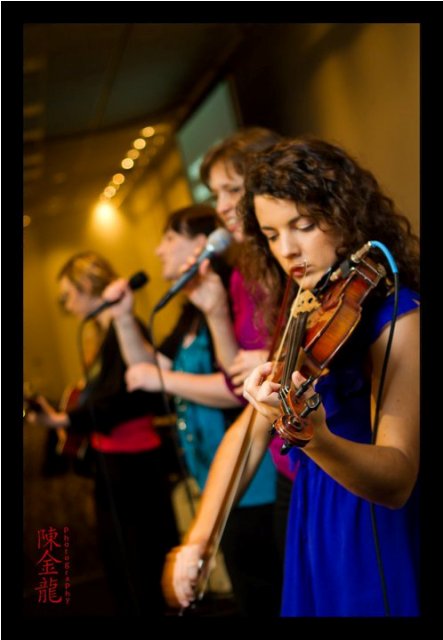
The wonderful mystery of harmony singing

cracking_the_harmony_2I absolutely love singing in harmony. It would have to be my most favourite thing to do. At church it takes lots of self-control to stop myself singing harmony all the time. (But I do refrain most of the time since it can seem a bit show-off-ish, and also off-putting if you are meant to be leading people in the melody up the front!)
But give me a few spare minutes and some other keen people, this is my preferred activity! There is just something totally mysterious, extraordinary and beautiful about the way harmonic notes blend together. When people ask me to write them some harmony parts for a song I rejoice at the challenge and opportunity to sit and fiddle with harmony for a few hours. (I’ve often wondered if this could be a lucrative business activity via the internet! What do you think?)
You may call me crazy for such harmonic enthusiasm, but this is what comes from being brought up on huge doses of harmony singing, at home, at school and church, in choirs and small a cappella groups. Yet despite my experience, when people ask me to teach them how to sing harmony I scratch my head and wonder? How do you teach someone what is a pretty complicated process in listening and anticipating?

“In the simplest style of vocal harmony, the main vocal melody is supported by a single backup vocal line, either at a pitch which is above or below the main vocal line, often in thirds or sixths which fit in with the chord progression used in the song. In more complex vocal harmony arrangements, different backup singers may sing two or even three other notes at the same time as each of the main melody notes, mostly with consonant, pleasing-sounding thirds, sixths, and fifths (although dissonant notes may be used as short passing notes)”. (So says Wikipedia)

You can now see why I say it is a pretty complicated process, especially if you are going to improvise!
I think the only way to learn to harmonise well it is to hear it, to hear someone do it, a lot, then try it! When you sing harmony you have to anticipate what’s coming, both in the melody and the chords that support it. You have to anticipate what will blend well with the note coming up. You have to hear the harmony in your head before you execute it, and then you need the courage to try it. Good harmony singing has to be “caught not taught”. I had about 17 years of ‘weekly lessons’ in harmony singing with my dad – well not formal ones, more just singing in the pew beside him each Sunday, listening to his improvised tenor line for every hymn in the book.

And are there any benefits of harmony singing, you may ask? Well for singers you have to listen to other people well, which has to be a good thing. It develops team work, and together you create something beautiful which one voice alone could not create. In performance it helps shift the focus from the glory of one person, to the team work of several. There are also benefits for the listener, as they hear the blend, the movement of sound, the tension and the resolution of different voices working together.
And of course there is a spiritual application here. Living in harmony with others requires the same practised skillful decision making. We must choose to listen to others, consider where they are heading (they may be walking in shoes very different from ours), and then choose grace over judgement. Again, these skills are often better caught than taught. Great harmony can be achieved from a group of people who are careful to keep in tune with God and each other, living selfless lives. The loving characteristics of our heavenly Father blend so well together. If we are reflecting his character and glory we cannot help but harmonise beautifully. He is the Father of all harmonies, both musically and between us.

2 Corinthians 13:11 NLT
“Dear brothers and sisters, I close my letter with these last words: Be joyful. Grow to maturity. Encourage each other. Live in harmony and peace. Then the God of love and peace will be with you.”

Here is a clip of some harmony singing I did with a friend (on melody) at a recent women’s conference. Oh the Deep Deep Love of Jesus.

You may also like:
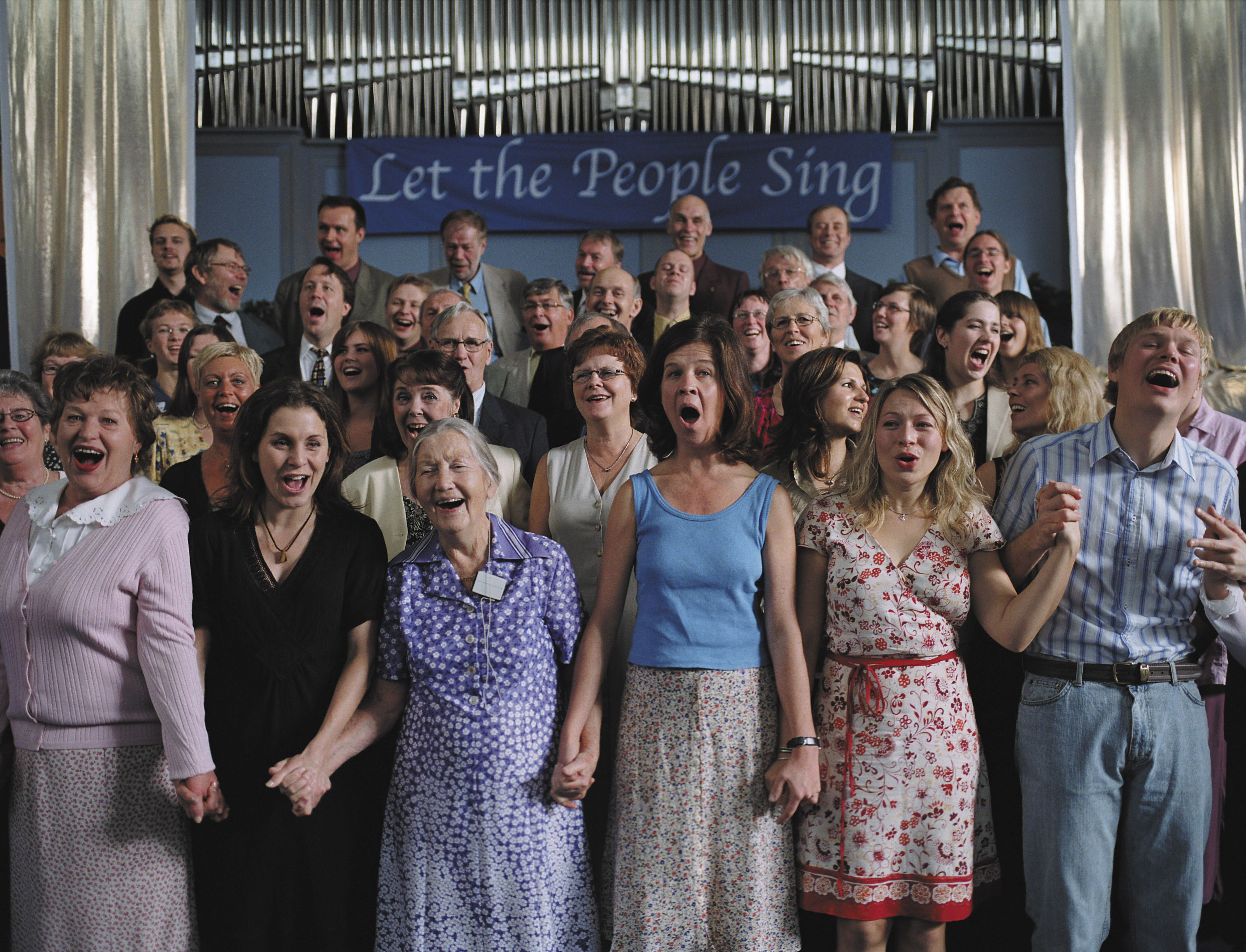
Film review: As it is in Heaven
As it is in Heaven

Hymn lines that didn’t stand the test of time

Today’s post comes from a ‘Gathered Worship Director’ (I like that!) in New Zealand – the original article can be found here at Chong’s Worship: I think you’ll find it quite amusing, but at the same time remember that some lines of our modern hymns may sound equally as strange in a few hundred years time!

old hymnGod’s blessed the church with hundreds of memorable hymns of the faith. Christians and non-Christians alike recognise lines such as “Amazing Grace! How sweet the sound…”, “How Great Thou Art”, “Great is Thy Faithfulness”, and “Abide with me, fast falls the eventide…” (I’m sure you can think of many of your own examples).

For a bit of a laugh, here are a couple of examples of old hymn lyrics that, although theologically sound, have thankfully fallen out of use:

Stanza 6 in “How Firm A Foundation”:

Even down to old age all My people shall prove
My sovereign, eternal, unchangeable love;
And when hoary hairs shall their temples adorn,
Like lambs they shall still in My bosom be borne.

(Hoary means ancient, aged.)

Stanza 9 of Charles Wesley’s “Come Thou O Traveller Unknown”:

’Tis Love! ’tis Love! Thou diedst for me!
I hear Thy whisper in my heart;
The morning breaks, the shadows flee,
Pure, universal love Thou art;
To me, to all, Thy bowels move;
Thy nature and Thy Name is Love.

The term “bowels” used to mean the seat of one’s emotion (what we refer today as our heart).

The first line of Isaac Watt’s “Hark the Herald Angels Sing” was originally:

Hark! How all the welkin rings, ‘Glory to the King of Kings.”

(Welkin refers to the highest heavens.)

And from verse 3 of Joseph Hart’s hymn, “Salvation to the Lamb”:

When we incurred the wrath of God, Alas! what could we worse?
He came, and with his own heart’s blood Redeem’d us from the curse.
This paschal Lambour heav’nly meat, was roasted in the flame.
Repeat, ye ransomed souls, repeat, “Salvation to the Lamb!”

While I like Joseph Hart’s sincere attempt to link Jesus to the Passover lamb in Exodus, this particular imagery is um… hard to stomach (thankfully other people have tried rewriting it).

To fit the language

So why did these hymnwriters use those words? To fit the language of the people at that time, who would have understood the phrases and meanings without any hint of snickering.

Brian Wren in his book Praying Twice adds some helpful insight (p.297-8):

“… The need for change sometimes overrides the need for familiarity… In the Preface to his Hymns and Spiritual Songs, [Isaac Watts] says that “what is provided for public worship should give to sincere consciences as little vexation and disturbance as possible” However, “where any unpleasing word is found, he that leads the worship may substitute a better; for (Blessed be God) we are not confined to the words of any Man in our public solemnities.”

“However much we value our past, our present interest in congregational song is not antiquarian, but immediate. We sing to God from today, in lyrics which — whether ancient or recent — express today’s faith. When a lyric from the past gets too archaic to be understood, or too out of sync with today’s hope, faith, and issues to speak for us, it will eventually cease to be sung, or amended to keep it singable.

I was reflecting awhile back on whether Christians had to hang on to obscure hymn lyrics. Ultimately, I think Brian Wren is right – if a line is worth understanding and remembering, it will stay in use. And if it makes you think about your bowels, it’s probably not worth keeping!

Working for those moments of Joy

grow musicThe non-musician in our Christian gatherings often looks towards the musicians with a certain measure of (perhaps misguided) awe. One thing they find ‘awesome’ is that we even bother! We musicians put ourselves through many practices, where we must work closely with others, negotiating different opinions, and we put ourselves ‘out there’ and up front, where the criticism can sometimes sting. . .  a lot. (Luther didn’t call church music the War Department for nothing!)  And while some look with awe, others may look with disdain and consider most of our efforts simply for show and self-glory.
But there is one thing that keeps musicians (music directors in particular) in the job – and it’s not usually the pay grade!  It is the love for gathering people together in song, praising our great God! Corporate singing provides a unique opportunity to create joy as people praise God and sing out words of encouragement to each other. It gives people the opportunity to express publicly the joy, confidence and hope they have in Christ. These are things they may not find easy to say in everyday conversation.
Since God also delights in the praise of His people (which thwarts Satan’s best efforts at discouragement) we musicians experience much blessing and encouragement ourselves in leading people in something that has eternal, spiritual and cosmological impact!

When we put effort into selecting great sets of song, that are biblically true, Gospel-focused and singable for a group of people, there is the hope that the Word in song will challenge people’s hearts and teach them to know and love their Saviour more. The lyrics might even move people to great (or small) acts of love and service, bringing glory to God. Some may experience a lightbulb moment, as a difficult theological concept makes sense for the first time, in song. “Where the Word goes the Spirit goes” (John Piper) – so the more our songs are steeped in the Word, the more He works through them.
And while I admit that not everyone may be looking joyful as we lead them in praising God, it is the possibility for creating deep inner joy that keeps us coming back. This is what we love! We love to hear God’s praises! We love to see the joy that music brings, joy that encourages us all on our journey of faith.

“. . . . for the joy of the Lord is our strength.”
(Nehemiah 8:10)

You may also like:

How to encourage your music team                                            10 Principles for Church singing
praise-godtaintedcanvasdotcompraise him pic


C.S. Lewis on musical taste and grace

music tasteA few days ago I wrote about the way we can show grace to others by not demanding that they pander to our prideful ‘good taste’ (in a variety of areas).
Here C.S. Lewis talks about a related topic, musical taste. Disagreements over the ‘right’ or most godly church music have produced many hard-fought and rarely-won battles. While Lewis’ comments below are a bit of a challenge in terms of the language, it is worth the slog if you can get to his main point. Grace is the key! We must bear with one another in love, bear with things we dislike for the sake of others whom we are called to love, in Christ. If we are in music ministry and find ourselves filled with pride at our skill, or contempt and hostility to the congregation we serve, it’s probably time for a break! It’s probably time to re-examine our motives – and pray for God to work in us for His glory. Blessings!

Musical Taste

“There are two musical situations on which I think we can be confident that a blessing rests. One is where a priest or an organist, himself a man of trained and delicate taste, humbly and charitably sacrifices his own (aesthetically right) desires and gives the people humbler and coarser fare than he would wish, in a belief (even, as it may be, the erroneous belief) that he can thus bring them to God. The other is where the stupid and unmusical layman humbly and patiently, and above all silently, listens to music which he cannot, or cannot fully, appreciate, in the belief that it somehow glorifies God, and that if it does not edify him this must be his own defect. Neither such a High Brow nor such a Low Brow can be far out of the way. To both, Church Music will have been a means of grace; not the music they have liked, but the music they have disliked. They have both offered, sacrificed, their taste in the fullest sense. But where the opposite situation arises, where the musician is filled with the pride of skill or the virus of emulation and looks with contempt on the unappreciative congregation, or where the unmusical, complacently entrenched in their own ignorance and conservatism, look with the restless and resentful hostility of an inferiority complex on all who would try to improve their taste – there, we may be sure, all that both offer is unblessed and the spirit that moves them is not the Holy Ghost.”

This was taken from an essay entitled “On Church Music” by C. S. Lewis. It can be found in a current publication called Christian Reflections published by Wm. B. Eerdmans Publishing Co.; ISBN: 0802808697.

Ps. Today I celebrate my 150th Blog Post! Thanks for reading.
Read more about C.S.Lewis on this post: Our Glorious Capital C Church

Grace has come – new Sovereign Grace album

grace has comeIf you are the person who chooses new songs for your church, (like me) you may be very excited by the announcement of a new album from Sovereign Grace (August 1). “Grace has come: Songs from the Book of Romans”looks sure to be a treat! Sovereign Grace certainly has figured out a good recipe for singable Gospel songs garnished with much grace! The sample track is based on Romans 8:31-39 – Nothing can tear us from the everlasting love of Christ.

NOTHING IN ALL THE EARTH

(click title to listen)

VERSE 1   
What shall separate us from Your love?
Can years of sorrow break eternal bonds?
Can condemnation ever raise its voice?
Against the pardon of the blood of Christ?
Though our journey here is long
This will be our triumph song

CHORUS
Nothing in all the earth

Not any height above
Could ever tear us from Your everlasting love
Nothing in all the earth
Not any height above
Could ever tear us from Your everlasting love

VERSE 2
What shall separate us from Your love?
For now the sting of death is overcome
And all the powers of this world must fall
Before Your feet because You rule them all
And though our journey here is long
This shall be our triumph song

BRIDGE
Nothing in all the earth
Could ever tear us from
Your everlasting love

© 2013 Sovereign Grace Worship (ASCAP)

http://sovereigngracemusic.bandcamp.com/album/grace-has-come-songs-from-the-book-of-romans

What happens when we sing?

WORDS OF WONDER: What happens when we sing?

I just stumbled across this great conference talk from pastor and songwriter Bob Kauflin at Sovereign Grace ministries. If you have ever wondered what the big deal is about the body of Christ singing together (or if you’ve tried to explain that to someone) then this talk has the answers! God doesn’t just want us to praise Him with words, but with SINGING!! If you have a spare hour (or a walk to go on with your ipod or some ironing to do) then have a listen. You will certainly find it encouraging! It might also be a great boost for any music team you lead, to listen and discuss together. Blessings

Never Alone

“Teach these new disciples to obey all the commands I have given you. And be sure of this: I am with you always, even to the end of the age.” (NLT Matthew 28:20)

“Keep your life free from love of money, and be content with what you have, for he has said, “I will never leave you nor forsake you.” So we can confidently say, “The Lord is my helper; I will not fear; what can man do to me?” (ESV Hebrews 13: 5-6)

Never Alone is a gentle song with a simple melody (which makes it great for church singing) but the lyrics bring us much comfort. Christ is with us! We are not alone . . . no matter how alone we may feel. This song closely echos and explains the reasons for our confidence in Christ, revealed in the bible passages above. In four verses it tells the story of the God-man Jesus coming to earth, dying and rising for us; now he walks with us, in all our joy and pain. He is alive!

Above you can watch a friend of mine with a beautiful voice (Sarah), leading a large group in singing ‘Never Alone’. It was written by Philip Percival & Simone Richardson (2006) from EMU Music – and has appeared on two of their albums: Let All Creation Sing and Songs for Little Rooms. You can buy the lead sheet here.
Whether or not you get to sing this with other people I trust it will be a blessing!

NEVER ALONE

1. We’re not alone, for Christ is here
Immanuel our God come near
We’re not alone, for to our world
Jesus has come, eternal Word.
And as he speaks, our souls laid bare
Naked, ashamed, sin is made clear
And yet he clothes us in his love
Never alone, Christ is with us, is with us.

2. The longest walk, earth’s darkest day
The pressing crowd, his mounting pain.
A heavy load of grief and shame
Breathless that we should breathe again.
“Father forgive them,” comes his cry
Silence from God blackens the sky.
A creeping dread in every heart
Lost in the world now God departs, God departs.

3. The dawn will come, the sun will rise
Out of the grave we’ll see hope’s light.
Tomb opened wide, stone rolled away
Morning has come, a brand new day.
“He isn’t here,” the angel said.
“He is alive no longer dead.”
Our hearts are lifted, souls raised high
Christ is with us, Christ is our life, he’s our life.

4. Never alone, is now our cry
In joy, in grief, in lonely sin.
Never alone, for Christ is ours
He lives in us, we live in him.
And ’til we reach that final day
When fears are gone, cast far away
We’ll live secure, trust in his love,
Never alone, Christ is with us, he’s with us.

Lyrics: © 2006 Simone Richardson Music: © 2006 Philip Percival

This is Amazing Grace

for the sake of the worldJust sharing the lyrics for this great new song from my last post, THIS IS AMAZING GRACE by Jeremy Riddle at Bethel Music (2012) from the album “For the Sake of the World”.

Click here for a pdf of words and chords. Here is a clip with song lyrics included (and they are included below also). This is why we sing! Amazing Grace!

This is Amazing Grace

Who breaks the power of sin and darkness
Whose love is mighty and so much stronger
The King of Glory, the King above all kings

Who shakes the whole earth with holy thunder
Who leaves us breathless in awe and wonder
The King of Glory, the King above all kings

Chorus:
This is amazing grace
This is unfailing love
That You would take my place
That You would bear my cross
You would lay down Your life
That I would be set free
Jesus, I sing for all that You’ve done for me

Who brings our chaos back into order
Who makes the orphan a son and daughter
The King of Glory, the King above all kings

Who rules the nations with truth and justice
Shines like the sun in all of its brilliance
The King of Glory, the King above all kings

Bridge:
Worthy is the Lamb who was slain
Worthy is the King who conquered the grave
Worthy is the Lamb who was slain
Worthy is the King who conquered the grave

CCLI # 6333821 Josh Farro, Phil Wickham, Jeremy Riddle
© 2012 Warner/Chappell Music, Inc. (ASCAP)/Seems Like Music (BMI)/Phil Wickham Music
(BMI) (admin by Simpleville Publishing, LLC)/Bethel Music Publishing (ASCAP).

You may also enjoy:
What is so amazing about “Amazing Grace”?      Keep your ears tuned to the Gospel of grace
amazing-grace-graphic4weblisten

Riddled with Grace

God graciously works through the weak and unimpressive

weaknessI’m sharing today something encouraging I found over at the Blazing Center blog. If you want to read the whole post you can visit there, but this is the heart of it:

“God often does his most powerful work through those who are weak and unimpressive.

John Flavel says:

How the weak have been used for the good of the church! Christ did not choose eloquent orators, or men of authority in the courts of kings and emperors, but twelve poor labourers, and fishermen. This is the most ridiculous course that can be imagined, in appearance, for such a design. And yet, in how short a time was the gospel spread in all the kingdoms of the world. (Voices From the Past, 140)

Jesus established his kingdom on the shoulders of fishermen, tax collectors, and prostitutes. He chose Peter to lead the charge out of Jerusalem. Peter, the guy who denied Jesus three times. Peter, the guy who gave up gospel ground to the Judaizers. Peter, the guy whose mouth seemed to always run ahead of his brain.

Jesus could have chosen the most articulate orators as his spokesman. He could have chosen great war heroes, or political superstars. He could have built a campaign of shock and awe and power. Instead he chose fisherman. Guys with cracked hands, plain speech, minimal learning, and the constant aroma of raw fish.  The disciples were not power players in the Roman world.

God will not allow us to receive any of the glory, so he builds his kingdom through and in spite of our weakness. If your worship team is mediocre, don’t freak out. Instead, work toward excellence and trust that God will use your weak, halting efforts for his glory. If you stutter and stammer when sharing the gospel, don’t get discouraged! Seek to improve your gospel communication, but more importantly, trust God to use your stutters and stammers to bring salvation to the lost. If your sermons feel like duds, don’t sink into despair. Improve your sermons and improve your confidence in God. If you feel like a constant parenting trainwreck, seek to grow in your parenting and trust God to use your trainwreck efforts to work in your children.”