If you have ever doubted the power of song, check out this enormous ‘choir’ singing in the stands at the MCG overnight. Men’s choirs are great!
http://balls.ie/football/95000-liverpool-fans-sing-youll-never-walk-alone-at-the-mcg/

If you have ever doubted the power of song, check out this enormous ‘choir’ singing in the stands at the MCG overnight. Men’s choirs are great!
http://balls.ie/football/95000-liverpool-fans-sing-youll-never-walk-alone-at-the-mcg/
Most of you would agree that any form of exercise is more enjoyable when someone else is with you. Even just walking with a friend they help you go further and longer than you ever thought possible. You forget about the difficulties, your sore foot, or back, the cold weather, or how much you hate exercise. Walking alone you can think of a million reasons to stop. A companion helps you keep going. (Dog companions are especially good at this.)
When it comes to us and God, we have a wonderful promise – that He is with us, always. There is not once that we were alone. He is in us, walking with us through every difficulty. Yet he is more than just a faithful or encouraging companion. He is a Spirit who lives in us, a Spirit not of timidity and fear, but of love, power and sound mind (2 Timothy 1:7). Matt Redman’s song “Never Once” (Album: 10 000 Reasons) captures well this confidence we have in Christ, that we are in Christ and He is most certainly with us, in us. We are never alone!
“Never Once”
Standing on this mountaintop
Looking just how far we’ve come Knowing that for every step You were with us
Kneeling on this battle ground
Seeing just how much You’ve done Knowing every victory was Your power in us
Scars and struggles on the way
But with joy our hearts can say
Yes, our hearts can say
Never once did we ever walk alone
Never once did You leave us on our own
You are faithful, God, You are faithful
Scars and struggles on the way
But with joy our hearts can say
Never once did we ever walk alone Carried by Your constant grace
Held within Your perfect peace
Never once, no, we never walk alone
Every step we are breathing in Your grace
Evermore we’ll be breathing out Your praise
You are faithful, God, You are faithful You are faithful, God, You are faithful
This is a clever medley of songs across the last few centuries. Styles may change, but the desire remains constant, the desire to sing and harmonise, to express joy and emotions that otherwise would be difficult to say. Praise God for this unique gift he has given us.
Sharing today an encouraging post from The Blazing Center, which describes the overflowing mercy God shows us. . .

“Oh, how abundant is your goodness, which you have stored up for those who fear you and worked for those who take refuge in you, in the sight of the children of mankind!” Psalm 31:19
A local coffee roaster has bags and bags and bags of coffee beans stacked up in his warehouse, waiting to be roasted. God has bags and bags of grace and mercy stored up in his heavenly warehouses for his children (John Bunyan). Not just a little bit of goodness – abundant goodness. God doesn’t just give us enough grace to barely get by. He blesses us lavishly. He opens the storehouses of heaven and pours out blessings we can’t contain.
After feeding the multitude there were 12 baskets of bread left over. There was more bread afterwards than he had to start with. Surely goodness and mercy shall follow me all the days of my life, and I shall dwell in the house of the LORD forever. (Psalm 23:6)
Is this how you think about God and your life? Do you have a goodness and mercy mindset? Can you see God’s goodness and mercy on your tail when you look back? I feel like I can’t keep up with all God’s mercies to me. I can’t keep track of them all. God’s thoughts toward us are too many to number. His steadfast love for us is higher than the heavens are above the earth. He removes our sin as far as the east is from the west. God gives us these poetic pictures that we might grasp that his goodness toward us is infinite beyond measure.
But God, being rich in mercy, because of the great love with which he loved us, even when we were dead in our trespasses, made us alive together with Christ—by grace you have been saved— and raised us up with him and seated us with him in the heavenly places in Christ Jesus, so that in the coming ages he might show the immeasurable riches of his grace in kindness toward us in Christ Jesus. (Ephesians 2:4-7)
God’s riches of grace in Christ to us are so “immeasurable” they will take “the coming ages” for him to lay them out for us. Did you hear that? He didn’t say he’d be showing us his riches of grace for the next 1000 years – it’s going to take him the next 1000 ages. For all eternity God will give us one long pleasure cruise tour of the storehouse of his kindnesses to us.
Ok, my brain just shut down. I can’t comprehend ages and ages of God showering me with his kindness. I can’t even take that in. Given all the goodness God has stored up for us, we should never have a mentality that we won’t have enough. That God somehow won’t meet our needs or supply all we need. He’s a generous, lavish God who anxiously waits to pour out his kindness on us.The God who dresses the lilies of the field more stylishly than Solomon will surely meet all the needs of those who take refuge in him.
http://www.theblazingcenter.com/2012/06/bags-and-bags-and-bags-of-grace.html
 A few days ago I wrote about the way we can show grace to others by not demanding that they pander to our prideful ‘good taste’ (in a variety of areas).
Here C.S. Lewis talks about a related topic, musical taste. Disagreements over the ‘right’ or most godly church music have produced many hard-fought and rarely-won battles. While Lewis’ comments below are a bit of a challenge in terms of the language, it is worth the slog if you can get to his main point. Grace is the key! We must bear with one another in love, bear with things we dislike for the sake of others whom we are called to love, in Christ. If we are in music ministry and find ourselves filled with pride at our skill, or contempt and hostility to the congregation we serve, it’s probably time for a break! It’s probably time to re-examine our motives – and pray for God to work in us for His glory. Blessings!
“There are two musical situations on which I think we can be confident that a blessing rests. One is where a priest or an organist, himself a man of trained and delicate taste, humbly and charitably sacrifices his own (aesthetically right) desires and gives the people humbler and coarser fare than he would wish, in a belief (even, as it may be, the erroneous belief) that he can thus bring them to God. The other is where the stupid and unmusical layman humbly and patiently, and above all silently, listens to music which he cannot, or cannot fully, appreciate, in the belief that it somehow glorifies God, and that if it does not edify him this must be his own defect. Neither such a High Brow nor such a Low Brow can be far out of the way. To both, Church Music will have been a means of grace; not the music they have liked, but the music they have disliked. They have both offered, sacrificed, their taste in the fullest sense. But where the opposite situation arises, where the musician is filled with the pride of skill or the virus of emulation and looks with contempt on the unappreciative congregation, or where the unmusical, complacently entrenched in their own ignorance and conservatism, look with the restless and resentful hostility of an inferiority complex on all who would try to improve their taste – there, we may be sure, all that both offer is unblessed and the spirit that moves them is not the Holy Ghost.”
This was taken from an essay entitled “On Church Music” by C. S. Lewis. It can be found in a current publication called Christian Reflections published by Wm. B. Eerdmans Publishing Co.; ISBN: 0802808697.
Ps. Today I celebrate my 150th Blog Post! Thanks for reading.
Read more about C.S.Lewis on this post: Our Glorious Capital C Church
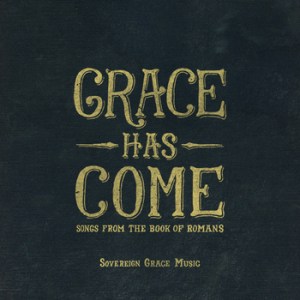 If you are the person who chooses new songs for your church, (like me) you may be very excited by the announcement of a new album from Sovereign Grace (August 1). “Grace has come: Songs from the Book of Romans”looks sure to be a treat! Sovereign Grace certainly has figured out a good recipe for singable Gospel songs garnished with much grace! The sample track is based on Romans 8:31-39 – Nothing can tear us from the everlasting love of Christ.
(click title to listen)
VERSE 1
What shall separate us from Your love?
Can years of sorrow break eternal bonds?
Can condemnation ever raise its voice?
Against the pardon of the blood of Christ?
Though our journey here is long
This will be our triumph song
CHORUS
Nothing in all the earth
Not any height above
Could ever tear us from Your everlasting love
Nothing in all the earth
Not any height above
Could ever tear us from Your everlasting love
VERSE 2
What shall separate us from Your love?
For now the sting of death is overcome
And all the powers of this world must fall
Before Your feet because You rule them all
And though our journey here is long
This shall be our triumph song
BRIDGE
Nothing in all the earth
Could ever tear us from
Your everlasting love
© 2013 Sovereign Grace Worship (ASCAP)
http://sovereigngracemusic.bandcamp.com/album/grace-has-come-songs-from-the-book-of-romans
Those of us who love music know how important it is to us, to be listening, creating and making music. But do we know why? Here are some interesting (though perhaps complex) answers from some neuroscientists, via the New York Times.

MUSIC is not tangible. You can’t eat it, drink it or mate with it. It doesn’t protect against the rain, wind or cold. It doesn’t vanquish predators or mend broken bones. And yet humans have always prized music — or well beyond prized, loved it.
In the modern age we spend great sums of money to attend concerts, download music files, play instruments and listen to our favorite artists whether we’re in a subway or salon. . . . So why does this thingless “thing” — at its core, a mere sequence of sounds — hold such potentially enormous intrinsic value?
The quick and easy explanation is that music brings a unique pleasure to humans. Of course, that still leaves the question of why. But for that, neuroscience is starting to provide some answers.
More than a decade ago, our research team used brain imaging to show that music that people described as highly emotional engaged the reward system deep in their brains — activating subcortical nuclei known to be important in reward, motivation and emotion. Subsequently we found that listening to what might be called “peak emotional moments” in music — that moment when you feel a “chill” of pleasure to a musical passage — causes the release of the neurotransmitter dopamine, an essential signaling molecule in the brain.
When pleasurable music is heard, dopamine is released in the striatum which is known to respond to naturally rewarding stimuli like food and sex and which is artificially targeted by drugs like cocaine and amphetamine. But what may be most interesting here is when this neurotransmitter is released: not only when the music rises to a peak emotional moment, but also several seconds before, during what we might call the anticipation phase.
The idea that reward is partly related to anticipation (or the prediction of a desired outcome) has a long history in neuroscience. Making good predictions about the outcome of one’s actions would seem to be essential in the context of survival, after all. And dopamine neurons, both in humans and other animals, play a role in recording which of our predictions turn out to be correct.
To dig deeper into how music engages the brain’s reward system, we designed a study to mimic online music purchasing. Our goal was to determine what goes on in the brain when someone hears a new piece of music and decides he likes it enough to buy it.
We used music-recommendation programs to customize the selections to our listeners’ preferences, which turned out to be indie and electronic music, matching Montreal’s hip music scene. And we found that neural activity within the striatum — the reward-related structure — was directly proportional to the amount of money people were willing to spend.
But more interesting still was the cross talk between this structure and the auditory cortex, which also increased for songs that were ultimately purchased compared with those that were not.
Why the auditory cortex? Some 50 years ago, Wilder Penfield, the famed neurosurgeon and the founder of the Montreal Neurological Institute, reported that when neurosurgical patients received electrical stimulation to the auditory cortex while they were awake, they would sometimes report hearing music. Dr. Penfield’s observations, along with those of many others, suggest that musical information is likely to be represented in these brain regions.
The auditory cortex is also active when we imagine a tune: think of the first four notes of Beethoven’s Fifth Symphony — your cortex is abuzz! This ability allows us not only to experience music even when it’s physically absent, but also to invent new compositions and to reimagine how a piece might sound with a different tempo or instrumentation.
We also know that these areas of the brain encode the abstract relationships between sounds — for instance, the particular sound pattern that makes a major chord major, regardless of the key or instrument. Other studies show distinctive neural responses from similar regions when there is an unexpected break in a repetitive pattern of sounds, or in a chord progression. This is akin to what happens if you hear someone play a wrong note — easily noticeable even in an unfamiliar piece of music.
These cortical circuits allow us to make predictions about coming events on the basis of past events. They are thought to accumulate musical information over our lifetime, creating templates of the statistical regularities that are present in the music of our culture and enabling us to understand the music we hear in relation to our stored mental representations of the music we’ve heard.
So each act of listening to music may be thought of as both recapitulating the past and predicting the future. When we listen to music, these brain networks actively create expectations based on our stored knowledge.
Composers and performers intuitively understand this: they manipulate these prediction mechanisms to give us what we want — or to surprise us, perhaps even with something better.
In the cross talk between our cortical systems, which analyze patterns and yield expectations, and our ancient reward and motivational systems, may lie the answer to the question: does a particular piece of music move us? When that answer is yes, there is little — in those moments of listening, at least — that we value more.
Robert J. Zatorre is a professor of neuroscience at the Montreal Neurological Institute and Hospital at McGill University. Valorie N. Salimpoor is a postdoctoral neuroscientist at the Baycrest Health Sciences’ Rotman Research Institute in Toronto.
You may also like:
Pick up your instrument – food for the soul and the brain
 How could you but be inspired sitting inside the beautiful timber frame of this old piano? What a great place to blog, to compose, to contemplate the music of our world. If anyone would like to make me one, I would happily accept.
 The other day I turned my nose up at an instant coffee made for me from a jar of Nescafe 43. I thought I could justify this ungracious response by defending my ‘good taste’ in coffee, but apparently not, according to C.S. Lewis.
“(Humans) . . . are best turned into gluttons with the help of their vanity. They ought to be made to think themselves very knowing about food, to pique themselves on having found the only restaurant in town whether the steaks are really “properly” cooked. What begins as vanity can then be gradually turned into habit. But however you approach it, the great thing is to bring him into the state in which the denial of any one indulgence “puts him out”, for then his charity, justice and obedience are all at your mercy. Mere excess in food is much less valuable than delicacy.” (Letter 16: Screwtape Letters by CS Lewis, 1942).
Ouch! If you have never read the Screwtape Letters I would encourage you to rush out and get a copy (or download). The Letters record fictional (but strangely believable) correspondence between a Senior and Junior devil. The uncle instructs his nephew on how to keep his ‘patient’ (a new convert to Christianity) from getting too close to the Enemy (for them the Enemy is, of course, God). In the section above Uncle Screwtape explains how to get at his patient, to annoy him, by encouraging the unbearably fussy eating of his mother and her delicate tastes. If he can make her insist on having her food served in a particular, apparently simple way he will have some delightful amusements. It is also designed to keep her deluded in selfishness and pride.
Here Lewis makes an insightful connection between the “god of the stomach” and pride in our own good taste. This is a much more dangerous distraction from godliness than simply overeating. What I find most interesting here is that he wrote on such matters long before our addiction to both reality TV cooking shows and the great variety of good foods we enjoy in the West (thanks to globalisation). Lewis’ words also come before ‘coffee culture’ swept our world and people became ‘coffee snobs’ – who insist on having their particular bean roasted a particular way on a particular machine in a particular shop, or their own kitchen. I have met people who will rave for hours about having the best taste in coffee and the most knowledge of how to make it – properly! How gracious are they when offered inferior coffee? (How gracious was I?) And it’s not just coffee. Our egos can be fed and mislead by thinking we have the best taste in food and the best skills in how cook it, to create amazing dishes and impress others.
I suppose I am not that far behind the people that I call coffee snobs! I do prefer real coffee from a coffee shop (though not A particular shop) and I do think I have better taste than others in many ways (doesn’t that just sound awful in print)! The more I think such proud thoughts, the more I train myself to respond to others with less grace, less charity, less justice and kindness. Let’s measure our “own good taste” against God’s measure, of perfect grace, humility, charity and kindness to others. We are more likely to display the fruits of the spirit to others when our hearts are not bent on satisfying our own ‘good tastes’, and proving our superiority in such matters. I’ll keep working on this!
You may also like:
Living under the power of grace Fullness of grace in man’s human frailty

WORDS OF WONDER: What happens when we sing?
I just stumbled across this great conference talk from pastor and songwriter Bob Kauflin at Sovereign Grace ministries. If you have ever wondered what the big deal is about the body of Christ singing together (or if you’ve tried to explain that to someone) then this talk has the answers! God doesn’t just want us to praise Him with words, but with SINGING!! If you have a spare hour (or a walk to go on with your ipod or some ironing to do) then have a listen. You will certainly find it encouraging! It might also be a great boost for any music team you lead, to listen and discuss together. Blessings
“Create in me a pure heart, O God, and renew a steadfast spirit within me.” Psalm 51:10
Praising God in the everyday
Following Jesus while Seeking Joy and Contentment in the Christian Life
The Musings of a Writer / Editor in Training
I'm Ash. I love Jesus. I'm a wife and a mum. I'm a teacher. I'm also studying my Masters of Counselling. I started studying a few years after started the very hard work of engaging my own story of harm and trauma. This is a place where you'll hear my stories, as well as the stories of others. I'll also reflect on faith, healing and walking with Jesus. I pray that these words might encourage you to do your own painful but life-bringing work of examining your own stories, and allowing Jesus to heal the parts of you still locked in shame. For He came that we might have life, and have it to the full. Welcome, fellow traveller.
Words, words, words... well said Hamlet! A little blog to go off on tangents within the worlds of history, literature, TV and film that interest me. From the Tudors to Tom Hardy's Tess, the Boleyns to Bollywood or from the Wars of the Roses to Wuthering Heights, feel free to browse through my musings to pick up extra ideas and points for discussion!
Jesus lover, aspiring writer & Bible Gateway Partner
I write for my own sanity, but I share with hope to encourage you.
Looking for the real God
Life in the country with family, animals, and good food
 sevennotesofgrace