10 Big Daily Reminders

sing in morningThis is a post I found at Desiring God. It is a great summary of the things we are so quick to forget (overnight)! We now have several copies around the house. Enjoy.

Ten Big, Daily Reminders  by Matt Reagan | March 20, 2013

I wake up lost every morning. At least that’s what it feels like. Perhaps something similar is true of you. Somehow during the night I’ve forgotten the big realities about God and the universe and myself and the gospel. I desperately need to steady myself with biblical truth rather than stumbling forward to live from unbelief.
I tend to forget the big realities during the day as well. I regularly catch myself living on the idiotic assumption that I will constantly remember the things that really matter — and that I will act in line with them. I assume that the realm of the seen and touched will not overwhelm the realm of the unseen and hoped for.
But in reality, whether it’s night or day, I don’t stay awake to what’s truly important for very long. I am like that college kid who sits in church on Sunday morning trying to keep his eyes open after an irresponsibly late Saturday night. My eyelids droop by default, and my mind wanders from the glories of the Bible to superfluous, naturalistic daydreams (that may or may not end with an embarrassing full-body twitch that snaps me awake again). So I’ve learned over time to put structures in place that remind me of those unseen things, especially during my bleary-eyed, half-conscious mornings.  One effort is this list of ten truths. I hung it up next to our dining room rocking chair (my preferred spot for study and contemplation). It’s developed over the years as a list of the daily reminders I need most. Many of them overlap substantially, but a double reminder only reinforces the original purpose.

1) God exists. (Exodus 3:14; John 8:58)

It seems so simple, so basic, but I tend to wake up a naturalist, and a narcissistic one at that. I assume that all there is in the world is what is in front of my face. My bed, my wife, my kids, and most importantly myself. The simple yet ultimate existence of God immediately clears my lens, makes me small, and infuses meaning into every step. God exists — and that changes everything.

2) God loves you. (Romans 5:8; John 16:27; Jeremiah 32:40–41)

Another massive biblical reality, this immediately counters my hesitation to embrace God’s ultimate authority, reminding me that he has set his affections on this little speck of a person. He is far from indifferent toward me.

3) Jesus died for you, and the Father has now bound himself to give you only good things. (Romans 8:28; Romans 8:32)

This draws me quickly to the central reality of all history: the cross. It is an objective truth set in time and space, so it immediately draws my gaze away from my own capacity to garner acceptance from God through my efforts. Furthermore, the outworkings of the cross make clear that even the harshest trials will come to me as blessing, for my ultimate good, no matter how bad I feel at the time.

4) God sees you as perfect. (Hebrews 10:14; 2 Corinthians 5:21)

My self-absorption, anxiety, and self-pity know no bounds. They must be beaten into submission by the beauty of imputed righteousness. The question, “How am I doing?” is met head-on with the answer, “Perfect.” In that regard, every day is a good day.

5) That is because of Jesus’ perfection, not yours. You deserve hell. (Romans 3:10; 1 Timothy 1:15)

There are two main purposes here: first, to counterpunch when my flesh looks for a way to subtly claim credit for the perfection that is mine only in Jesus; second, to maintain a sense of trembling gratitude for my salvation. While I enjoy the glory of the gospel, there should always be an awestruck voice in the back of my mind that is whispering, “I shouldn’t be here.”

6) You will die. (James 4:14, Hebrews 9:27)

Nothing brings clarity to me like this simple and straightforward reminder. How quickly I assume my earthly immortality, and how often I need to think of myself as a terminal cancer patient.

7) You will live forever in the new heavens and new earth. (Romans 8:18, Hebrews 10:34)

I don’t want to be a clear-headed fearer of death, like some atheistic poet. I want to glory in the guarantee of indescribable bliss that is just around the corner. And I want to live like it’s real — because it is.

8) For now, you are an exile on the earth. (Hebrews 11:13–16)

This keeps me from feeling at home when I’m not at home (especially in my own home). It prepares me for not fitting in, for weird looks when I speak with conviction about Jesus, and for holding loosely to every bit of earthly life.

9) Nothing on earth is truly worth putting your hope in. (Jeremiah 2:13; Galatians 6:14)

This is a practical specification of #8. It is right for me to remember that I will inevitably be disappointed by every earthly pursuit or relationship or emotional experience. It runs me back to my true Home and the true Bridegroom.

10) You have no right to be unhappy. (Philippians 4:4; 1 Peter 1:8–9)

This is a summarizing application of all the previous reminders, but it merits its own slot. How quick I am to become “blah” when there is a treasure trove of happy reality at my disposal! I must beat this into my discontent little brain. I can be plenty unhappy, but I have no right to be.

These reminders flee from my mind like stray socks in an armful of laundry. Every time I pick one up, another falls. By the time I read #10, #1 is beckoning again. What a grace that #4 is still true!

You may also enjoy:

Song of the Morning (at A Needed Word)

Why wouldn’t we remember Christmas?                 Is Your Smart Phone making you dumb?
dec 25hands on wheel

The blessed and God-breathed Book (2 Timothy 3:16)

GodBreathed_slide1x_365_y_273This is one of the most breath-taking Three Sixteens, one which you may have already committed to memory.  2 Timothy 3:16-17 is that great statement of assurance concerning God’s Word, the Bible, the God-breathed book on which we build our faith.

“All Scripture is breathed out by God and profitable for teaching, for reproof, for correction, and for training in righteousness, that the man of God may be competent, equipped for every good work.” (ESV)

“All Scripture is inspired by God and is useful to teach us what is true and to make us realise what is wrong in our lives. It corrects us when we are wrong and teaches us to do what is right. God uses it to prepare and equip his people to do every good work.” (NLT)

I recently read through 2 Timothy with a friend, over several weeks and many great coffees! The whole letter is a call to persevere in the faith, despite persecutions and difficult people. These are (possibly) Paul’s parting and most important words. He wants Timothy to stick to the truth of the Scriptures, which he’d been taught from his earliest days. (For Timothy this would mean the Old Testament scriptures as well as the teachings of the apostles.) There are so many treasures in this 3:16 (and 17), but I’ll focus on just three points:

1. The Word is God-breathed:  Just as we speak with our actual breath, which forms and carries the sounds of our words, so it is with God’s breath. He has exhaled these words, he has breathed them into the minds and hearts of people who have faithfully written them down, carried along by the Holy Spirit who always does the Father’s will. How else could this extraordinary book, penned by so many authors across millennia, have such consistency and unity of message? This is His Word to us and he has ensured that his breath, his voice, will continue to be heard as we await the return of Christ, the Word of God.

I love what Peter Blowes says about the way the words of the omnipresent and eternal God apply across all time and space:
“. . . God had every reader of Holy Scripture in mind at the time of its ‘exhalation’. This means not only that God’s word is inspired and universally applicable, but also that, in it, God is speaking presently to every particular reader (or hearer) of his Word.” (2011, “Reading the Bible”, Matthias Minizine). 
This leads to my second point.

2. Reading the Word is the most profitable thing we can do.
More than the early morning coffee, jog, paper, news update, more than crossing things off our to do list, more than any amount of television viewing, study or social media, more than relaxing with the family, more than making money .  . . investing in the Word of God is THE most profitable thing we can do. The world shouts at us, calling for our attention, telling us that those ancient words are dead, irrelevant and useless. But as we immerse ourselves more and more in his Word we understand why reading it is the most profitable thing we can do. By reading we come to know our immortal, invisible, all wise, good and gracious God. The Spirit works in us and we grow in confidence of his power, his might and the reality of his work in our world and hearts. We grow in the certainty of our salvation won in Christ.

3. The Word is wonderfully sufficient, equipping us for every good work.
The Bible equips us not by containing enough lists of do’s and don’ts to train us how to do good in every situation (this is the world’s view of the “good book” – which shouldn’t be ours. Christ has fulfilled the law!) Instead, the Word of God equips us by making us more like Christ – who is entirely and always about the Father’s good work. The Word changes us from the inside out and drives our behaviour. This behaviour becomes good work, good fruit (like those good works prepared in advance for us, which Paul described in Ephesians 2:8-10).

John Piper explains well:
Bearing fruit in “every good work” (see Colossians 1:10 ) means that it comes out on the branches of your life naturally from something that has changed inside. And what has changed is that you are dead to the law as a set of lists to constrain from the outside, and are now united to Jesus Christ in a relationship of joyful trust so that when he speaks—even speaks some of that same law—it comes from within as the desire of your heart. . . .The Scripture, day after day, reveals to us the greatness and the beauty and the power and the wisdom and the mercy of all that God is for us in Christ so that by the power of the Spirit we find our joy in him, and the ways of sin become distasteful—indeed ugly and repugnant. Yes the Bible gives us many specifics as pointers how to live. But most deeply the way the Bible equips us for every good work is by changing what we find satisfaction in so that our obedience comes from within freely, not by coercion from without. It does this when we read it and meditate on it and memorize it and meditate over it every day.”
(John Piper from Desiring God)

You may also enjoy:
Sharing the rich, indwelling Word               Sharing the perspicuity of God’s gracious Word
bible-28

Laying aside my taste in music

bird tree musicSharing some challenging thoughts today from Nick Morrow’s blog, about leading songs in church which we don’t necessarily like! In fact we might not like them at all. He suggests that such a situation is a great opportunity to examine our egos (which we should check in at the church door) and our servant heart – do we have one?  Other great points include the fact that everyone’s different musical tastes and opinions are equally valid (can you believe it?) and the importance of not expecting the church worship band to be the outlet for all your creative outpouring. I’m sure you’ll find it worth a read!

CONFESSIONS OF A CHRISTIAN MUSIC SNOB (AND MY SIX STEPS TO REHAB)

“Confession: Of all the songs we sing at my church, I like about five of them.

Meaning, actually like them. Meaning, they’re songs I might listen to outside the four walls of my church. . . . There still exists an uncomfortable tension between my artistic tastes and most of the worship music I hear. I want to offer my musical abilities to serve the church, but I also want to be honest. It’s not that I have anything against worship bands. And it’s definitely not that the lyrics are bad. It’s just a matter of opinion.

It’s not about maintaining “artistic integrity” or musical street cred. We all have to check that ego at the door when we come to church. It’s about trying to figure out how to play and lead songs I may not like and still be completely genuine.
At some point every worship leader is going to get asked to sing a song they hate in church. The way that we respond to these requests speaks volumes about our views on servanthood. It’s been a long road for me in releasing my musical pride and embracing worship music. Here are a few steps I found helpful:

1. Realize that your opinions are just that: opinions. Your musical tastes are 100% opinion. No amount of graphs and flowcharts and albums sales will “prove” that your taste is better than anyone else’s. Believe me, I’ve tried. I learned the hard way that my musical tastes are not sovereign. Musical tastes are kind of like taste buds. They can be developed and stretched over time to appreciate more complex things. But the snob who looks down on people with different or less-developed tastes isn’t impressive. He’s just a jerk.

2. Know that your opinions are valid…and so are everyone else’s. I have to catch myself on this a lot. I try to replace phrases like “They’re the best band ever” with phrases like “they’re one of my favorites.” I know the semantics probably don’t matter in most conversations, but it keeps my music-critic ego from swelling up and entering a parallel universe where my musical opinions are absolute truths. Understanding exactly why someone loves polka or nu-metal or funk-tron-burgercore probably isn’t very important. But respecting the fact that they’re entitled to that opinion is. All our tastes are subjective, and that’s okay.

3. Be honest. The world (and the church) doesn’t benefit from your silence about the creative process. If you want to offer alternative opinions, start with humility and be honest. If something sounds cheesy, it’s okay to say it, just be kind and diplomatic about how you communicate that. Remember never to challenge people, but to focus on the group’s creative goals and helping achieve them.

4. Be pragmatic. Remember that music is all about context. You might crank out some Bruce Springsteen while driving on the highway with the windows down, but you’ll likely turn to a very different genre to lull you to sleep. Worship music is the same. Respect the fact that while youjohn-coltrane may not have any worship music on your “all time favorites” playlist, Beatles and John Coltrane songs don’t make for very good worship tunes.

5. Resolve to submit to church authority on matters of opinion. Don’t ever give your church leadership a chance to question your loyalty to the church. If you’re serving with a large “platform” like worship leading, submission should be foundational anyway. Musicians are known for rebellious attitudes, and I’ve even seen it happen in the church before. Don’t be the rebellious punk rock guy that always quotes the Scripture about Jesus flipping over tables. That may score you “cool” points with scenesters, but not in the Kingdom of God.

6. Use your unique voice to bless the church and further the Kingdom. Every worship musician offers something unique to their church. Find out what your musical offering is, and give it gladly. Don’t worry about whether people “get” what you’re trying to do artistically. There is a place for raw art and creativity, but it’s probably not your local church. You may have a deeper desire to serve the church through your creativity. Your local church may not recognize or need that. Don’t freak out. It’s okay to write, create, and serve outside of your local church. The advent of the Internet makes that easier than ever.
Leading worship in church may not satisfy all of your creative longings. That’s okay. Worship music is about glorifying Jesus and serving your church. “Serving your own agenda” is never part of the deal. The more we realize that, the more we’ll be able to serve with joy and clarity.
Are you willing to sacrifice your artistic tastes for the church? Even if you aren’t getting paid for it? What do you do when you don’t like a song you’re asked to sing in church? I’m convinced that the answers speak to our integrity and willingness to serve. It may not always be easy, but it’s totally possible to serve the church with your musical talents, even when you don’t like the music.

You may also like:
C.S. Lewis on musical taste and grace                    Oh for a humble attitude to church
music tasteWorship_War_Thumb

Grace dispels fear through the promises

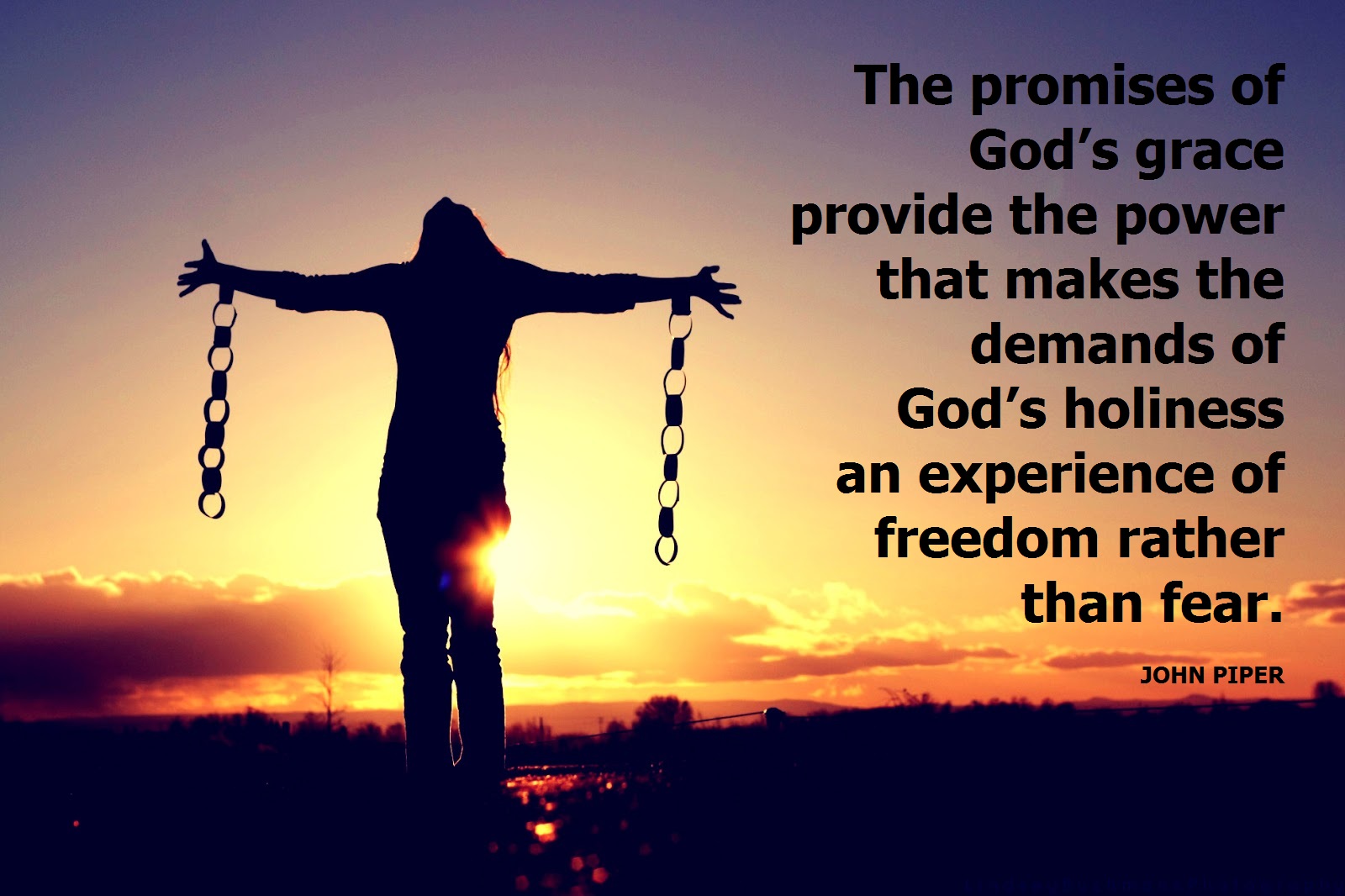
freedom with textJohn Piper “The Power of a Superior Promise” from Solid Joys Devotionals

You may also like:
Grace has now appeared                     Co-Heirs with the Child of the Promise

Is your Smart phone making you dumb?

driving texting dangerousSmart phone technology has brought many radical social changes in the last decade or so. People are doing things (without a second thought) that were once considered really stupid or anti-social. Who would have thought we humans would try operating a motor vehicle while staring at a three-inch screen? Or walking on a train platform doing the same? Imagine sitting with a group of friends and gazing intently at the palm your hand, offering them no conversation or eye contact! Perhaps you have already observed some of these odd and addictive tendencies in the people around you – and most frighteningly, in yourself!

A columnist in our local paper just confessed to being a phonoholic. “My phone has become the 207th bone in my body. I think I would feel barely upright without it. . . Such a feeling has been named nomophonophobia – the fear of being without your mobile phone.” (J. Fynes-Clinton, Sept 26, 2013)

Smartphones don’t discriminate in taking prisoners! It is not only those selfie-taking tween addicts who are at risk of losing all their ‘smarts’ to their smart phone. In fact, our “selfie-obsessed” Prime Minister posted his latest shaving cut via Instagram just weeks before the election (he lost). So, before we all lose our common sense to our smart phones, let’s ‘hang up’ on excessive smart phone use. Here are 10 things you should know about your awesome smart phone (before you find yourself cast in the sequel of Dumb and Dumber To):

1. Smart phones don’t make you smarter and won’t make you happy.
Yep, they sure are sleek, complex and nifty little gadgets that do cool things. They can connect you to a web of ‘friends’, music, video, games and the latest social news – but they may detract from your wisdom, intelligence and satisfaction level. You can become so reliant on mobile google that you give up thinking or remembering anything! Smart phones may make you look cool, acceptable and impress your friends, but there are more important things in life, which can bring greater and lasting joy.

2. People are better than Smart phones.galaxy-s4-life-companion
Have we forgotten this?  People are unique and complex individuals. They have more potential to surprise, entertain and inspire you than anything you’ll flick by on the small screen. Living, three-dimensional, high resolution people make far better company. No matter what Samsung may tell you, your smart phone is not a ‘life companion’. People are way smarter and worth investing in. Try paying close attention to their faces, eyes and body language – and see what happens. Don’t become so dependent on that small screen that you lose touch with real people and relationships.

3. They make you forget basic good manners and conversation skills.
Smart phones make us think it is acceptable to silently stare at a little screen in the presence of another human being, especially when everyone else is doing it! (Actually, everyone else has to do it so they don’t feel ignored!) We even think it’s fine to do so when someone is actually speaking to us. Hello!?

4. They tempt you to build your self-esteem on how many people like your social media updates.
How easy to become addicted to that sort of affirmation when it is at your fingertips? Do you really need to know that people like your latest meal or cup of coffee? Smart phones encourage us to binge on social media. Turning off those distracting phone notifications may allow you to engage fully with people in the moment.

attention-while-walking5. You look pretty silly when your phone is constantly in hand.
And you’ll looking sillier if you injure yourself while walking and typing. In New Jersey, police began (May 2012) issuing $85 citations for careless walking, and the Utah Transit Authority made distracted walking around trains punishable by a $50 fine. Signage is also being used widely to reduce pedestrian accidents caused by texting. Try putting the thing in your bag or pocket, or in another room. And by the way, smart phones and toilets don’t mix well for many reasons!


6. They tempt us to be a stupid driver who texts or updates Facebook while driving.
How easy would it be to stop the car to attend to that important text message? Facebook also can wait! If you must recharge your phone in the front of the car, shut it in the glove box or put it out of reach so you won’t be easily tempted. (Besides that, it is pretty stupid not to avoid a fine for being on your phone while driving, if you can.)

7. Smart phone technology addiction can actually rewire your brain, to be less smart!
In “The Brain that Changes Itself” (2008) author Norman Doidge says that our dependence on this technology can rewire our brains to the extent that it becomes difficult to concentrate on a complex conversation or listen to a lecture. “Electronic media are so effective at altering the nervous system because that both work in similar ways. . . Both involve the instantaneous transmission of electronic signals to make linkages. Because our nervous system is plastic*, it can take advantage of this compatibility and merge with the electronic media, making a single, larger system. . . Now man is beginning to wear his brain outside his skull, and his nerves outside his skin” (p.311). At the very least, excessive smart phone use discourages us from tackling problems, conversations, a novel or the philosophical writings of great thinkers. Why? Because these things do not involve the instantaneous gratification of electronic media.
(‘Plastic’ means it can change and adapt.)

8. Your eyes can suffer.
Those muscles for distance vision will become weak if you are staring at a small screen constantly, keeping your eyes operating at the same focal length all the time. Researchers have actually recorded an increase in myopia (short-sightedness). Read more here.

9. Sleep can become elusive.electronic-light-sleep
The glow of the smart phone screen prevents our bodies releasing seratonin, which helps us fall and stay asleep. Your brain needs sleep to be smart – so again the smart phone doesn’t make you smart. No smart phones in your bed/bedroom may be a smart policy in your home (and mine). Read more here

10. Excessive self-absorption will not make the world a better place.
The idea of showing a random act of kindness or service to someone else can become so far-removed from our thought patterns if we are no longer observing the people around us. Blinkers are for horses, not for people – people who have the power to impact those around them for good. If you want to see more good, more love, more thoughtfulness in the world, take off those smart phone blinkers and live again!

(Check out this post about a guy who is going to divorce his iphone: http://www.oddcrunch.com/why-you-should-get-a-divorce/0)

You may also enjoy:

Why music makes our brains sing                                         Music – food for the soul & brain
brainsingpiano

All You’ve Ever Wanted (Casting Crowns – new single)

casting crownsYou may be very interested to know that Casting Crowns has just released a new single “All You’ve Ever Wanted”. You can listen on Spotify or buy from iTunes and Amazon. The song focuses on the “relentless love” of a God who simply wants our hearts! There are plenty of echoes of the challenging lyrics Casting Crowns have presented before, but with the comfort that our guilty stains are already washed away. I love the piano riff that underlies the track. Enjoy!

All You’ve Ever Wanted

I just looked up today
And realized how far away I am from where You are
You gave me life worth dying for
But between the altar and the door
I bought the lies that promised more
And here I go again

Lord, I know I let You down
But somehow, I will make You proud
I’ll turn this sinking ship around
And make it back to You

But all my deeds and my good name
Are just dirty rags that tear and strain
To cover all my guilty stains
That You already washed away

(‘Cause) All You’ve ever wanted, all You’ve ever wanted
All You’ve ever wanted was my heart
Freedom’s arms are open, my chains have all been broken
Relentless love has called me from the start
And all You wanted was my heart

I was chasing healing when I’d been made well
I was fighting battles when You conquered hell
Living free but from a prison cell
Lord, I lay it down today

So I’ll stop living off of how I feel
And start standing on Your truth revealed
Jesus is my strength, my shield
And He will never fail me

No more chains, I’ve been set free
No more fighting battles You’ve won for me
Now in Christ, I stand complete

Publishing: © 2013 Sony/ATV Tree Publishing (BMI) All rights on behalf of Sony/ATV Tree Publishing administered by Sony/ATV. / My Refuge Music (BMI) (adm. at EMICMGPublishing.com) / Bernie Herms Music (BMI) (adm. by The Loving Company). All rights reserved. Used by permission.

Writer(s): Mark Hall, Bernie Herms

You may also like these posts about Casting Crowns songs:

Our Glorious Capital ‘C’ church

To Know Christ means to. . . ?

Leading praise and worship is not about us

It also doesn’t depend on us feeling good!  I recently read the interesting musings of a worship leader who was feeling temporarily rather flat, and contemplating how to go about leading at church in such a state.  I love his conclusions, about the fact that faithfulness to the task is what counts, not the results. I’m sure you’ll be encouraged by the excerpt below.

FEELING FLAT (from Daniel K. Robinson, Voice in Worship)

“. . . My current sense of d_feelingflat1ejection did have me wondering (as you do) about the role of the worship leader and how we don’t always ‘feel’ like leading people in worship. . . . So let’s hypothesise that I was ‘rostered on’ to lead worship this Sunday. How should I approach such a service? Should I, as I just suggested, ‘rouse’ my emotions and challenge myself to sing God’s praises regardless. Most certainly! God is worthy of my praise, regardless of my situation, circumstance or even emotional state. . . .  Can I worship God, moreover can I, and should I lead worship even when I’m not feeling emotionally buoyant?
Well I guess the answer to that query is found in the underlying ethos upon which my worship orientation is founded. For example, as Mark Pierson (2010) writes in The Art of Curating Worship, “If excellence is a primary goal, then the weak, the timid, the depressed, the disabled, the unskilled, the sick, the introverted, the overweight, the less attractive, the poor, and the untalented aren’t going to get a look in” (p. 65). I’m adding to Mark’s list…the temporarily despondent.
Allow me to offer the thought: perhaps my worship (and my leading thereof) in this moment of temporary despondency is worship experienced differently. Sure, on the outside it might not present with the level of excellence I have in the past but I am choosing to worship regardless of my feelings; offering myself as a living sacrifice – imperfectly despondent. Could this actually be a wonderful opportunity, disguised though it may be (even to myself), where my offering of worship is simply in the doing? Sometimes our worship becomes very ‘results’ orientated. . .  But maybe this occasion calls me to simply do and be with no expectation of result or outcome. How wonderfully un-gratifying! Now, in my current state of glumness, it’s not about me…it has to be all about Him. In the midst of the moment it may well be that God touches me in a refreshing way and I come through the experience changed and uplifted. Equally, it might not happen like that. But that should not be my reasoning anyway. I don’t worship simply for ‘what’s in it for me’. At least I shouldn’t…and this circumstance (my feeling flat) has actually gifted me with the opportunity to make sure that the worship service can’t be about me – but about the one to whom we offer our praise!”

(Read the full article here: Voice in Worship)

You may also like:

Working for those moments of joy                                     Sharing the rich, indwelling Word
grow musicbible-28

Jesus, friend of sinners

casting-crowns-come-to-the-well-TOURJesus, Friend of Sinners is the title of a beautiful song from Casting Crowns’ most recent album “Come to the Well“. It is a song which speaks of need for us to show the love of Christ to others, to show what we stand for . . . that we stand for and by the grace that has been shown to us in Christ. We stand for His forgiveness, won on the cross. We want the world to know that our God shows unmeasured grace and love to those who are his enemies. We don’t want the world to define Christians as those who simply oppose everything, and who stand against them. Jesus is the only righteous Judge of those for whom he died, so let’s leave the judging to him. Let this resounding challenge (from the chorus) go with you today:

“Oh Jesus, friend of sinners, Open our eyes to the world at the end our pointing fingers
Let our hearts be led by mercy, Help us reach with open hearts and open doors
Oh Jesus, friend of sinners, Break our hearts for what breaks Yours.”

Jesus, Friend of Sinners

Jesus, friend of sinners, We have strayed so far away
We cut down people in Your name
But the sword was never ours to swing
Jesus, friend of sinners, The truth’s become so hard to see
The world is on their way to You
But they’re tripping over me

Always looking around but never looking up, I’m so double minded
A plank-eyed saint with dirty hands and a heart divided

Oh Jesus, friend of sinners
Open our eyes to the world at the end our pointing fingers
Let our hearts be led by mercy
Help us reach with open hearts and open doors
Oh Jesus, friend of sinners
Break our hearts for what breaks Yours

Jesus, friend of sinners
The One whose writing in the sand made the righteous turn away
And the stones fall from their hands
Help us to remember we are all the least of these
Let the memory of Your mercy
Bring Your people to their knees

Nobody knows what we’re for, only what we’re against
When we judge the wounded
What if we put down our signs, Crossed over the lines
And loved like You did

You love every lost cause, You reach for the outcast
For the leper and the lame, They’re the reason that You came
Lord, I was that lost cause, And I was the outcast
But You died for sinners just like me, a grateful leper at Your feet

‘Cause You are good, You are good
And Your love endures forever
And I was the lost cause, And I was the outcast
You died for sinners just like me
A grateful leper at Your feet

by Mark Hall, Matthew West © 2011 Sony/ATV Tree Publishing (BMI)

Listen to Mark Hall speak about the story behind the song – click HERE

You may also like:

Our glorious capital ‘C’ Church                                                               The Basin and the Towel
screwtapeImage created by Sarah Danaher with a Canon EOS 5D MkII

Why men have stopped singing in church

This is one of the most thought-provoking articles I have read about congregational singing in quite a while. As musicians we appreciate the freedom we now enjoy to learn and teach an infinite number of great songs in our gatherings. We are no longer limited to the several hundred in our now passé hymn book. But what is the impact of this change, particularly for men? This post suggests many things we should perhaps take heed of. It reminds me of the benefits that come from sticking to a smaller playlist for a term, as people get to know songs better. Let me know what you think.

WHY MEN HAVE STOPPED SINGING IN CHURCH

Worship BandIt happened again yesterday. I was attending one of those hip, contemporary churches — and almost no one sang. Worshippers stood obediently as the band rocked out, the smoke machine belched and lights flashed. Lyrics were projected on the screen, but almost no one sang them. A few women were trying, but I saw only one male (other than the worship leader) making the attempt.

A few months ago I blogged, “Have Christians Stopped Singing?” I did some research, and learned that congregational singing has ebbed and flowed over the centuries. It reached a high tide when I was a young man – but that tide may be going out again. And that could be bad news for men.

First, a very quick history of congregational singing.

Before the Reformation, laypersons were not allowed to sing in church. They were expected to stand mute as sacred music was performed by professionals (priests and cantors), played on complex instruments (pipe organs), and sung in an obscure language (Latin).

Reformers gave worship back to the people in the form of congregational singing. They composed simple tunes that were easy to sing, and mated them with theologically rich lyrics. Since most people were illiterate in the 16th century, singing became an effective form of catechism. Congregants learned about God as they sang about God.

A technological advance – the printing press – led to an explosion of congregational singing. The first hymnal was printed in 1532, and soon a few dozen hymns became standards across Christendom. Hymnals slowly grew over the next four centuries. By the mid twentieth century every Protestant church had a hymnal of about 1000 songs, 250 of which were regularly sung. In the church of my youth, everyone picked up a hymnal and sang every verse of every song.

About 20 years ago a new technological advance – the computer controlled projection screen – entered America’s sanctuaries. Suddenly churches could project song lyrics for all to see. Hymnals became obsolete. No longer were Christians limited to 1,000 songs handed down by our elders.
At first, churches simply projected the songs everyone knew – hymns and a few simple praise songs that had come out of the Jesus Movement. People sang robustly.

But that began to change about ten years ago. Worship leaders realized they could project anything on that screen. So they brought in new songs each week. They drew from the radio, the Internet, and Worship conferences. Some began composing their own songs, performing them during worship, and selling them on CD after church.
In short order we went from 250 songs everyone knows to 250,000+ songs nobody knows.

Years ago, worship leaders used to prepare their flocks when introducing a new song. “We’re going to do a new song for you now,” they would say. “We’ll go through it twice, and then we invite you to join in.”
That kind of coaching is rare today. Songs get switched out so frequently that it’s impossible to learn them. People can’t sing songs they’ve never heard. And with no musical notes to follow, how is a person supposed to pick up the tune?
And so the church has returned to the 14th century. Worshippers stand mute as professional-caliber musicians play complex instruments, sung in an obscure language. Martin Luther is turning over in his grave.

What does this mean for men? On the positive side, men no longer feel pressure to sing in church. Men who are poor readers or poor singers no longer have to fumble through hymnals, sing archaic lyrics or read a musical staff.
But the negatives are huge. Men are doers, and singing was one of the things we used to do together in church. It was a chance to participate. Now, with congregational singing going away, and communion no longer a weekly ordinance, there’s only one avenue left for men to participate in the service – the offering. Is this really the message we want to send to men? Sit there, be quiet, and enjoy the show. And don’t forget to give us money.

There’s nothing wrong with professionalism and quality in church music. The problem isn’t the rock band, or the lights, or the smoke machine. The key is familiarity. People enjoy singing songs they know.
How do I know? When that super-hip band performed a hymn, the crowd responded with gusto. People sang. Even the men.

http://www.patheos.com/blogs/afewgrownmen/2013/05/why-men-have-stopped-singing-in-church/

You may also enjoy:

How Church music can welcome newcomers                    When should we sing that song?
Image created by Sarah Danaher with a Canon EOS 5D MkIIpiano-stairs3

Is He really making a list, checking it twice?

santaYes, Christmas is still several days away (well, 15 Saturdays at least), but I was revising some posts on Christmas and Christmas songs which I had shared in the past, and found this post (borrowed from My Broom). It contains some really encouraging thoughts about how God sees us, in defiance of a popular song about Santa. You know the one, where he makes a list, checks it twice, and will certainly find out who is naughty or nice.
Some of us mistakenly slip into thinking about God this way – that he is keeping a list of whether we are doing good or bad, and is completely discouraged by our lack of faithfulness. But God has moved to us with pure grace in Christ! This post also serves a reminder for me in parenting: at Christmas time we have the opportunity to tell our children that our gifts (to them) are not based on merit (and won’t be taken back if they are naughty!). Rather, they are gifts of GRACE and love – just like the gift of new life in Christ.

IS GOD MAKING A LIST?
Having entered into the joy of salvation, many Christians spend the rest of their lives in a fearful and frantic state of trying to ensure they don’t lose it. They have tasted the Lord and found that He is indeed good, but their knowledge of the work of Christ is either incomplete or incorrect, and so they focus their efforts on staying in His favour ~ (not losing their salvation).
For those who have been taught that Christ bore your sins up to the moment you repented and then put the load of obligation to live righteously straight back on our shoulders, I would say this ~ ‘you don’t have to live a moment longer worrying if you are living your life well enough to keep God satisfied’.
It doesn’t matter how well you live your life ~ you will never be able to maintain your salvation by your good works, our salvation rests squarely on the work of Christ both for its inception and for its maintenance. We do not drift in and out of salvation according to whether we have keep our list short and repented of every sin we can think of. No, No, No, we have crossed over from death to life… to think otherwise would be to lift from us the curse of sin, only to place back on us the curse of fear.
The writer of Hebrews expands on this in chapter 4 and verse 10; he says; “For anyone who enters God’s rest also rests from his own works, just as God did from His”. Have you ever thought that Christ has also rested from His work on the cross? When Christ said; “it is finished” He meant the entire problem of sin was finished for those who fix their eyes on Christ and Him crucified.
The only thing that remains is for us to live in the assurance of our completed salvation by faith, Hebrews calls this ‘rest’, it is a completely new way of living, one of boldness and confidence, based entirely on Christ. Some will say that I am advocating a license to sin, hardly, I am advocating that we don’t have to sin any longer because Christ has given us righteousness… we are free to live from the sheer joy of knowing that God doesn’t keep a list.
I’ve tried to live the yo-yo life of pleasing God by watching every step I take, it’s exhausting, it’s crushing, it’s dis-empowering. Now I spend my day focused on Christ’s goodness and not my own, and if I trip up I don’t get stressed, I just rest in the fact that all my failings were crucified with Christ.”

You may also like:

Trying on the Shoes of a Christmas visitor                                       Grace has now appeared
2012-carols1advent