The conundrum of keys, capos and congregational singing

capoarticle_1_1

Most of the songs we now use to gather Christ’s body together in praise and worship are not written for that specific purpose – for singing together. Rather, they are written to be performed and recorded (for God’s glory), while satisfying the vocal range of an experienced soloist, who most often has a fairly high male (tenor) voice. The melodies are therefore shaped and situated in a vocal range that few of us can manage. Sure, we can sing along with the best of them on our iPods, but unconsciously we do a lot of octave jumping, or harmonising, so that we can sing along. This doesn’t work too well when the congregation is singing together.

Choosing the right key is quite tricky. The default or original key on SongSelect rarely works well. It can end up with a really high melody section in the chorus that no one can sing (bar the tenors) or else the whole thing is too low when you jump down an octave. This low singing equates to really quiet singing, and when we can’t hear each other we are discouraged from singing at all.

You also have to consider the musicians: is this great key the guitarists are happy to play in one which will induce a mild psychosis in the keyboard player, as they scamper around playing on only the black notes?

Here are just four rules of thumb that I find work well when selecting singable and playable keys for church singing (on SongSelect (CCLI) or a similar website).

1. Keep the vocal range between A (below middle C) and D (8 notes above middle C). Remember that D signals Distress for many people, so ensure the transposed melody only has a few passing notes of the high D (and the low A as well, for that matter). If the song ends up with a low G as the anacrusis note in the melody of the verse then teach it as a B instead (it should fit the chord, and won’t really be noticed).

2. Try to maintain the original shape and development of the song, starting with low verse notes and moving to higher chorus notes. If you sabotage the ‘chorus lift’ by a poorly chosen key, or by forcing people to jump down an octave, it can all fall seriously flat.

3. Don’t choose keys that have too many sharps or flats. Stick to maximum of four sharps (E major) and max 3 flats (Eb major). There are a few major keys that work well for both guitar and keys: C, D, E, G and A major. Keyboard players generally don’t mind keys with flats (one flat F major, two flats Bb major), but these will probably make your guitarists unhappy. This leads to my next point.

4. Understand Capos and get your guitarists to understand and use them. The keyboard and the guitarists can play in different keys quite effectively. A guitar capo effectively shortens the guitar strings and produces a higher sound. This enables the guitarists to play in comfortable keys (mostly ones with sharps) while the pianist can play in a key with flats that may mean a better vocal range for the congregation.

For example, if I want to use Matt Redman’s Ten Thousand Reasons in a flat key (Eb major, with three flats), then the guitarists can play in D (with their music in key of D) and capo on the first fret. (Each fret raises the guitar’s pitch by a semitone. So, the guitarists playing in D major want it to sound Eb major. Placing the capo on fret one moves the sound up by a semitone. Success! It sounds in Eb major but they don’t have to play in a key with flats.)

Another example would be Trevor Hodge’s No Other Name (Listen below!) in Bb, which has two flats. The guitarists can play in G major, but sound Bb by placing the capo on fret 3. There are 3 semitone steps to get from G to Bb (go check a keyboard) which is why the guitar must use capo three.

Remember that the guitarist needs to be playing in a key slightly lower than the keyboard player, so that the capo will bring their sound up to pitch, and they will only need to use capo 1, 2 or 3.

Next time: let’s look at a case study and decide what to do with Tomlin’s ‘Jesus, Son of God’ which has a huge vocal range! I’m still working on this one myself.

Sing in me, Breath of God

image

“Singing is a profound example of how we are made in the image of God. Whether we come to it through the science of the body, the breath drawn in and transfigured into music, just as the breath of God brought the first human to life (according to Genesis); or whether we find it through the mathematics of the intervals of sound that work together to produce beauty; or the soul of the artist, painting with sighs; there is room for everyone to come together with God in that work of creating God’s image on earth.

Whether you are the outgoing type who just has to share all your feelings and words with the people around you; or whether you are more on the shy side, hiding yourself inside the notes, letting the music speak for you, give you a voice, there is room for every image of God in the choir, in the song.

And just as we never reach the end of the image of God, so we never reach the end of the ways that music can speak to us and for us. It is a gift.

And those who sing it show us the image of God, and bless us with the image and echoes of immortality.
Amen.”

Originally published at http://wp.me/p1sWUy-1jn

Violin design – sonic power

How a Renaissance design doubles a violin’s sonic power

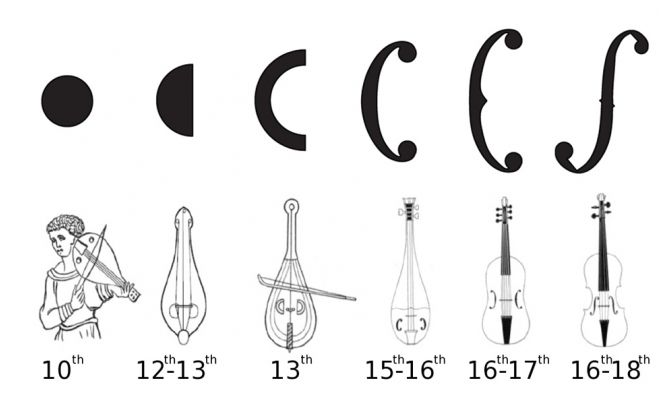
Scientists have discovered that the distinctive “f-hole” (so-called because it resembles a written “f”) in a violin is not just a pretty shape. It is perfectly designed to maximise the sound issued from the instrument.

The shape is twice as efficient at transmitting sound as a round hole researchers found.

MIT accoustics expert Nicholas Makris studied the development of the holes. he found that the the more elongated the sound hole, the more sound can escape from the violin, and set about to prove it mathematically.

He says that, while it is unclear whether the instrument makers understood the mathematics behind the efficiency of the f-hole, it developed in an “evolutionary” way.

He and his team analysed 470 instruments made between 1560 and 1750 and found that the change from round hole to the f-hole was gradual but consistent.

Whatever they knew about the maths, instrument makers “definitely knew what was a better instrument to replicate,” says Makris.

As Jennifer Chu writes in MIT News:

The more elongated these are, the more sound a violin can produce. What’s more, an elongated sound hole takes up little space on the violin, while still producing a full sound — a design that the researchers found to be more power-efficient than the rounder sound holes of the violin’s ancestors, such as medieval fiddles, lyres, and rebecs.

Makris didn’t set out to study violin acoustics, Chu reports, but arose when he took up a new hobby – playing the lute.

“I’m an acoustics expert, but promised myself I wouldn’t think about the acoustics of the instrument, I’m just going to play the thing,” Makris told Chu.

That thinking didn’t last long, as he began trying to understand his instrument better.

How the shape developed

How the shape developed

Magpie songs

The musical carolling of this Australian songbird is a daily feature of the lighthouse walk at Byron Bay, in northern New South Wales. The magpies live alongside the tourists and local lighthouse lovers.
What a magnificent song from a bird that is often considered a nuisance in the suburbs. The details of God’s artistry in the musical mechanics of the natural world never cease to amaze.
(Video courtesy of Sean O’Shea Art)

Watch “Adult beginner violinist – 2 years progress video” on YouTube

This 24-year-old adult beginner from Norway wanted to see if it was possible to learn to play the violin as an adult. This video shows her progression from week 1 until today. This is so encouraging. I hope it will inspire many of you to pick up a new instrument, or pick up where you left one from your childhood days.

The dark canvas that points to Grace

This is such a joyful song which brilliantly describes the Joy we share in Christ. My favourite line is this: “The dark is just a canvas for Your grace and brightness.”  If this post meets you in a dark place look to Christ, the song of our hearts.

“Joy” (Rend Collective)
We’re choosing celebration
Breaking into freedom
You’re the song
You’re the song
Of our hearts

We cast aside our shadows
Trust You with our sorrows
You’re the song
You’re the song
Of our hearts

We’re dancing to the rhythm of Your heart
We’re rising from the ashes to the stars

You’re the joy joy joy lighting my soul
The joy joy joy making me whole
Though I’m broken, I am running
Into Your arms of love

The pain will not define us
Joy will reignite us
You’re the song
You’re the song
Of our hearts

The dark is just a canvas
For Your grace and brightness
You’re the song
You’re the song
Of our hearts

We’re dancing to the rhythm of Your heart
We’re rising from the ashes to the stars

CHORUS

You’re the joy
The song in my heart
The hope of my soul

In the shadows
In the sorrows
In the desert
When the pain hits
You are constant
Ever-present
You’re the song of my heart
[x2]

CHORUS


Music for the Unborn

Source: Music and Abortion

By Murray Campbell
image
Scientists have discovered that babies in the womb, as young as 16 weeks, respond to music by ‘dancing’.
“The foetuses responded to the music by moving their mouths or their tongues as if they wanted to wanted to speak or sing,” said one of the researchers, Marisa Lopez-Teijon. The research has been published in journal of the British Medical Ultrasound Society, Ultrasound.

What this means is that babies’ cognitive faculties, creative faculties, and listening and communication skills are more highly developed at 16 weeks than previously thought.

The more scientists study human beings in the womb, the more wonder, beauty and complexity we discover. As scientific research advances, the findings increasingly demonstrate that embryos are not less human but fully human, and from the very earliest stages.

I am reminded of the words spoken by one excited mum, ‘As soon as the sound of your greeting reached my ears, the baby in my womb leaped for joy’ (Luke 1:44).

It was interesting to note that the article inThe Australian, while sometimes referring to embryos, also addresses them as babies. The days when scientists and proabortionists justified abortion by claiming embryos were not human has long gone.

This latest research makes the reality of abortions even more appalling. It is a dreadful paradox of our society, that a child who enjoys listening to music in the womb can, on the same day, be killed in the womb.

How can we justify killing a child who in their first weeks of life is being moved by the sounds of Mozart and Bach? Not that responding to music defines their humanity but it further proves their humanity. He or she is not potential life, but is life with a mind and body that is active and alert.

Science is showing us the ignominy of our attitudes toward the unborn, but will we listen? We have longed turned deaf to the Bible’s pleas about the sanctity of life, and I suspect that we will also turn a blind eye to these amazing revelations that are being proven through empirical research.

Through music, science is affirming an ancient theological truth, embryos are people like us. But will we listen?

If you are reading this as a pregnant mum and you are questioning whether you should keep your baby, please talk to someone. We have a trained female counsellor at Mentone Baptist who is available to listen and help –faye.Ludik@mentonebaptist.com.au. 

If you are reading this post as someone who struggles with a past decision to undergo an abortion, I want you to know that the good news of Jesus Christ means that real forgiveness and healing is promised through him. Abortion is wrong, but it is not the unforgivable sin. Again, please contact our church counsellor. If you don’t live near Mentone but are keen to find out more, please contact us and we’ll try to find a suitable church near where you live. 

Sing along!

This is just such a groovy song. You will soon be singing along, trust me. Thanks for the music Pentatonix.

from the October 2015 self-titled album.

Why you should thank your music teacher

gracepianoHere are ten things music teachers should be thanked for.

1. They taught you that it’s ok to make mistakes, and making them is how we learn and grow as a person. That’s something useful for life in general, not just music.

2. They taught you to believe in your abilities and stay calm under pressure. Again, not bad qualities to have regardless of what you’re doing.

3. They encouraged you to do your best and push your limits.

4. They destroyed the “practice makes perfect” cliche. In reality, a copious amount of practice is not enough to become a great musician. You always need to find a way to make yourself inspired.

5. They show tremendous dedication, including by taking after school lessons, running school orchestras and clubs, and planning activities. A lot of this additional commitment is never recognised in a teacher’s working hours or salary.

6. They made mathematics easier to understand.After all, its simpler to grasp the concept of two quarter notes fitting in to a half than trying to stare at a badly drawn diagram on a blackboard.

7. They pushed you to take responsibility for your actions, by practicing for your weekly piano lessons or remembering to bring your violin to school.

8. They opened the doors to something which has been shown to stimulate the entire brain. As we noted in a recent article, a vast quantity of scientific research has proven the positive effects of music in many areas.

9. They stressed the importance of always looking for ways to improve. Whether or not you’re still playing piano today, a healthy dose of self-criticism can only be a good thing.

10. They showed you that music is a lot more than just something you listen to or have on in the background. It’s there to be experienced.

Ten Reasons to Thank Your Music Teacher

Dog Filmed Home Alone Gives His Parents A Surprise

https://www.thedodo.com/dog-plays-piano-sings-1330099739.html?

This is too good not to share. It would be interesting to know what a dog actually hears when it hits those keys…..a much greater range of harmonics than we mere humans, I guess.