9 Glorious things about Jesus’ Resurrection

empty tombSharing today a great post from Stephen Altrogge at The Blazing Center – because I couldn’t have said it better myself. The resurrection is the most significant event in history, which changed everything – and continues to change everything for individuals, families, communities, and the world as a whole. Here are 9 glorious things which the empty tomb means for us:

“The resurrection baffled everyone. When the disciples came to Jesus’ empty tomb, they couldn’t comprehend what they were seeing. They had witnessed him die, saw the spear plunge into his side, heard him cry out, “It is finished!” But they couldn’t make heads or tails of the resurrection and the vacant grave clothes and the stone that had been tossed aside. What did these things mean? John 20:9 says:

…for as yet they did not understand the Scripture, that he must rise from the dead.

They knew Jesus was not there but they didn’t really understand what his resurrection meant. We can be just like the disciples. We know that Jesus rose from the dead but we don’t know what it means for us. . . 

1. THE RESURRECTION MEANS JESUS IS ALIVE

This may sound like I’m stating the obvious but think deeply about this for a moment. Paul said that if the resurrection didn’t happen, we are most to be pitied. Everything we’ve believed and built our lives upon is a horrendous trick, a lie of demonic proportions.

But the resurrection IS true, which means that Jesus is alive, which means that everything he promised will happen. It’s not a myth, fairy tale, or children’s tale. Christ is risen from the dead and is achieving EVERYTHING he said he would.

2. THE RESURRECTION MEANS JESUS IS REIGNING

Our risen Lord is just that – Lord. He sits on the throne of heaven, the King of Kings and Lord of Lords. Our lives and the world may seem insanely chaotic but there is nothing outside of the sovereign rule of King Jesus.

Satan, every demon, and every nation may plot against us and the Lord, and yet Jesus responds like this:

He who sits in the heavens laughs; the Lord holds them in derision (Ps 2:4).

Nothing can stop our Lord from accomplishing his good plans.

3. THE RESURRECTION TOMB MEANS A MAN SITS UPON THE THRONE

This is utterly mind boggling. The incarnation, death, and resurrection of Christ mean that a man, a human, bone of our bone and flesh of our flesh, is seated on the throne of heaven.

God is not distant, unfeeling, and unable to sympathize. We have a king who became like us. He knows hardship, grief, sadness, and rejection. Jesus the King is high and exalted, Jesus the man draws near to the brokenhearted.

Although he was a son, he learned obedience through what he suffered (Heb 5:8).

4. THE RESURRECTION MEANS THE PENALTY FOR SIN HAS BEEN PAID

The wages of sin is death. Those who love wickedness must face the just consequences of their choice. Our rightly deserved punishment is both spiritual and physical death.

When Jesus rose from the dead, it demonstrated that the penalty for sin – death – had been satisfied. Nothing else was needed, the price was paid, all had been accomplished.

D. Martyn Lloyd-Jones wrote:

The Resurrection is the great announcement of the momentous fact that Christ has finished the work He came to do. He is no longer “under the law.” He is back in glory. Why? Because He has done everything that the Law could demand. Now the Law has exhausted itself upon Him, and He will die “no more.”

When Jesus cried, “It is finished,” he was not exaggerating or adding theatrics. It was a beautiful statement of objective truth.

5. THE RESURRECTION MEANS JESUS WILL MAKE ALL THINGS NEW

In the song “All Things New,” Andrew Peterson writes:

So hold on to the promise
The stories are true
That Jesus makes all things new

Jesus will come again, and when he comes he will make ALL things new. Every tear will be wiped away, sin will be eradicated, and this rickety, run-down, sin-stained world will be made new.

Thank God that this world is not our final home. Thank God our life doesn’t consist of eating, drinking, and then dying. The risen Christ will make all things new.

6. THE RESURRECTION MEANS WE WILL RECEIVE NEW BODIES

Christ is the first fruits of the harvest that is coming.

Just as we have borne the image of the man of dust, we shall also bear the image of the man of heaven (1 Co 15:49).

Right now, our bodies decay. Fall apart. Go to pieces. We afflicted with cancer, depression, Alzheimer’s, and ALS. But this won’t always be the case. Christ will return and we will receive new, resurrection bodies that don’t feel the crippling effects of sin.

That is such good news.

7. THE RESURRECTION MEANS WE HAVE A SYMPATHETIC GREAT HIGH PRIEST

The risen Jesus is our Great High Priest, taking us into the Most Holy Place, and praying on our behalf. Because he also suffered, he is able to sympathize with our weakness.  He knows our frame, knows that we are dust, and strengthens us accordingly.

Jesus is near to us, helping us, praying for us. He brings our requests to God, purifying and sanctifying them. Because of our sympathetic great high priest, we can draw near with confidence.

For we do not have a high priest who is unable to sympathize with our weaknesses, but one who in every respect has been tempted as we are, yet without sin. Let us then with confidence draw near to the throne of grace, that we may receive mercy and find grace to help in time of need (Heb 4:15–16).

8. THE RESURRECTION MEANS WE HAVE THE HOLY SPIRIT

Now that Jesus is alive, he gives the Holy Spirit to all who believe in Him.

Being therefore exalted at the right hand of God, and having received from the Father the promise of the Holy Spirit, he has poured out this which you see and hear (Acts 2:32-33)

Praise God, the Holy Spirit is no longer reserved for prophets and mighty men and women. He comes to all who believe, weak and strong, young and old, mature and immature.

Through Christ, we are brought into a relationship the triune God.

9. THE RESURRECTION MEANS WE HAVE HOPE

Though we struggle and flail and stumble now, we have hope. Though we are pressed and afflicted, we are not destroyed. Though we walk through the Valley of Death, we will fear no evil. We can let goods and kindred go, this mortal life also, the body they may kill, God’s truth abideth still, Jesus has risen from the dead.

Risen indeed!
Back to 3:16 – Your reason for hope (1 Peter)

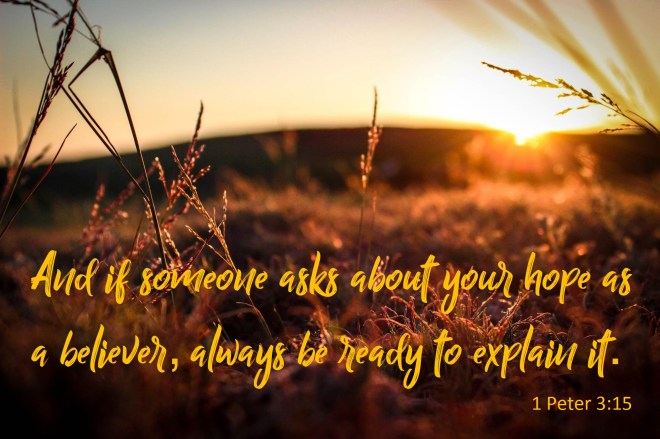
sunrise for hope1 Peter 3:14-16

1 Peter 3:14-16 (NIV)
14 But even if you should suffer for what is right, you are blessed. “Do not fear their threats; do not be frightened.” 15 But in your hearts revere Christ as Lord. Always be prepared to give an answer to everyone who asks you to give the reason for the hope that you have. But do this with gentleness and respect, 16 keeping a clear conscience, so that those who speak maliciously against your good behavior in Christ may be ashamed of their slander.

Greetings fellow bloggers,

It is nearly three years since I stalled in my exploration of the Three Sixteens, but today is the day to jump back in. With only four more of these 3:16 verses to go, perhaps I will make it to Revelation by Christmas! (If you missed all the earlier posts, on Matthew 3:16 through to James 3:16, then I’d encourage you to go back to the start and check them out.)

It is truly astounding the way such rich theology is anchored at this point in nearly every New Testament book. Admittedly, the more memorable verse sometimes does fall at 3:15 or 3:17, but this one starts in 15 and carries on.

Firstly, some context. In Chapter 3, Peter has been writing about submission to Christ and to each other, about our witness, and suffering in doing good. Verse 14 says, if we are doing what is right and suffering for it it, we should not fear the threats and slander of mere humans. These should be of no consequence to us (which is much easier said than done, right?). In fact, Peter says we are blessed/rewarded for the suffering we must endure, as we seek to live a holy life. This right behaviour ‘in Christ‘ (done in his strength and for his sake) is further described in verse 16. Other people are going to speak maliciously against us, but Peter says that when we act in good conscience, the slanderers who criticise our good behaviour will ultimately be put to shame. That’s tough for them, but good for us. (However, you certainly wouldn’t want to be doing ‘good things’ with that motivation in your heart – to shame others!)

So, what is the heart of the matter in this 3:16?

As I said before, verse 16 begins in 15, and it starts with a big BUT: But in your hearts revere Christ as Lord. In the midst of suffering and slander, revere Christ. This is Peter’s solution.

The presence of the BUT tells me that our natural inclination is to do just the opposite. Our natural reaction is NOT to revere Christ as Lord. Instead, we hold the opinions and power of mere humans as being more important than that of Christ. We are naturally afraid of living in a way that brings suffering for following Christ (verse 14). That is the precisely the way the World lives – fearing one another, and the power that others’ have over us, yet constantly seeking the approval of those very people.

That’s why Peter has to say, “But . . “ do this instead! Honour Christ. Fear Christ.

Rather than fearing Man, we Christ-followers are to revere Christ as Lord, to recognise that He is the Lord of this universe and He holds ultimate power. Because He will Judge each of us, He is the right person to fear. And when we fear the right thing, everything else falls into place. When we fear the Lord, the suffering that brings blessing for us also brings hope and peace!

This is what Peter alludes to in verse 14, which is a reference to Isaiah 8:12-15:
12 “Do not call conspiracy all that this people calls conspiracy, and do not fear what they fear, nor be in dread. 13 But the Lord of hosts, him you shall honor as holy. Let him be your fear, and let him be your dread. 14 And he will become a sanctuary and a stone of offense and a rock of stumbling to both houses of Israel, a trap and a snare to the inhabitants of Jerusalem. 15 And many shall stumble on it. They shall fall and be broken; they shall be snared and taken.” (NLT)

In the fear of the Lord there is refuge and sanctuary. In fearing the Lord we find peace and confidence (we are not frightened), because we revere the true power! Isn’t that astounding?

Perhaps it is only when we patiently suffer for Christ that we find the strength and opportunity to express the HOPE that is in us.

What an encouraging bunch of verses we have here, which remind us that our strength comes from Christ! The meat in the sandwich (verse 15) is honouring or revering Christ, which brings us hope and a readiness to share the hope. This hope allows us to cope with the suffering wrapped around our hope, as we live for Christ in a world that despises him, and us.

Ultimately Peter’s message is this:
As you live for Christ, you will suffer – but you will be blessed and strengthened in your hope as you honour Christ as Lord of your life.

That sounds like a pretty significant message to take away.
Thanks for another great 3:16, Peter!

(Note: If you have ever wondered how we got chapters and verses in the bible, you can read about it here.)

More Than A Birthday Party For Jesus? 

away-in-a-manger-king-size-bed-jesus

What can worship leaders, pastors and creative leaders do to help Christians experience the ‘true meaning’ of Christmas? http://worshipsessions.com.au/site/teaching

Christmas can be a stressful time of year, and Christians are not immune to the pressures and demands of this season. Many Christians find it difficult to significantly engage with Christmas on a spiritual level. Have you ever heard a Christian say “it just doesn’t feel like Christmas?”

The Christian experience of Christmas should be much richer, more distinct and more meaningful than the Christmas experience promoted across our culture. But for this to happen, Christmas must become more than just a birthday party for Jesus and a time for family reunions.

For Christians to gain a deeper and richer appreciation for the Christmas season as a Christian event (rather than just a cultural one) we must take a step back and look at Christmas in the broader context of the historical Christian calendar.

For centuries believers have followed the Christian Year as part of their spiritual formation and discipleship. According to this ancient tradition, Christmas was celebrated as a twelve-day feast, not just a one-day event. This celebration was the culmination of four weeks of spiritual preparation and anticipation known as Advent.

The well-known Internet Monk blogger Michael Spencer illustrates the difference between Advent and Christmas. He says, “Christmas is joyous, but the joy comes after weeks of waiting, watching, lamenting and calling upon God. Advent is that season of waiting; of looking for the signs and promises of the Saviour in the Scriptures and in the world.”1

I believe that rediscovering the spiritual rhythm and preparation of Advent will help Christians experience the true meaning of Christmas.

In the weeks leading up to Christmas – when our culture is shouting at us to “spend!” “buy!” and “consume!” – the season of Advent teaches us to slow down and reflect on God’s story and our place in it, it teaches us patience, and cultivates within us a child-like sense of anticipation and longing. Advent does this by helping us to remember the historical silence of the Scriptures between the Old and New Testaments and the expectation of a soon-coming Messiah. Advent also helps us to anticipate Jesus’ future return and the eventual completion of His work in redeeming and renewing all of Creation.

Advent spirituality is about recognising that we are living in the “now, but not yet…” between the inauguration and fulfilment, between promise and completion. During Advent, the words of John the Baptist ring in our ears “Prepare the way for the Lord, make straight paths for him,”2 as we eagerly await the Messiah’s return. For Christians, Advent is a time for spiritual preparation, reflection and repentance, which directly opposes our culture’s penchant for busy-ness, over-spending and over-indulgence in the lead up to Christmas.

Christmas is more than just a celebration of Christ’s arrival. In the light of Advent, Christmas becomes the fulfilment of the expectation that builds throughout the Advent season. At Christmas, we remember that God broke through into our earthly dimension. Through His birth, life, ministry, death and resurrection, Jesus Christ worked to restore the earth and all creation from within, according to God’s good plan and purpose. Our response as His followers is to join with Him, today and every day, in His ongoing work of restoring the world unto Himself, until the day that He returns.3

In this way, Christmas calls us to a tangible response as followers of Jesus: to live out ‘incarnational spirituality’4 – an expression of Christian faith that embodies the life of Christ into the world in which we live. The prayer of the Christmas season is “Your kingdom come, your will be done on earth as it is in heaven.”5 It is a reminder that “the work of restoring creation has begun,”6 and that we are called to join in that work, empowered and enabled by the Holy Spirit.

By understanding and integrating these historically important Christian ideas into worship gatherings leading up to Christmas, worship leaders and pastors can help those they lead to discover a deeper and more significant Christmas spirituality. That is, where faith overflows into tangible and intentional expressions of incarnational Christianity – a faith that is in the world but not of it.

Worship leaders and songwriters can help their communities experience Advent by choosing and writing songs, prayers and using language that focuses on the expectation of Christ’s coming; and saving the celebration of his arrival until Christmas Day.

Worship leaders can research, read and learn more about the seasons of Advent and Christmas in order to help their congregations wrap their Christmas experience around God’s story, not the story of commerce, culture and consumption.7

As worship leaders and creative influencers, we have the opportunity to shape the ways in which our worshipping communities experience Christmas, and ultimately influence the kind of Christianity the live out between Sundays. As we learn and immerse ourselves in the rich meaning of the “Christian Year” and prayerfully contextualise the themes and ideas of these seasons into our worship gatherings, I believe that Christmas can once again become a primarily Christian event in our churches – one that encourages us in our faith and empowers us in our witness as we remember, experience and live out the Truth of Christmas.

Ryan Day is the Worship Pastor at Gymea Baptist Church
www.gymeabaptist.org.au   www.ryanday.com.au

References:
1.      Spencer, Michael; http://www.internetmonk.com/archive/imonk-classic-michael-spencer-helps-us-prepare-for-advent (Accessed on 1 December 2011)
2.      Matthew 3:3b (See also John 1:23 and Isaiah 40:3) (NIV)
3.      For a balanced and insightful look at the role of Christians as restorers, see “The Next Christians” (DoubleDay Publishing, 2010) by Gabe Lyons.
4.      Webber, Robert “Ancient-Future Time”, Baker Books (Grand Rapids, MI), 2004, page 61-71.
5.      Matthew 6:10 (NIV)
6.      Webber, page 61
7.      Robert Webber’s book “Ancient-Future Time” would be a great introduction to understanding Advent, Christmas and the entire Christian calendar.

THIS ARTICLE CAME FROM http://worshipsessions.com.au/site/teaching

King of Heaven – come now!

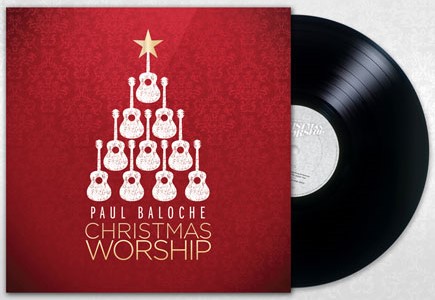
paul-baloche_christmas-worship-vinyl-image_web-2At Christmas we remember the coming of the infant King of Heaven, Jesus Christ. God could have sent him as a fully grown man, and provided a grand entrance with enough pomp and circumstance to rival any contemporary celebrity. Yet God chose for him the womb of a virgin and a lowly cave/stable as his first resting place on the planet. Jesus shared the growing pains of our humanity so that he could be our perfect counsellor, Saviour and Lord. This King of Heaven is coming again and we probably should spend a lot more time praying for such an outcome, rather than sitting comfortably in the limitations of our mortality.
Paul Baloche’s KING OF HEAVEN (2012 – “The Same Love” album) is a song which captures something of the longing we (should) have for Jesus’ return. Here is his Christmas version of the song combined beautifully with Hark the Herald Angels Sing:

And here is the original song, performed with All Sons and Daughters: (don’t mind the 40 seconds of silliness at the start – the song officially gets going around 45 secs. I’m determined to included KING OF HEAVEN as one of our congregational songs next year.)

KING OF HEAVEN

Jesus, let Your kingdom come here
Let Your will be done here in us
Jesus, there is no one greater
You alone are Savior, show the world Your love

King of Heaven come down
King of Heaven come now
Let Your glory reign shining light the day
King of Heaven come
King of Heaven rise up
Who can stand against us?
You are strong to save in Your mighty name
King of Heaven come

We are children of Your mercy
Rescued for Your glory
We cry, Jesus set our hearts towards You
Every eye would see You lifted high

Ooh, ooh, ooh, King of Heaven come

Let’s Stop Underestimating Christmas

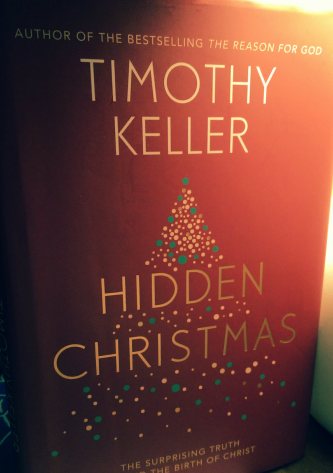
imag5856_1Today’s post comes from the Gospel Coalition and echoes much of what I spoke of a few days ago – about the great worth of remembering God’s great works at Christmas time. I am currently reading Keller’s book mentioned below, titled “Hidden Christmas” – which is surprising me more and more, in a good way, with each passing chapter. It would make a great gift this Christmas.

“Christmastime is here. For some of you, that sentence evokes nostalgia and joy. Others of you, not so much. Yet one thing many of us share in common this time of year is hearing the classic readings from the Gospels (if not in church then from Linus). And all the while, we can become so familiar with the incarnation that we end up domesticating it.

Christmas is familiar, but it isn’t tame. As Tim Keller puts it in his new book, Hidden Christmas: The Surprising Truth Behind the Birth of Christ (Viking), “Christmas is both more wondrous and more threatening than we imagine.” Working from the writings of Matthew, Luke, and John, he illumines the modern import of the ancient story.

I asked Keller, pastor of Redeemer Presbyterian Church in Manhattan and vice president of TGC, why neither the god of moralism nor the god of relativism would’ve bothered with Christmas, how unbelievers try to “name” Jesus, and more. (And yes, this brief book would make an excellent Christmas present.)

In the book I say that about the theme of “light in the darkness” that’s so prominent not only in the biblical understanding of Christ’s birth (Isa. 9:2Matt. 4:16) but also in most contemporary celebrations of Christmas. The Bible doesn’t say “from the world a light has dawned” but “upon the world a light has dawned.” The point is that the world is a dark place that needs salvation to come from outside of it. This means the end of cheery statements like, “If we all pull together, we can make the world a better place.” No, we can’t. We don’t have what it takes.

The Bible doesn’t say ‘from the world a light has dawned’ but ‘upon the world a light has dawned.’ The world is a dark place that needs salvation to come from outside of it.

This is a clear-eyed, realistic approach to our problems. It’s not rah-rah optimism. Yet it’s not pessimistic either, because there ishope, and a certainty that God will eventually destroy all evil.

Why is it foolish to rush past the genealogy at the beginning of Matthew’s Gospel? 

Matthew’s genealogy of Jesus does a lot of work. First, it roots Jesus in history. The gospel doesn’t begin “once upon a time.” Christ isn’t a legend; he was a flesh-and-blood human being in space and time. Second, the genealogy includes women who were racial and cultural “outsiders” (Rahab and Ruth) as well as involved in incest, adultery, and prostitution (Tamar, “Uriah’s wife,” and Rahab).

Even the ‘begats’ of the Bible drip with God’s mercy.

In ancient and less individualistic times, one’s genealogy was like one’s résumé. Like today’s résumés, many things were usually expunged to make it look better to the reader. Women were seldom put in ancient genealogies at all, let alone women who reminded readers of the sordid sins and corruption of ancestors such as Judah and David. All of these figures would have been disowned or expunged from a normal genealogy, but here they are not. They are all—male and female, king and prostitute, Jew and Gentile—equally part of Jesus’s family. So even the “begats” of the Bible drip with God’s mercy.

Neither the god of moralism nor the god of relativism would have bothered with Christmas, you observe. Why not?

Moralism is essentially the idea that you can save yourself through your good works. And this makes Christmas unnecessary. Why would God need to become human in order to live and die in our place if we can fulfill the requirements of righteousness ourselves? Relativism is essentially the idea that no one is really “lost,” that everyone should live by their own lights and determine right and wrong for themselves. The “all-accepting god of love” many modern people believe in would never have bothered with the incarnation. Such a god would have found it completely unnecessary.

The ‘all-accepting god of love’ many moderns believe in would never have bothered with the incarnation. Such a god would have found it completely unnecessary.

Why was the naming of baby Jesus significant? 

All parents have the right to name their own child. It’s a sign of their authority over the child, and the power they have over how the child will live and who the child will become. This was even truer in ancient patriarchal societies than it is now. But the angel doesn’t allow Joseph or Mary to name Jesus. One reason is that Jesus was the first child ever born who was far older than his parents! The other is that, even though Jesus submitted to his human parents authority during his childhood (Luke 2:51), they weren’t ultimately his master. He was their master. By refusing to let Mary and Joseph name their son, the angel was essentially saying something like this: “If Jesus is in your life, you’re not his manager—he’s your manager. You don’t name him or tell him who he is—he’s come to tell you who you are.”

What can we learn about the difference between closed-minded doubt and open-minded doubt from contrasting Zechariah and Mary in Luke 1?

When the angel Gabriel appeared and told Zechariah he would have a son, Zechariah expressed doubts about how this could come to such an elderly couple (Luke 1:18)—and he was disciplined for his doubt (Luke 1:20). When Gabriel appears and tells Mary she will have a son, she expresses doubts to the same angel in almost the same words—wondering how this could come to a virgin (Luke 1:34). Yet there’s no word of rebuke, only a further explanation. Why the difference? The only real possibility is that the inner motivations and dynamics of Zechariah’s and Mary’s doubts were different. There’s a kind of doubt that really is seeking more information—that “wants” to believe if it’s possible. There’s also a kind of doubt that really is looking for a way out, that doesn’t want to believe or submit, that’s looking for a way to keep control of one’s own life.

This is a wonderfully nuanced approach to doubt. The Bible doesn’t view doubts as always rebellious, nor does it encourage people to live in doubt perpetually. That’s why we’re told to “be merciful to those who doubt” (Jude 1:22).”

https://www.thegospelcoalition.org/article/tim-keller-wants-you-to-stop-underestimating-christmas

Why Jesus came

This post comes from John Piper at Desiring God. It is a really helpful explanation of the reason for the season.

“Since therefore the children share in flesh and blood, he himself likewise partook of the same things, that through death he might destroy the one who has the power of death, that is, the devil, and deliver all those who through fear of death were subject to lifelong slavery.” (Hebrews 2:14–15) 

Hebrews 2:14–15 is worth more than two minutes in an Advent devotional. These verses connect the beginning and the end of Jesus’s earthly life. They make clear why he came. They would be great to use with an unbelieving friend or family member to take them step by step through your Christian view of Christmas. It might go something like this…

“Since therefore the children share in flesh and blood…”

The term “children” is taken from the previous verse and refers to the spiritual offspring of Christ, the Messiah (see Isaiah 8:18; 53:10). These are also the “children of God.” In other words, in sending Christ, God has the salvation of his “children” specially in view. It is true that “God so loved the world, that he sent [Jesus].” But it is also true that God was especially “gathering the children of God who are scattered abroad” (John 11:52). God’s design was to offer Christ to the world, and to effect the salvation of his “children” (see 1 Timothy 4:10). You may experience adoption by receiving Christ (John 1:12).

“…he himself likewise partook of the same things [flesh and blood]…”

Christ existed before the incarnation. He was spirit. He was the eternal Word. He was with God and was God (John 1:1; Colossians 2:9). But he took on flesh and blood and clothed his deity with humanity. He became fully man and remained fully God. It is a great mystery in many ways. But it is at the heart of our faith and is what the Bible teaches.

“…that through death…”

The reason he became man was to die. As God, he could not die for sinners. But as man he could. His aim was to die. Therefore he had to be born human. He was born to die. Good Friday is the reason for Christmas. This is what needs to be said today about the meaning of Christmas.

“…he might destroy the one who has the power of death, that is, the devil…”

In dying, Christ de-fanged the devil. How? By covering all our sin. This means that Satan has no legitimate grounds to accuse us before God. “Who shall bring any charge against God’s elect, it is God who justifies” (Romans 8:33) — on what grounds does he justify? Through the blood of Jesus (Romans 5:9).

Satan’s ultimate weapon against us is our own sin. If the death of Jesus takes it away, the chief weapon of the devil is taken out of his hand. He cannot make a case for our death penalty, because the Judge has acquitted us by the death of his Son!

“…and deliver all those who through fear of death were subject to lifelong slavery.”

So we are free from the fear of death. God has justified us. Satan cannot overturn that decree. And God means for our ultimate safety to have an immediate effect on our lives. He means for the happy ending to take away the slavery and fear of the Now.

If we do not need to fear our last and greatest enemy, death, then we do not need to fear anything. We can be free. Free for joy. Free for others.

What a great Christmas present from God to us! And from us to the world!

O come, O come, Emmanuel – The Piano Guys

Listen to this beautiful rendition of O Come, O Come Emmanuel by the Piano Guys. If you would like to know more of the origins of this beautiful Christmas song, read on.

This is one of my favourite Christmas songs, for the very fact that you cannot miss who Jesus is from the very first line – God with us, Emmanuel! This song recognises Christ’s first arrival, and makes us long for His second, expressed in most eloquent theology. Yet who is the author, you may ask? It was penned in Latin by an unnamed European monk, sometime before the 8th century A.D. He must have had a unique and rich knowledge of the Bible, shown by the way he weaves together several Old Testament prophecies about the coming of the Messiah: “the rod of Jesse,” the “Dayspring from on high,” the “Key of David,” and “Wisdom from on high.”  For Medieval Christians who did not have a Bible to read, this valuable song would help them know and understand and teach others what the hope of Christ was all about. In the early 19th century an Anglican priest named John Mason Neale came across the hymn in an ancient book called the “Psalteroium Cantionum Catholicarum.” The tune that went with the text was from a 15th century French Franciscan convent of nuns ministering in Portugal. Rev. Neale translated the Latin into English and gave the world a song.

O come, O come, Emmanuel,
And ransom captive Israel,
That mourns in lonely exile here,
Until the Son of God appear.
Rejoice! Rejoice! Emmanuel
Shall come to thee, O Israel.

O come, Thou Rod of Jesse, free
Thine own from Satan’s tyranny ;
From depths of hell Thy people save,
And give them victory o’er the grave.
Rejoice ! Rejoice ! Emmanuel
Shall come to thee, O Israel.

O come, Thou Dayspring, from on high,
And cheer us by Thy drawing nigh;
Disperse the gloomy clouds of night,
And death’s dark shadows put to flight.
Rejoice ! Rejoice ! Emmanuel
Shall come to thee, O Israel.

O come, Thou Key of David, come
And open wide our heav’nly home ;
Make safe the way that leads on high,
And close the path to misery.
Rejoice ! Rejoice ! Emmanuel
Shall come to thee, O Israel.

O come, Adonai, Lord of might,
Who to Thy tribes, on Sinai’s height,
In ancient times didst give the law
In cloud and majesty and awe.
Rejoice ! Rejoice ! Emmanuel
Shall come to thee, O Israel.


Two new albums: Matt Redman and Casting Crowns

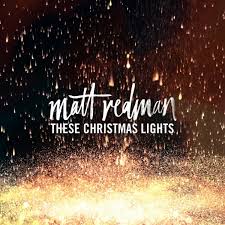
matt-rHere are two new albums I found recently. They contain some great new favourites from artists who reliably point us to Jesus, the living Word of God, Emmanuel! Matt Redman’s Christmas album is refreshingly original with beautiful lyrics to inspire. You may find something special here for your Christmas program. Blessings to you!

MATT REDMAN – These Christmas Lights (2016) Listen on iTunes

Here is a lyric video which could be used at a Christmas carols night: http://www.christiansongtracks.com/worship-tracks/62398/these-christmas-lights-

CASTING CROWNS: The Very Next Thing (2016) Listen on iTunes

Friday Flashback: Lord Of The Dance

Lord of the Dance by Steven Curtis Chapman

On the bank of the Tennessee River
In a small Kentucky town
I drew my first breath one cold November morning
And before my feet even touched the ground
With the doctors and the nurses gathered ’round
I started to dance, I started to dance

A little boy full of wide-eyed wonder
Footloose and fancy free
But it would happen, as it does for every dancer
That I’d stumble on a truth I couldn’t see
And find a longing deep inside of me, it said 

I am the heart, I need the heartbeat
I am the eyes, I need the sight
I realize that I am just a body
I need the life
I move my feet, I go through the motions
But who’ll give purpose to chance
I am the dancer
I need the Lord of the dance

The world beneath us spins in circles
And this life makes us twist and turn and sway
But we were made for more than rhythm with no reason
By the one who moves with passion and with grace
As He dances over all that He has made

I am the heart . . .

And while the music of His love and mercy plays
I will fall down on my knees and I will pray

I am the heart, You are the heartbeat
I am the eyes, You are the sight
And I see clearly, I am just a body
You are the life
I move my feet, I go through the motions
But You give purpose to chance
I am the dancer
You are the Lord of the dance
I am the dancer
You are the Lord of the dance

Are we eager for the King of Heaven?

Here is a song from Paul Baloche which I have been considering for a while to include in our church repertoire: King of Heaven from ‘The Same Love’ album. It challenges us to collectively anticipate and call on the Lord Jesus for His return. It has a lively and uplifting feel. You will find the words in the first clip, and at the end. Blessings!

“King Of Heaven”
Jesus, let Your kingdom come here
Let Your will be done here in us
Jesus, there is no one greater
You alone are Savior, show the world Your love

King of Heaven come down
King of Heaven come now
Let Your glory reign, shining like the day, King of Heaven come

King of Heaven rise up
Who can stand against us?
You are strong to save in Your mighty name
King of Heaven come

We are children of Your mercy
Rescued for Your glory
We cry, Jesus set our hearts towards You
Every eye would see You lifted high

King of Heaven come down
King of Heaven come now
Let Your glory reign shining like the day
King of Heaven come

King of Heaven rise up
Who can stand against us?
You are strong to save in Your mighty name
King Of Heaven come

Ooh, ooh, ooh, King of Heaven come

King of Heaven come down
King of Heaven come now
Let Your glory reign, shining like the day
King of Heaven come

King of Heaven rise up
Who can stand against us
You are strong to save in Your mighty name
King of Heaven come