New songs say ‘God is doing something now’!

music_is_nature__silhouette_by_sammy3773-1Sometimes change can make us very uncomfortable. It can make us feel totally out of control, it can rob us of things to which we feel entitled. Let’s explore this for a moment in terms of church music.
We Christians develop a real attachment to the songs of our faith. They become associated with the ups and downs we have been through, or the exciting time of our youth, or the time we first came to faith. When we sing them the songs instantly conjure the emotions of those times. This is why some people just can’t sing songs from the funerals of dearly departed friends and family, without being overwhelmed by sadness.

So should we learn new hymns and spiritual songs, especially when such change can cause great angst?  I had a conversation with a lovely friend over the weekend who was frustrated with a lack of interest for changing and updating the songs they sing in their church. Many of her congregation are still attached to the ‘Scripture in Song’ repertoire which became popular in the 70s and 80s. The musical style of these choruses hark back to this era . . . and make some people really cringe!

I have found a great rationale for new songs from Rick Warren, author of the “Purpose Driven Church” (1995). If you study church history you’ll discover that every genuine revival has always been accompanied by new music. New songs say ‘God is doing something here and now, not just a hundred years ago’. Every generation needs new songs to express its faith“.

Another great insight comes from a Presbyterian minister Rowland Lowther (2002). He says that his favourite Christian song is “When I survey the Wondrous Cross”, to the old hymn tune, . . . but for the sake of the Gospel I would be willing to change the musical style so that those wonderful lyrics could impact on the next generation. . . What matters to me more is not that I be moved, but those in the next generation has those wonderful old lyrics to a music format that can lift their spirits to worship the same living God that the writer of this hymn worshipped hundreds of years ago”.

Great point. I think it also comes down to the concept of “renewing our minds”. By hearing the gospel explained by new people, in new and fresh ways, our understanding of God and the gospel of His grace is strengthened and deepened. That has got to be a good thing.

You may also like:

12 Principles for Church Singing                                       New Songs we have been singing
praise him picFamily Singing

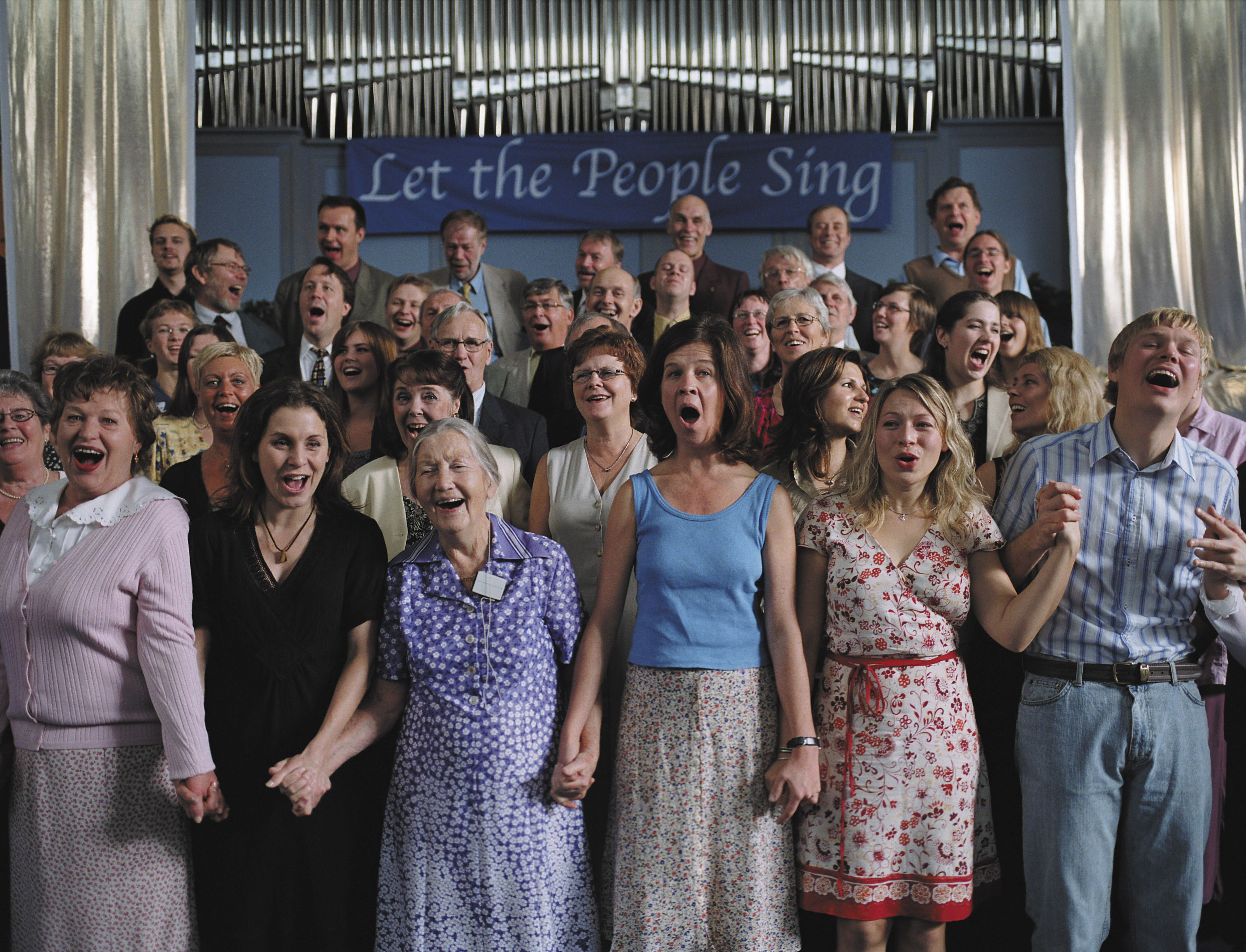
Film review: “As it is in Heaven”

If you have ever sung in a church choir or run a church choir, and if you have no aversion to foreign films, then like me you might really enjoy the film “As it is in Heaven” (2004). Set in Sweden the film tells the story of a brilliant violinist, conductor and composer, Daniel Daréus, who is forced to “retire” from his musical career due to ill health. He returns to Norrland, his childhood home town, but no one remembers him and just as well! He was ostracised and bullied there as a child. Though initially alone and viewed with strange curiosity by the townsfolk, he is soon asked to take on the leadership of the local church choir. Predictably he takes their small group from mediocrity to brilliance, yet the journey is enthralling and in no wasy predictable! There is such a mixture of personalities and personal issues which bubble along, creating both tension and many hilarious moments. His vocal training methods produce great results and there are eventually more people in the choir than there are in church congregation, much to Pastor Stig’s disgust! Daniel’s morality is soon brought into question: “There’s sin in the congregation hall” one wary and reluctant chorister reports! The film is full of funny moments for viewers who are privvy to the dynamics of church congregations.
But even more than the humour I love the way the film reveals the impact and significance of music in our lives. It has such power to unite people and create harmony, both vocally and in our relationships. In the final, surprising scene Daniel is immersed in the beautiful unwritten harmony coming of around 1000 voices. Perhaps this is as it should be, as it IS in heaven!

“Then I heard every creature in heaven and on earth and under the earth and on the sea, and all that is in them, singing: “To him who sits on the throne and to the Lamb be praise and honor and glory and power, for ever and ever!” (Revelation 5:13)

What amazing grace God has given us in those 7 little notes (A to G) which can be employed in infinite combinations for such diversity of results!

You may also like:
Why music makes our brain sing                                                               Who has the X Factor?
brainsingcat vass


To Glory in my Redeemer

my-redeemer-livesWhile some people may argue that a song can have more impact than a sermon (probably none of those people are preachers!) I would say that it is only the extent to which God’s Word is at work in either a song or sermon that people’s hearts and minds will be transformed!  This may sound rather complicated.  Let me explain what got me thinking about this.

On Good Friday morning we sang the words of a beautiful song together, “I will Glory in My Redeemer” (click on the title to see the lyrics).  As I was song leading that morning and trying to articulate something worthwhile in my introduction, the meaning of the title got me thinking. What does it mean to “glory in” my redeemer?  And how can I explain that in two easy sentences?  (Please pause here and have a go at it yourself!)

The song itself explains much about the saving work of our Redeemer: His blood has ransomed me, He has crushed the power of sin and death, He has bought my life, He crowns my life with lovingkindness, He waits for me at gates of gold!  But how are we to “glory in” this?  To say “I will glory in” something is not a very common expression these days. Looking up a dictionary I discovered that to “glory in” means to enjoy, to derive great pride, pleasure, amusement or satisfaction from something. What an amazing statement and challenge this song title holds! It prompts me to ask questions like: Am I glorying in my Redeemer?  Is He my only boast? Am I satisfied in Him alone (as the song says) and does He really “own my love”?

To glory in my Redeemer is an action, something we can choose to do; in fact it is a daily decision to be made! We will enjoy Jesus when we turn daily (hourly? moment by moment?) from the things of ourselves, our abilities and our possessions and status in this world as a source of our glory, and instead we give the glory to Him. Rather than boasting in myself, my house, my children, or my ability to be organised and control the myriad of circumstances and concerns of each day, I must choose to boast in Christ alone! He must receive the glory from my life and circumstances. My ultimate delight should be in contemplating the saving work of my redeemer and the treasure of my relationship with Him.

The impact of this song lies in the way it so closely echoes the challenge of God’s Word. From Paul to the Philippians ” …everything else is worthless when compared with the infinite value of knowing Christ Jesus my Lord. For his sake I have discarded everything else, counting it all as garbage, so that I could gain Christ and become one with him.”(Philippians 3:8-9 NLT). And it is through the power of the Holy Spirit, as we think on God’s word, that our minds can be transformed: Don’t copy the behavior and customs of this world, but let God transform you into a new person by changing the way you think. Then you will learn to know God’s will for you, which is good and pleasing and perfect. (Romans 12:2 NLT)

So may I encourage you to examine your own hearts in light of this challenge, and turn to Him who alone deserves to be treasured in this world, whose glory is fading away. May we “glory in” our Redeemer alone!