Great resource for learning new songs

worship siteThere is an invaluable resource, particularly for guitarists, within the Worship Together website. In case you haven’t discovered it yet, go there now! http://www.worshiptogether.com/
Each song comes with a SONG VIDEO/NEW SONG CAFE where the song writer is interviewed, they share their song, and explain some of the unusual things they do to make the song work. Chord structures, rhythm and dynamics are all explored. It’s also helpful to hear the history of how the song came together, and the main things the writer intends the song to say. I always enjoy getting to know a little about the person behind the song as well.  These clips are a great research for helping with tricky chord structures, and just getting the right feel to a song. I hope you find it helpful!


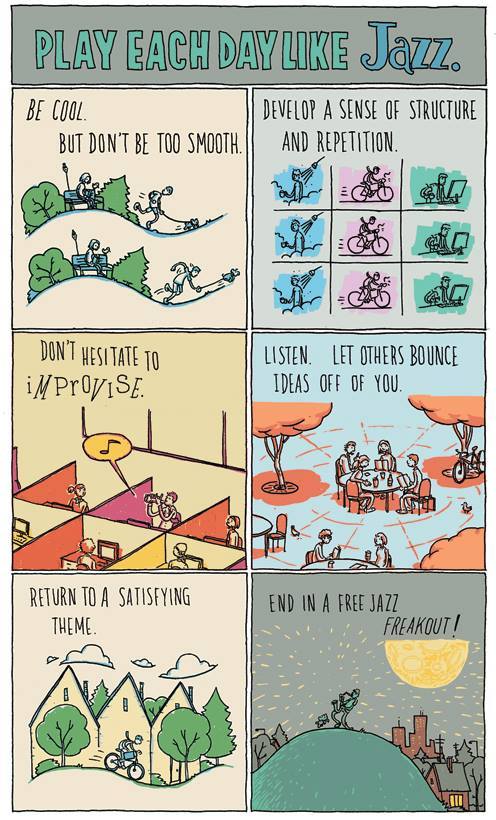
Play each day like Jazz.

This will make sense to some of you . . just a little musical humour to brighten your day. Blessings!jazz

Not the first generation to be addicted to bass

If you have ever wondered about the love of pipe organs in church music, and the intense love for ‘good old hymns’ which have been played on this grand instrument, the following research may help explain these strong connections:

Church organ Does organ music ‘instil religious feelings’?

According to an experiment people who experience a sense of spirituality in church may be reacting to the extreme bass sound produced by some organ pipes.

Many churches and cathedrals have organ pipes that are so long they emit infrasound which at a frequency lower than 20 Hertz is largely inaudible to the human ear. In a controlled experiment in which infrasound was pumped into a concert hall, UK scientists found they could instil strange feelings in the audience at will. These included an extreme sense of sorrow, coldness, anxiety and even shivers down the spine.

To test the impact of extreme bass notes from an organ pipe on an audience, researchers constructed a seven-metre-long “infrasonic cannon” which they placed at the back of the Purcell Room, a concert hall in South London. They then invited 750 people to report their feelings after listening to pieces of contemporary music intermittently laced with sound from the “cannon”.

The results showed that odd sensations in the audience increased by an average of 22% when the extreme bass was present. Some of the experiences were described as, ‘shivering on my wrist’, ‘an odd feeling in my stomach’, ‘increased heart rate’, ‘feeling very anxious’, and ‘a sudden memory loss’. This was an experiment done under controlled conditions and it shows infrasound does have an impact, and that has implications in a religious context and some of the unusual experiences people may be having in certain churches.”

Sarah Angliss, an engineer and composer in charge of the project, added: “Organ players have been adding infrasound to the mix for 500 years so maybe we’re not the first generation to be ‘addicted to bass’.”

The article “Organ music ‘instils religious feelings‘” was first reported by the BBC in 2003.

http://www.musicademy.com/2014/05/first-generation-addicted-bass/

Drawing back the curtains on Christ – the role of Song Leaders

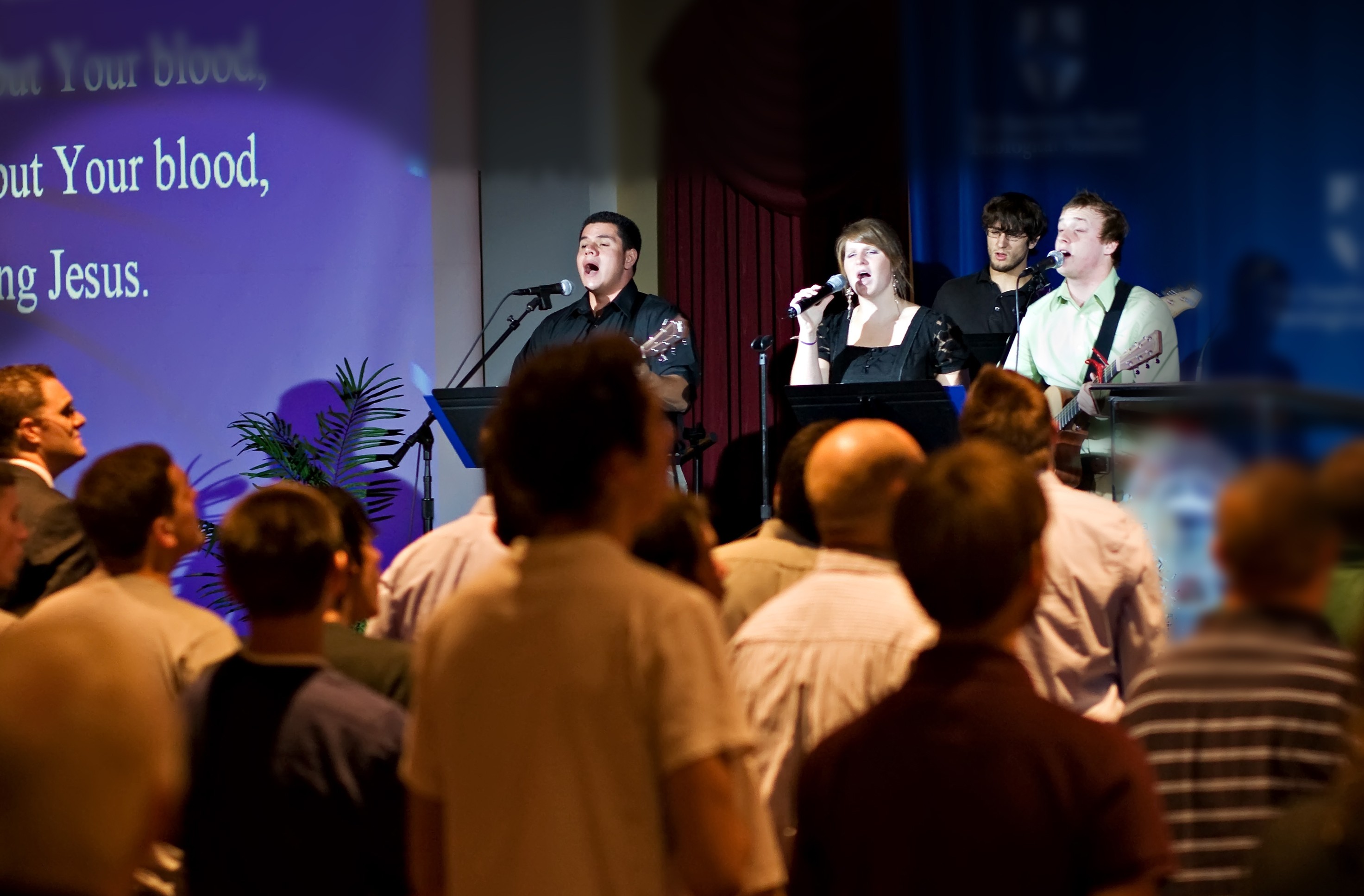
worship-band-chapel-sept-08A week ago I began a discussion on what makes a good song leader and promptly got distracted by the case for “song leaders” rather than worship leaders. (You can read it here: Why I prefer Song leader to Worship Leader.) Whether or not you are happy with my choice of terminology please come with me to consider 12 things that make an effective song leader.

Allow me to preface this list with a few comments. I’ve been working with song leaders and church bands (and serving as a song leader) for about 25 years now. I’ve seen the best and worst examples of what song leading can look like, and I’ve worked through plenty of issues. From what I’ve observed (in myself and others) I know that song leading can lead to all kinds of flattery, self-deceit and bad attitudes about your own importance and Christian life. (These must be confronted as soon as they raise their ugly heads, so be honest with someone you trust.)

To be an effective song leader requires discipline of both the mind and voice. It takes a balancing act of several important elements – especially humility, a desire to serve, vocal ability and confidence. And this does not just apply to when you are on stage! Song leaders must be genuine Christians who see their role as one of service, teaching and encouragement. They must think things through and prepare well. One of the most helpful and guiding pieces of advice I have found for song leaders was given by Charles Spurgeon! Though originally aimed at preachers, he said the challenge was to “draw back the curtains on Christ and get lost in the folds.” What a brilliant reminder that we are not up front for self-glorification, but for Christ!

Bob Kauflin defines the role of the song (‘corporate worship’) leader in a single sentence, like this:
“An effective corporate worship leader, aided and led by the Holy Spirit, skillfully combines biblical truth with music to magnify the worth of God and the redemptive work of Jesus Christ,
thereby motivating the gathered church to join him in proclaiming and cherishing the truth about God and seeking to live all of life for the glory of God.” (
http://www.worshipmatters.com/2006/03/01/what-does-a-worship-leader-do-part-16/)

That’s a pretty good definition, so I’m not going to tamper with it!

But for those wanting a longer list of things that make for effective song leading, here are my 12 points regarding the PERSPECTIVE, PRESENCE and PRACTICAL matters that can help song leaders serve more effectively:

Perspective:
1. See yourself as a “servant leader” who is doing a job to help others, to enable the gathered body of Christ to sing together, to praise God and encourage each other. You are serving the congregation with your voice, with clear and well-tuned singing that is easy to follow (just as you might serve with your hands in vacuuming the auditorium).
2. Keep serving in other ways. Don’t think song leading should be the full extent of your service to God. Be willing to take a break from it if it becomes all-consuming, or totally taking you from other gospel opportunities. (Vacuum the auditorium now and then! And speak the gospel to a friend!)
3. Don’t see yourself as the star of the show, and don’t take your musicians or sound crew for granted. Talk to them and express genuine appreciation! (On the other hand, don’t be blasé about your role. It is important to serve people in this role! And it is important for people to sing together to God and to encourage one another.)

Presence:
4. Your body language and facial expressions are pretty important, because they will be reflected to you by the congregation. If you are looking awkward or nervous or disinterested, they will feel that way too. A smile, particularly with your eyes, while you sing is something you can practice. Mirrors provide useful feedback. Stand evenly on your balls of feet, relax your knees, one foot slightly in front of the other. Keep your shoulders down and relaxed. Be a good example of an engaged and joyful participant in corporate praise to our great God!
5. Clothing choice is a question of not drawing attention to yourself and modesty. (Do I need to elaborate here? Is what your wearing causing some to focus their eyes on the shape of some particular part of you? Or not? Are you trying to show off your good taste and style, your brand names, or get attention? Consider modesty of dress and being less conspicuous than you might otherwise choose.)

Practicalities:
6. Be well practiced, so that you arent missing cues, or stuffing up words and doing things that will draw attention to yourself.
7. Be realistic about your abilities and keep tuning your instrument – get vocal lessons to help iron out any issues. Breathing technique is all important. Learn good technique! If you know you are forcing your voice to sound the way you do, seek some help or you could do damage!
8. Learn basic music theory so you can follow a melody and sing the right rhythms, or hold on to notes for the appropriate length. Learn how to follow repeats, first time endings, 2nd time endings, what ‘D.S al Coda means’ – and more.
9. Sing in a way that is easy to follow – avoiding “opera voice” or solo performer voice, with lots of trills and grace notes and vibrato. This makes it difficult for groups to follow. Use harmonies sparingly as these can get people off track when they are following you. Make sure the dominant voice is not the one doing the harmonies, and keep the harmony under the melody. (Descant lines can be especially distracting, unless it is a known part that many in the church know too – or one you want them to learn.)
10. Hold the microphone close enough so that the sound technician can get good levels (about 2 inches/5cm).  It’s easy to turn you down if too loud, but no way to boost a weak/distant signal. Pull it further away on high notes so you don’t blast the congregation!  If microphones are really new to you, get some time along in your church auditorium and sing, with foldback, to get used to sound of your own voice – because sometimes it can frighten you into singing more quietly (not great for a song leader to do!)
11. Give clear instructions if you are leading the band (both during practice and in the service). Use cues to keep everyone together. Make sure the structure of the song is clear for everyone. Listen to the members of the band, what they are saying in practice, as well as what they are playing.
12. Be on time for band practices – and organise them well ahead of time if that is something you as the singer has to do. Sing the song enough times on your own so that the melody is fully entrenched in your mind. Know the structure of the song as it will be sung at church, which may differ from the recorded version. Be willing to pray for your team and with your team, for their role as musicians in the gathering.

Being a song leader is a great privilege and it can be a great blessing to others as you help Christ’s visible body gather together in songs of praise to our great God. If you are a song leader, keep working at it! I hope these points have been helpful!

You may also like these earlier posts on similar topics:

Sharing the rich, indwelling word (Colossians 3:16)

How to encourage your music team even when you’re not the leader

Working for those moments of Joy

You are a Theologian

My Congregation Barely Sings; How Can I Help?

This article from 9Marks singing congreghas so many great points about helping your congregation sing better together, especially #7 and #16. I think I’m ready to start up a church choir again next year!



My Congregation Barely Sings; How Can I Help?


Come and love through me

worth it allFollowing on from some recent posts about love, I would like to share with you a song from Meredith Andrews, a singer I’ve only recently discovered and am really enjoying.  It comes from an album “Worth it All” and expresses a longing for God to work in her life, that he might love through her. Sometimes it is discouraging  to look at the great lack of love in the world, in people and families around us – but really it starts with us choosing to be obedient to God’s great command to love. He is willing and able to love through us, through me! What a privilege!

START WITH ME

You are air to desperate lungs
Water falling on the sand
Silence to an angry storm sight to a blind man
You’re still the God of miracles
So if You’re gonna move again
Then would You move in me move in me

You’re the beat to a broken heart
Bread for a hungry crowd
And one word from Your voice rings out
And the dead throw their grave clothes down
‘Cause You’re still the God of the empty tomb
The One who came to life again
So come alive in me come alive in me
Come alive in me come alive in me yeah

My life is an empty cup
Fill it up fill it up
I want to hear ev’ry rescued heart cry
You’re enough You’re enough
Break what needs breaking
‘Til You’re all we see and start with me
Start with me

Whose arms hold the fatherless
Whose voice do they hear
Who sits with the prisoner
And stands for the one in fear
You’re still the God of what is just
And You’re still the God of love
So would You love through me
Love through me yeah
Come and love through me
Would You love through me yeah

(Bridge)

Your kingdom come
Your will be done
Lord let it be and start with me start with me
Yes Your kingdom come and Your will be done
Oh Lord let it be
Let it start with me start with me yeah
Start with me
Start with me oh

CCLI Song # 6378185 Meredith Andrews | Paul Duncan | Paul Mabury © 2012 Word Music

They will know us By Our Love

HEART CLOTHESLINEThis week I read a wonderful post entitled “Got Love?” from In My Father’s House. It was about the importance of love for others, a way to know if we actually know God, that we belong to Him, that we are his children. Here is a sample:

“Though I speak with the tongues of men and of angels,
but have not love, I have become sounding brass or a clanging cymbal.
And though I have the gift of prophecy,
and understand all mysteries and all knowledge,
and though I have all faith, so that I could remove mountains,
but have not love, I am nothing.
  And though I bestow all my goods to feed the poor,
and though I give my body to be burned,
but have not love, it profits me nothing.” (1 Cor.13:1-3)

Are you a “Spirit-filled person? Going to a vibrant Spirit-filled church? The sick are getting healed, demons cast out? That’s great. Do you have prophecies, glory clouds, visions of the Third Heaven? Awesome. Do you think having and defending correct doctrine is important? Cool. Are you all about social justice? Feeding the poor? Making the world “a better place?” That’s wonderful. Are you willing to die for your faith? Admirable.

But Without God’s love,  spiritual power can blow people up. Without God’s love, all our biblical knowledge and defending the “truth” becomes the source of combative spiritual pride and carnal divisiveness. Without God’s love, social justice turns into nothing more than self-righteous works to make us feel significant, or worse, ease our guilt. Without God’s love, our martyrdom is nothing more than religious zeal. Without God’s unfailing love, we will fail.

How do we measure spiritual maturity?

What if spiritual maturity was not measured by our Bible knowledge, our training, our spiritual gifts, our willingness to serve, our zeal, our charisma, but was totally based on our ability to receive God’s love and give it away?

What if it was based on how well we’ve been able to enlarge our heart (open the “faucet” of our heart) to receive more of this unending ocean of God’s love living inside of us right now? Do you understand that if we don’t know how to open our heart to receive His unconditional love, and give it away unconditionally, we can’t be trusted? . . . ”

It’s certainly a challenging post and worth reading all of it: http://melwild.wordpress.com/2014/03/31/got-love/
It reminded me of the challenge of a song we use at church, BY OUR LOVE by Christy Nockels.
You can listen and read through the lyrics below. I trust you will find it helpful. Here is the chorus:

The time is now, Come Church arise
Love with His hands, See with His eyes
Bind it around you, Let it never leave you,
And they will know us by our love.

BY OUR LOVE

Brothers, let us come together
Walking in the Spirit, there’s much to be done
We will come reaching, out from our comforts
And they will know us by our love

Sisters, we were made for kindness
We can pierce the darkness as He shines through us
We will come reaching, with a song of healing
And they will know us by our love!

The time is now, Come Church arise
Love with His hands, See with His eyes
Bind it around you, Let it never leave you,
And they will know us by our love.

Children, You are hope for justice
Stand firm in the Truth now, set your hearts above
You will be reaching, long after we’re gone
And they will know you by your love!

Song Number 5489329 Author Christy Nockels Copyright 2009 worshiptogether.com Songs

You can look up sheet music here: http://www.worshiptogether.com/songs/songdetail.aspx?iid=1052518

Frozen instruments…..who knew?

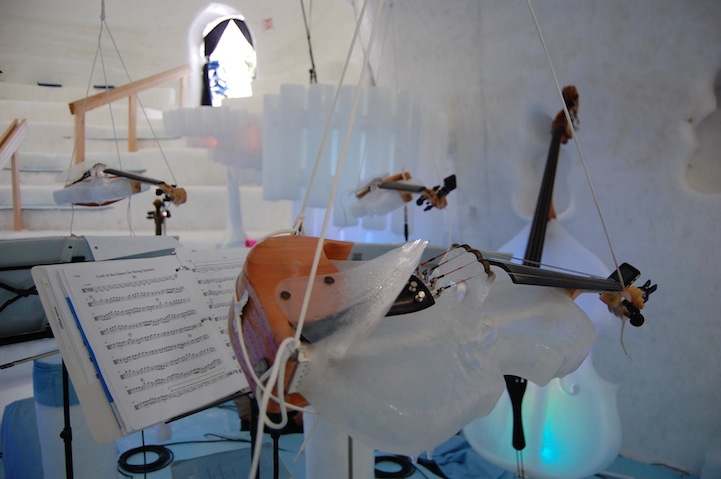
TimLinhartIceMusic1iceviolinHere is an amazing post I found – testimony to the endless and surprising creativity of musical people:

“Many artists these days are finding brilliant ways to create with ice. In the past, we’ve seen incredibly complex maze-like castles, ice hotels, and colorful ice forts. Yet in that long list of creations, we have yet to see musical instruments—until now. Located in Luleå, Sweden, Ice Music is a chilly new art form where musicians dress warmly in winter coats and hats and play instruments carved out of ice.

Paying great attention to the delicate details of each piece, Ice Music founder and ice artist Tim Linhart builds, by hand, instruments including violin, viola, cello, contrabass, banjo, mandolin, guitar, drum kit and xylophone. Due to the fragile nature of the sculpted objects, some of the instruments are secured to the ceiling with rope while the musicians play. This prevents any accidental damage if the instrument slips out of a musician’s hand during a performance.

The concerts take place in a wintery igloo with glowing lights cast all around. Within the enclosed, rounded space, the elegant music consumes the audience in an explosion of sound. The igloo maintains a constant temperature of 23ºF so it is recommended that any attendees wear at least three layers of clothing plus gloves and a hat. The beautiful sounds and the enchanting light show make up for the chilly temperatures, creating a wonderful atmosphere that celebrates what the website describes as the “winter spirit of Swedish Lapland.” Click on the link below to LISTEN to the music!

http://www.mymodernmet.com/profiles/blogs/tim-linhart-ice-music

The benefits of singing in the dark – together

Power of WordsOnce I was at a teacher’s conference with around 1000 people, about to sing the hymn WHEN I SURVEY THE WONDROUS CROSS, when the power went off. You might assume this was a disaster. Yet we all sang, even though there were no projected words to follow. And what a difference it made! It forced you to think more about what you were singing, of how the words connected logically together, from one thought to another, from verse to verse, to see the whole gospel message being presented. It was an amazing exercise of where things go “wrong” to the glory of God.

Why am I recalling this unusual event?

Today I read over at CHONGS WORSHIP that their church is intentionally singing without projected or written words (though not all the time). Here is their story, which I must say is quite inspiring!

“Some of you know that at our church we’ve started a year-long project of memorising 10 hymns of the faith. I spent a few weeks getting the music and the hymn books together in preparation. We started our first one (In Christ Alone) at the beginning of March, and on Sunday (while I was worship leading), we sang the entire hymn without the projected words. At the back of my mind I wondered what proportion of the church had been actively trying to memorise each hymn, or if it would be of much benefit.

So I was really encouraged to get this feedback from someone at church (the person has asked to remain anonymous):

“I have to admit – I used to not like In Christ Alone that much. It had become monotonous for me. Well, I would like to let you know that memorising the whole song has brought about a remarkable change. For the first time, I no longer heard the tune, but visually saw the whole song. I can’t quite articulate what I mean, but it was as if I saw the song only in its various parts with the first and last verse being the most obvious. But by memorising the song, I finally saw the whole song and would visualise the song in my mind when singing it.

It made a big difference to the way I sang the song too, whereby I no longer heard the tune, but saw the whole gospel story.

Look forward to memorising the next song.”

Reading between the lines, it sounds like they actually printed and gave out the song words to learn ahead of singing them in church. And I suppose that for visitors you would need to have some printed sheets available. But what an interesting challenge. I might try this! How much better would people “get” the gospel in song if they committed to learning it to sing together, to one another, for the good of one another, as the gathered Body of Christ.


A great way to search for songs

sg-ministries-bannerI’ve recently discovered a great search tool for Sovereign Grace songs at their website. Though I’ve been using Sovereign Grace for many years (as a source of good biblical, singable songs for church) I had not noticed the menu that allows you to search for songs by theme, tempo, key, genre and keyword. It’s especially useful if your church sings many of their songs. But even if you don’t it’s very easy to follow links to the songs, listen to samples and download the music for free. Sometimes even the suggestion of song titles can help point you in the direction of songs you do know (with similar titles).

Here is a link to the search page:
http://www.sovereigngracemusic.org/Songs

Make sure you scroll down when you get to the page. The top half is all about style, but the bottom section has an immense number of themes you can select in your search. I found it best to tick just one or two boxes at a time. (If you choose too many you will get results ‘zero’.)

Here is my shortlist of the most congregation-friendly Sovereign Grace songs:

1. Jesus Thankyou (Pat Sczebel)
2. O Great God (Bob Kauflin)
3. Let Your Kingdom Come (Bob Kauflin)
4. I will Glory in My Redeemer (Steve & Vikki Cook)
5. The Glories of Calvary (Steve & Vikki Cook)
6. O the Deep Deep Love of Jesus ((Bob Kauflin arrangement)
7. Unashamed (Mark Altrogge)
8. Show us Christ (Bob Kauflin & Doug Plank)
9. Through the Precious Blood (Mark Altrogge)
10. Hope has come (Stephen Altrogge)
11. How high and how wide (Mark Altrogge)