Don’t wait til you feel like singing

http://nickmorrowmusic.com/learning-to-jog/

If you’re the type of person who doesn’t like the current racket of Christian radio, or is embarrassed to invite your friends to church because they make fun of the music, I can relate. If you stand with your hand in your pockets during worship sets, or cross your arms, or pretend like you’re singing so that no one thinks you actually hate the music, or spend the entire worship set in the prayer room so that you don’t have to sing…I can relate. I’ve done all that since I was old enough to sing in church.

But about a year ago, something changed: I started jogging every morning.

Anyone who has ever made the resolution to work out in the morning knows that for the first 10-15 minutes of being awake, you want to stab yourself in the face for ever having the idea to wake up before the sun does, let alone work out. 

But five or ten minutes into my first run, something strange happened. My body adjusted to the shock, and the fresh air felt good on my lungs. The silence of the early morning brought a calming serenity, and my head cleared. Pretty quickly I realized that a morning workout was better than a strong cup of coffee. My energy levels drastically increased. I started eating healthier to supplement my work-out habit. Prayers and creative ideas would come to me during morning workouts. I became one of those crazy people who really like working out early in the morning. (For the record, I never started jogging in place or wearing bright spandex shorts.)

I realized that I had become pretty physically disciplined through exercise, but I was totally neglecting spiritual discipline in regards to corporate worship. “What would happen,” I thought, “if I treated corporate worship like I do my jogging routine. What if I was consistent whether I felt like it or not. What if every time I went to church, I made conscious decision that I was going to worship God, no matter what?”

The results were immediate. I started singing in church, every Sunday. No matter who was watching or listening, no matter how much I didn’t like the music. I reflected on the truth of the lyrics, and sang along. The first few times I did this, I noticed something strangely familiar. After about 10 minutes of singing my reservations wore off. My critical spirit disappeared, and I began to really open up and worship. I began to connect with God. My pretense slowly melted away, and I was left with gratitude and a sense of fulfillment. Just for having showed up and worshiped.

I also started leading worship more consistently for various church functions. No matter how I felt or what songs we were playing, I’ve committed to showing up, giving my best effort, and focusing my attention on God. Some of the times when I was most reluctant to show up and lead worship music have been the most engaging corporate worship experiences I’ve ever had.

I learned a solid principle when it comes to spiritual discipline: we should worship God because it is good for us, not because it makes us feel a certain way. We can’t wait around until we “feel” like worshiping. That may never happen. Worship is a spiritual discipline. We shouldn’t wait for a “reason to sing” any more than we should wait on a reason to pray or to love our neighbor. Like love within marriage, “worship” is a choice and an action, not a feeling. Sentimental emotions toward God will come and go, but the best weapon in the arsenal of Christian worship is resolution: a firm dedication to giving God the glory He is due, as often as possible. 

So next time you show up to a worship service and don’t feel like it, start with discipline. Force yourself to sing the gospel, and let me know how that goes for you…


 

Not the first generation to be addicted to bass

If you have ever wondered about the love of pipe organs in church music, and the intense love for ‘good old hymns’ which have been played on this grand instrument, the following research may help explain these strong connections:

Church organ Does organ music ‘instil religious feelings’?

According to an experiment people who experience a sense of spirituality in church may be reacting to the extreme bass sound produced by some organ pipes.

Many churches and cathedrals have organ pipes that are so long they emit infrasound which at a frequency lower than 20 Hertz is largely inaudible to the human ear. In a controlled experiment in which infrasound was pumped into a concert hall, UK scientists found they could instil strange feelings in the audience at will. These included an extreme sense of sorrow, coldness, anxiety and even shivers down the spine.

To test the impact of extreme bass notes from an organ pipe on an audience, researchers constructed a seven-metre-long “infrasonic cannon” which they placed at the back of the Purcell Room, a concert hall in South London. They then invited 750 people to report their feelings after listening to pieces of contemporary music intermittently laced with sound from the “cannon”.

The results showed that odd sensations in the audience increased by an average of 22% when the extreme bass was present. Some of the experiences were described as, ‘shivering on my wrist’, ‘an odd feeling in my stomach’, ‘increased heart rate’, ‘feeling very anxious’, and ‘a sudden memory loss’. This was an experiment done under controlled conditions and it shows infrasound does have an impact, and that has implications in a religious context and some of the unusual experiences people may be having in certain churches.”

Sarah Angliss, an engineer and composer in charge of the project, added: “Organ players have been adding infrasound to the mix for 500 years so maybe we’re not the first generation to be ‘addicted to bass’.”

The article “Organ music ‘instils religious feelings‘” was first reported by the BBC in 2003.

http://www.musicademy.com/2014/05/first-generation-addicted-bass/

Shake like you’re changed

Mercy Me has produced another fun song with Shake (video and lyrics below) but the message is most significant! God’s love is real and we can’t stay the same as we were before. If we are in Christ there will be a noticeable difference in our lives, our attitudes, our reactions, our level of contentment, thankfulness and joy. This is the confidence we have, that God is committed to his project of changing us to be more like His Son. “He who began a good work in you will perfect it until the day of Christ Jesus.” (Philippians 1:6)
(Another great song you might like to look up on this topic of change is an older one from Steven Curtis Chapman: The Change?)


I just can’t believe
Where my life was at
All that I know is that my heart was broken
And I don’t ever wanna go back

Ain’t no explanation
How I saw the light
He found me and set me free
And it brought me back to life

Blame it on the transformation
Changed down to the core
His love is real
And I can’t sit still
Cause my name’s not shamed no more

Great God Almighty, gonna change this
Great God Almighty, He gonna change me

You gotta shake, shake, shake
Like you’re changed, changed, changed
Brand new looks so good on you
So shake like you’ve been changed

Come on and shake, shake, shake like you changed
Shake, shake, shake like you changed

Maybe He came to you
When everything seemed fine
Or maybe your world was upside down and hit you right between the eyes
No matter when it happened
At 7 or 95
Move your feet ’cause you are free
And you’ve never been more alive

You gotta shake, shake, shake
Like you’re changed, changed, changed
Brand new looks so good on you
So shake like you’ve been changed

Come on and shake, shake, shake
Like you’re changed, changed, changed
Brand new looks so good on you
So shake like you’ve been changed

Come on and shake, shake, shake like you changed
Shake, shake, shake like you changed
Shake, shake

Great God Almighty, gonna change me
Great God Almighty, He gonna change me
Great God Almighty, gonna change me
Great God Almighty, He gonna change me

No matter when it happened
At 7 or 95
Move your feet, ’cause you are free
And you’ve never been more alive
You gotta shake, shake, shake
Like you’re changed, changed, changed
Brand new looks so good on you
So shake like you’ve been changed

The violent grace that saves and transforms

Welcome to all my new followers who have joined up in the last few weeks. (Thanks!) Great to have you along! Today I’m reposting something I wrote a year or two ago which explores the unexpected nature of God’s grace to us in Christ . . . and a great song:

“So ruthless, He loves us,
So reckless His embrace

To show relentless kindness,
To a hardened human race

The joy that was before Him
On the Man of Sorrows face,
And by His blood He bought a violent grace”

Many years ago some great ministry friends introduced me to a writer of very “deep” and challenging Christian songs, Michael Card. And I had almost forgotten him until the other day! Now why did I remember him, you ask? At the moment I am studying for an exam, a “big picture” Bible overview subject and I really need to get some memory verses and concepts stuck in my head, about how Christ fulfills all the OT law and prophets. So then I thought, Hebrews! Great book for explaining that. This was quickly followed by my recollection that Michael Card’s “Soul Anchor” album is the book of Hebrews in song (just about).

“A Violent Grace” (quoted above and below) is Track 1. So passionately does it remind us that God’s grace was no stroll in the park! Jesus was the high priest who sacrificed Himself. His love was (and is) ruthless! He showed the ultimate kindness and grace to the hardened human race that despised Him. Yet the joy set before Him held the Man of Sorrows to the Cross. And what was this joy? (Hebrews 12:2)
“Let us fix our eyes on Jesus, the author and perfecter of our faith, who for the joy set before him endured the cross, scorning its shame, and sat down at the right hand of the throne of God.” (NIV)
“We do this by keeping our eyes on Jesus, the champion who initiates and perfects our faith. Because of the joy awaiting him, he endured the cross, disregarding its shame. Now he is seated in the place of honor beside God’s throne.” (NLT)

What was this joy? I suppose there was the joy of sitting on the Throne. But moreso, we are His joy! We are His reward. His death saved a people. All those the Father gave Him can never be snatched from His hand by the power of His death and resurrection. (John 10:28-29) We are God’s chosen people, recipients of immense and violent grace.
No wonder the message of the Cross is so offensive to so many.
But for us being saved it is the power of God!

A Violent Grace (Michael Card, 2001)

A mural of memories moves by in a blur
His prayers all seem unanswered and unheard
His pleading petitions, his loud cries and tears
A last reprieve will simply not appear
So ruthless, He loves us, So reckless His embrace
To show relentless kindness, To a hardened human race
The joy that was before Him
On the Man of Sorrows face
And by His blood He bought a violent grace
Most willing of victims, And with His final breath
Destroyed the one who holds the power of death
The hate heaped upon Him, scorning all the shame
But all for love He died and overcame

In all of time no one had ever heard
And to the world the thought seemed so absurd
Beyond their wildest dreams no one could ever tell
Of a high priest who would sacrifice Himself

How worship murders our self-righteousness

20140428-162940.jpg
This is a post I have been meaning to share from Zac Hicks blog. It is a brilliant argument for persevering in the ‘gathered worship’ of God, even if we have issues with other people or with things not suiting our personal taste . . . Or even when it hurts! Of course ‘Worship’ is much greater than merely the Sunday gathering – it is a whole of life response of thankfulness for Christ’s saving work in us. But if you ever thought gathering together for corporate worship was not all that necessary, think again. God has some special work to do in us there.

“Many of us struggle to see gathered, corporate worship as helpful to our spiritual growth and vitality. And even if we find it helpful, we might lift an eyebrow at anyone who might say that it is instrumental or (dare say it) necessary. The irony for those of us who take lightly the weekly gathering of the people of God is that the spirit which rises up within us that says “I don’t really need this that much” is the very same spirit that worship intendeds to kill. If worship had a Twitter profile, its brief description would have to include “Murderer.” Worship was built by God to be a blood-thirsty attack dog with a keen appetite for something very specific in us. My favorite worship theologian, Jean-Jacques von Allmen, explains:

To declare that [worship] is optional, that it is not necessary to the continuation of God’s work of salvation, is to despise the source of grace. … By worship, if not by worship exclusively, the Church keeps open the wound which the resurrection of Christ and the outpouring of the Spirit have inflicted on the self-righteousness of the world, and in this way too the process of salvation is continued.*

God designed worship to slay our self-righteousness.

We human beings are “bruised by the Fall” (Philip Bliss) in such a way that we are hell-bent self-justification machines. We know no other pattern than to hide our weaknesses and manufacture pseudo-strengths. Our instinct, when accused of wrongdoing, is to deny and defend. Our default, when we do the right thing (no matter how much we say it’s “for the glory of God”) is to pat our spiritual selves on the back and believe that God is more happy with us because of what we’ve done. When the Holy Spirit applied the work of Christ to us, God the Father delivered the mortal wound to the beast of our self-righteousness. But the beast, while bleeding out this side of eternity, is still snarling, clawing, lashing, biting, and lunging. It is this disgusting creature that Paul is talking about in the latter half Romans 7, when he finally cries out, “Wretched man that I am!” This tormenter of souls rises weekly, daily, hourly within us.

But we’re not without hope. God has equipped a warrior to unsheath his gospel-sword every week to deliver another thrust into the thick flesh of our self-righteousness. That warrior is worship.

What von Allmen meant was that worship, rightly done, takes us on a needed weekly journey where we are reminded that we must come to the end of ourselves before we can fully see, appreciate, appropriate, and drink in the gospel. The beginning of worship should cast such a vision of God that we are blinded by His glory and leveled by His perfection. Worship gives us a picture of God’s holiness that is so high and so “other” that we are jarred out of any sense of being able to attain it. During the week, our amnesia begins to set in, and our eyes go blurry, such that the mountain of God’s glory starts looking like a gently-sloped hill. “I can climb that,” we think. (“I can avoid these pet sins for a few days.” “I can please God by being faithful in my devotions and Bible reading.” “I can be a good mom and not lose my temper.” “I can avoid those channels and sites.”) We think, “God must love me more this week, because I’ve been pretty good.”

And worship grabs us by the collar, slaps us in the face, and says, “Wake up, man!” It yells, “You’re far worse than you ever imagined, because, look, look at God!” And, once again, the scales fall off our eyes and the placid, green, hills-are-alive peak you thought you were looking at is really a hulking Himalayan cliff. And there it is: the moment of impossibility, where God’s gracious sword enters the beast yet again. Worship is God’s gracious murderer.

But God is in the business of killing precisely so He can make alive again. However, instead of reviving our self-righteousness, He gives us an alien organism–His very Self, Jesus Christ the Righteous One. This is the moment in worship where, after we have seen God’s glory and confessed our sin, God delivers the word, “There is therefore now no condemnation for those who are in Christ Jesus.” The gospel is good news, indeed.

Worship should be that epic…every week.”

*Jean-Jacques von Allmen, Worship: Its Theology and Practice (New York: Oxford, 1965), 115-116.

Check out this post for some more discussion about church and worship.
Blessings,
Ros

The Gospel changes everything, it’s changing me!

gospel changes everythingSharing today two simply beautiful songs which seek to share the message and the hope of the gospel of grace. They are from two different writers and bring two different perspectives. The first is about the changes Jesus has made both to history and the heart of the person he rescued. The second song focuses on the manner by which Jesus went to the Cross and took our shame, the perfect man showing perfect love to the unworthy (in just 4 lines).

The Gospel Changes Everything
(Meredith Andrews – from Worth it All)

Verse 1

The gospel changes ev’rything
The turning point in history
Even now it’s changing me from who I was
The story of my Savior calls
Me to the wonder of the cross
The gospel changes ev’rything
And it is changing me
(REPEAT)

Chorus 1

You saved my soul by Your blood
And I’m undone by Your great love
You made a way so I could come
Just as I am to You my God

Verse 2

Jesus changes ev’rything
There is no greater mystery
That God would come to rescue me
From who I was
The kindness of my Savior calls
Me to the wonder of His love
Jesus changes ev’rything
And He is changing me

You made a way so I could come
Just as I am to You my God
To You my God
Just as I am to You my God

The Gospel Song
(Sovereign Grace Music Bob Kauflin and Drew Jones – from Songs for the Cross-Centered Life)

Holy God in love became
Perfect man to bear my blame
On the cross He took my sin
By his death I live again
© 2002 Sovereign Grace Praise (BMI)/Sovereign Grace Worship (ASCAP).

Drawing back the curtains on Christ – the role of Song Leaders

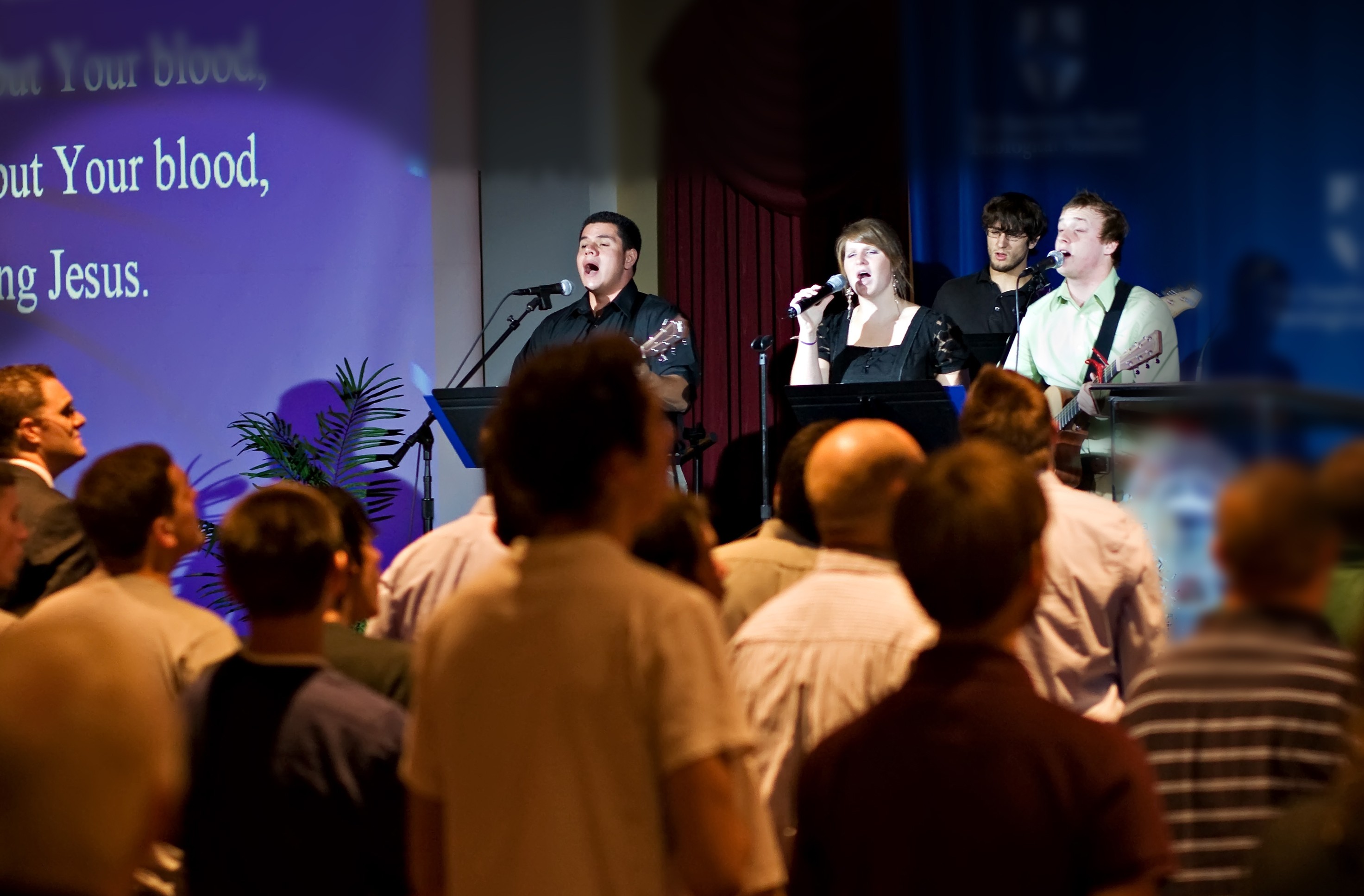
worship-band-chapel-sept-08A week ago I began a discussion on what makes a good song leader and promptly got distracted by the case for “song leaders” rather than worship leaders. (You can read it here: Why I prefer Song leader to Worship Leader.) Whether or not you are happy with my choice of terminology please come with me to consider 12 things that make an effective song leader.

Allow me to preface this list with a few comments. I’ve been working with song leaders and church bands (and serving as a song leader) for about 25 years now. I’ve seen the best and worst examples of what song leading can look like, and I’ve worked through plenty of issues. From what I’ve observed (in myself and others) I know that song leading can lead to all kinds of flattery, self-deceit and bad attitudes about your own importance and Christian life. (These must be confronted as soon as they raise their ugly heads, so be honest with someone you trust.)

To be an effective song leader requires discipline of both the mind and voice. It takes a balancing act of several important elements – especially humility, a desire to serve, vocal ability and confidence. And this does not just apply to when you are on stage! Song leaders must be genuine Christians who see their role as one of service, teaching and encouragement. They must think things through and prepare well. One of the most helpful and guiding pieces of advice I have found for song leaders was given by Charles Spurgeon! Though originally aimed at preachers, he said the challenge was to “draw back the curtains on Christ and get lost in the folds.” What a brilliant reminder that we are not up front for self-glorification, but for Christ!

Bob Kauflin defines the role of the song (‘corporate worship’) leader in a single sentence, like this:
“An effective corporate worship leader, aided and led by the Holy Spirit, skillfully combines biblical truth with music to magnify the worth of God and the redemptive work of Jesus Christ,
thereby motivating the gathered church to join him in proclaiming and cherishing the truth about God and seeking to live all of life for the glory of God.” (
http://www.worshipmatters.com/2006/03/01/what-does-a-worship-leader-do-part-16/)

That’s a pretty good definition, so I’m not going to tamper with it!

But for those wanting a longer list of things that make for effective song leading, here are my 12 points regarding the PERSPECTIVE, PRESENCE and PRACTICAL matters that can help song leaders serve more effectively:

Perspective:
1. See yourself as a “servant leader” who is doing a job to help others, to enable the gathered body of Christ to sing together, to praise God and encourage each other. You are serving the congregation with your voice, with clear and well-tuned singing that is easy to follow (just as you might serve with your hands in vacuuming the auditorium).
2. Keep serving in other ways. Don’t think song leading should be the full extent of your service to God. Be willing to take a break from it if it becomes all-consuming, or totally taking you from other gospel opportunities. (Vacuum the auditorium now and then! And speak the gospel to a friend!)
3. Don’t see yourself as the star of the show, and don’t take your musicians or sound crew for granted. Talk to them and express genuine appreciation! (On the other hand, don’t be blasé about your role. It is important to serve people in this role! And it is important for people to sing together to God and to encourage one another.)

Presence:
4. Your body language and facial expressions are pretty important, because they will be reflected to you by the congregation. If you are looking awkward or nervous or disinterested, they will feel that way too. A smile, particularly with your eyes, while you sing is something you can practice. Mirrors provide useful feedback. Stand evenly on your balls of feet, relax your knees, one foot slightly in front of the other. Keep your shoulders down and relaxed. Be a good example of an engaged and joyful participant in corporate praise to our great God!
5. Clothing choice is a question of not drawing attention to yourself and modesty. (Do I need to elaborate here? Is what your wearing causing some to focus their eyes on the shape of some particular part of you? Or not? Are you trying to show off your good taste and style, your brand names, or get attention? Consider modesty of dress and being less conspicuous than you might otherwise choose.)

Practicalities:
6. Be well practiced, so that you arent missing cues, or stuffing up words and doing things that will draw attention to yourself.
7. Be realistic about your abilities and keep tuning your instrument – get vocal lessons to help iron out any issues. Breathing technique is all important. Learn good technique! If you know you are forcing your voice to sound the way you do, seek some help or you could do damage!
8. Learn basic music theory so you can follow a melody and sing the right rhythms, or hold on to notes for the appropriate length. Learn how to follow repeats, first time endings, 2nd time endings, what ‘D.S al Coda means’ – and more.
9. Sing in a way that is easy to follow – avoiding “opera voice” or solo performer voice, with lots of trills and grace notes and vibrato. This makes it difficult for groups to follow. Use harmonies sparingly as these can get people off track when they are following you. Make sure the dominant voice is not the one doing the harmonies, and keep the harmony under the melody. (Descant lines can be especially distracting, unless it is a known part that many in the church know too – or one you want them to learn.)
10. Hold the microphone close enough so that the sound technician can get good levels (about 2 inches/5cm).  It’s easy to turn you down if too loud, but no way to boost a weak/distant signal. Pull it further away on high notes so you don’t blast the congregation!  If microphones are really new to you, get some time along in your church auditorium and sing, with foldback, to get used to sound of your own voice – because sometimes it can frighten you into singing more quietly (not great for a song leader to do!)
11. Give clear instructions if you are leading the band (both during practice and in the service). Use cues to keep everyone together. Make sure the structure of the song is clear for everyone. Listen to the members of the band, what they are saying in practice, as well as what they are playing.
12. Be on time for band practices – and organise them well ahead of time if that is something you as the singer has to do. Sing the song enough times on your own so that the melody is fully entrenched in your mind. Know the structure of the song as it will be sung at church, which may differ from the recorded version. Be willing to pray for your team and with your team, for their role as musicians in the gathering.

Being a song leader is a great privilege and it can be a great blessing to others as you help Christ’s visible body gather together in songs of praise to our great God. If you are a song leader, keep working at it! I hope these points have been helpful!

You may also like these earlier posts on similar topics:

Sharing the rich, indwelling word (Colossians 3:16)

How to encourage your music team even when you’re not the leader

Working for those moments of Joy

You are a Theologian

My Congregation Barely Sings; How Can I Help?

This article from 9Marks singing congreghas so many great points about helping your congregation sing better together, especially #7 and #16. I think I’m ready to start up a church choir again next year!

My Congregation Barely Sings; How Can I Help?


Why I prefer “song leader” to “worship leader”

grow musicSo I sat down to compile my thoughts in answer to a question someone asked on Facebook: “What makes a good church song leader?”  What should their attitudes and actions be? I was going to make a useful list to share, but soon realised that first I’d better explain why I’m talking about “song leaders” and not “worship leaders”. The latter term is probably the most widely used across the globe to describe those people who sing upfront in church. But is it the most helpful title? I think “song leader” is much better and my reasoning could be pretty significant in shaping the thinking and actions of any “song” or “worship” leader.

For me the term “song leader” is not something new. It has been part of our church culture here* for more than a few decades. Back in the 90’s when (for us) it was a new thing, and a big deal, to have singers upfront leading the congregation, there were a few things impressed on me by our pastor. One was our title: songleader!  Our job was to lead the singing, to help people to praise God together. There were many new songs, and much more syncopation than most hymns demanded. It was easier for a congregation to learn songs and sing together in time if there was a leader. But these singers weren’t leading the worship. Worship is about more than just singing, as this comment from Don Carson explains:

“I would abolish forever the notion of “worship leader”. If you want to have a “song leader” who leads part of the worship, just as the preacher leads part of the worship, that’s fine. But to call the person a “worship leader” takes away the idea that by preaching, teaching, listening to and devouring the Word of God, and applying it to our lives, we are somehow not worshipping God.”
(Don Carson – from Tony Payne interview with D.A.Carson, The Briefing, Issue 232, Matthias Media, 2000)

“Worship” is all of life, 24×7. To see only the singing, or even just the Sunday gathering, as “worship” is to deny what Romans 12:1 calls us to do in giving our whole lives to Christ: “Therefore, I urge you, brothers, in view of God’s mercy, to offer your bodies as living sacrifices, holy and pleasing to God-this is your spiritual act of worship.” Cleaning the toilets, leading a bible study, going to work, encouraging others, praying to God privately, serving coffee, serving your family, controlling your anger – all these are part of our worship of our Lord and Saviour Jesus Christ.

“There can only be one call to worship, and this comes at conversion, when in complete repentance we admit to worshiping falsely, trapped by the inversion and enslaved to false gods before whom we have been dying sacrifices. This call to true worship comes but once, not every Sunday, in spite of the repeated calls to worship that begin most liturgies and orders of worship. These should not be labeled calls to worship but calls to continuation of worship. We do not go to church to worship, but, already at worship, we join our brothers and sisters in continuing those actions that should have been going on – privately, [as families], or even corporately – all week long.” (Harold Best, Music through the eyes of Faith, p.147)

Going further, you could say that Jesus is the only true worship leader. He is the only mediator between God and man, the perfect man who sings God’s praise in our midst. (1 Tim. 2:5; Heb. 2:12) He is our high priest who has offered the perfect sacrifice of Himself to insure our entrance into the holy places. (Heb. 10:19-22)

This is what Jesus is doing now and always in the throne room of heaven, while for us daily life goes on, and Sundays roll by only every seven days. But on those Sundays the “ultimate worship Leader in the gathering, who enables us to know the Father – He tells us the Father’s name – and leader of our song of adoration, is Christ Himself! We aren’t the only ones singing. The Church sings to a singing God. “The Lord your God is in your midst, a mighty one who will save; he will rejoice over you with gladness; he will quiet you by his love; he will exult over you with loud singing.” (Zephaniah 3:17)
(from “Doxology & Theology: How the Gospel forms the Worship leader” by Matt Boswell, 2013)

Jesus is in the presence of the Father and we are in Him. We are in His presence all the time, wrapped up in Christ, united with Him. We don’t need a worship leader to lead us into his presence, or into the feeling of being worshipful. Christ is with us, we are with Him.

“It’s only when we understand his (Christ’s) presence in the church as being the fulfillment of God’s promise in Zephaniah 3:17 to “quiet you with his love” and “rejoice over you with singing” that a crucial aspect of our salvation comes into perspective. Jesus didn’t coldly settle accounts for us. He doesn’t bark us into improving ourselves. He unites us to himself in the glorious communion he has enjoyed for eternity with his heavenly Father. He resides within us to heal the broken places and reflesh our cauterized hearts. He sings us into a new mode of existence.”
(from “With One voice: Discovering Christ’s Song in our Worship” by Reggie Kidd, 2005).

Couple all this with the fact that we collectively are the temple of living stones, the place where the praises of God resound, and you may see why attaching the word ‘worship’ to such a narrow slice of our Christian lives (singing together on Sunday) may not be the best idea to perpetuate. There are so many great reasons to sing together as the body of Christ, as I have written about before (see https://sevennotesofgrace.com/2013/05/07/sharing-the-rich-indwelling-word-colossians-316/). Promise I will get back to that list about song leaders soon, but at least you may now understand my choice of words.

* My church is part of the Presbyterian Church of Queensland, but you will find the term ‘song leader’ commonly used with Sydney Anglicans and some other denominations across Australia. I’d be interested to know if the term is used in the USA (where I know the majority of my lovely readers are from) so please feel free to share your thoughts!

They will know us By Our Love

HEART CLOTHESLINEThis week I read a wonderful post entitled “Got Love?” from In My Father’s House. It was about the importance of love for others, a way to know if we actually know God, that we belong to Him, that we are his children. Here is a sample:

“Though I speak with the tongues of men and of angels,
but have not love, I have become sounding brass or a clanging cymbal.
And though I have the gift of prophecy,
and understand all mysteries and all knowledge,
and though I have all faith, so that I could remove mountains,
but have not love, I am nothing.
  And though I bestow all my goods to feed the poor,
and though I give my body to be burned,
but have not love, it profits me nothing.” (1 Cor.13:1-3)

Are you a “Spirit-filled person? Going to a vibrant Spirit-filled church? The sick are getting healed, demons cast out? That’s great. Do you have prophecies, glory clouds, visions of the Third Heaven? Awesome. Do you think having and defending correct doctrine is important? Cool. Are you all about social justice? Feeding the poor? Making the world “a better place?” That’s wonderful. Are you willing to die for your faith? Admirable.

But Without God’s love,  spiritual power can blow people up. Without God’s love, all our biblical knowledge and defending the “truth” becomes the source of combative spiritual pride and carnal divisiveness. Without God’s love, social justice turns into nothing more than self-righteous works to make us feel significant, or worse, ease our guilt. Without God’s love, our martyrdom is nothing more than religious zeal. Without God’s unfailing love, we will fail.

How do we measure spiritual maturity?

What if spiritual maturity was not measured by our Bible knowledge, our training, our spiritual gifts, our willingness to serve, our zeal, our charisma, but was totally based on our ability to receive God’s love and give it away?

What if it was based on how well we’ve been able to enlarge our heart (open the “faucet” of our heart) to receive more of this unending ocean of God’s love living inside of us right now? Do you understand that if we don’t know how to open our heart to receive His unconditional love, and give it away unconditionally, we can’t be trusted? . . . ”

It’s certainly a challenging post and worth reading all of it: http://melwild.wordpress.com/2014/03/31/got-love/
It reminded me of the challenge of a song we use at church, BY OUR LOVE by Christy Nockels.
You can listen and read through the lyrics below. I trust you will find it helpful. Here is the chorus:

The time is now, Come Church arise
Love with His hands, See with His eyes
Bind it around you, Let it never leave you,
And they will know us by our love.

BY OUR LOVE

Brothers, let us come together
Walking in the Spirit, there’s much to be done
We will come reaching, out from our comforts
And they will know us by our love

Sisters, we were made for kindness
We can pierce the darkness as He shines through us
We will come reaching, with a song of healing
And they will know us by our love!

The time is now, Come Church arise
Love with His hands, See with His eyes
Bind it around you, Let it never leave you,
And they will know us by our love.

Children, You are hope for justice
Stand firm in the Truth now, set your hearts above
You will be reaching, long after we’re gone
And they will know you by your love!

Song Number 5489329 Author Christy Nockels Copyright 2009 worshiptogether.com Songs

You can look up sheet music here: http://www.worshiptogether.com/songs/songdetail.aspx?iid=1052518