This Christmas – Idea of North

This ChristmasI somehow missed a great Christmas album two years ago. You may have done the same. The album is ‘This Christmas’ by the Idea of North. You can read the review below, or simply go and listen online. I’m sure you will enjoy it.

“If you want your Christmas to groove along with some stunning arrangements, then The Idea of North’s latest recording is an absolutely must.

This ensemble, known for its contemporary flavour and mellow vocal blend, has captured the joy of the season with a selection of traditional carols. American Christmas-themed songs (Have Yourself a Merry Christmas, The Christmas Song / Chestnuts Roasting, and I’ll Be Home for Christmas), also features along with some more modern numbers (Angel, Candlelight Carol), and are all mixed together with sophisticated jazz harmonies and some wonderfully rich orchestrations.

James Morrison’s inclusion (playing trombone) in Mary’s Boy Child lends an improvisatory edge to the setting, whilst the reprise of this song as a band mix has a more Latin feel. The title track, This Christmas, has an all-encompassing Christmas appeal (and some additional fine solo guitar work).

The inspirational song Angel (In the Arms of the Angel) has seen performances from all over the world, including from the song-writer Sarah McLachlan, Josh Groban, Westlife, Angelis, The King’s Singers, and Katherine Jenkins, not to mention this Australian version, which is as powerful as those famous renderings before it.

Australia’s most recognised contribution to the Australian carol tradition is not forgotten either, with William James’s The Silver Stars are in the Sky, which shows the group’s ability to find new harmonic gestures throughout the lullaby-like verses.

The Christmas Medley seamlessly merges rhythmic responses of Once in Royal David’s City and Hark The Herald Angels Sing, with a more straight forward God Rest Ye Merry Gentlemen. Poverty is hymn-like in its four-part traditional harmonies, giving a respite to the rhythmically energised arrangements that occupy the bulk of this recording.

Poignancy and simplicity is found in the Thad Jones signature tune, A Child is Born (complete with trumpet doubling the melody).

This CD should get a real workout this Christmas season, and become a favourite for many. Beautifully sung and meticulously recorded, The Idea of North has produced another gem in this recording, where every track has real musical magic.”

http://www.barrywalmsley.com.au/2012/12/this-christmas-the-idea-of-north/

Mary did you know?

Just watch this!

http://fascinately.com/feel-good/2014/11/incredible-performance-of-mary-did-you-know-will-get-you-in-christmas-spirit/

The Perfect Gift – lovely Christmas clip!

Love this new Christmas song I’ve just found by JJ Heller – THE PERFECT GIFT. It was released two days ago. Guess what video clip we will be playing at our carols this year?
He was the perfect gift, Oh..
He came to bring us peace, Oh..
Holy Child, our King!

Here are the lyrics:

THE PERFECT GIFT

Have we forgotten, with all the rushing around,

With all the shops and the cards, and the chaos in this town?

Have we forgotten we need some sorting out?

Clear our minds we will find what the story is all about. oh…

CHORUS:

He was the perfect gift, Oh..

He came to bring us peace, Oh..

Holy Child, our King!

Do we remember the wonders of his love?

Will our voices join with the chorus up above?

Do we remember how on that silent night

There was a baby who came to recall us back to life? Oh..

CHORUS

Fill our hearts with wonder

Turn our winter into summer

Fill our lungs with laughter, peace and joy, peace and joy

The perfect gift, bringing peace….Oh

He was the perfect gift, Oh..

He came to bring us peace, Oh..

Holy Child, our King!

Holy Child, our King!

And in case you’ve not encountered JJ Heller before, he is one of her older and most charming songs: THE BOAT SONG

I’ve been trying to buy one of her albums on iTunes but apparently Taylor Swift has blown up iTunes! “Try again later.”


Just in time for Christmas!

Joey Hoelscher's avatarJoey Hoelscher Music

sleep jesusJust in time for Christmas, my new arrangement of “Sleep, Jesus, Sleep” is now available through Heart Publications! This tender Christmas lullaby is a beautiful addition to your church’s Christmas repertoire. The simple SATB voicing can be learned quickly, and the included parts for violin, bass, and guitar/harp add layers and depth to the piano accompaniment. The arrangement works well with choir as well as smaller groups. You can purchase the arrangement at Heart Publications’ website here, and see a score sample here.

Also, All Saints’ Church (Northampton, UK) is accepting pre-orders for their latest recording, Be Merry!, which will be released November 1. This recording includes my Still, Still, Still and is the first professional recording of the piece. I’m excited to hear it! This CD also includes settings by Forrest, Courtney, and Anglea, among others, and you can pre-order here.

View original post

New Christmas album from Sovereign Grace!

Sharing an exciting announcement from Sovereign Grace: A new Christmas album, Prepare Him Room: Celebrating the Birth of Jesus in Song, will be released on September 1. Here are the details from Bob Kauflin:

PHR Album Art bg_Fotor“We released our first Christmas album, Savior: Celebrating the Mystery of God Become Man, in 2006. A few years ago I started thinking we should do another one. After all, we can never have too many songs that help us reflect on and celebrate the wonder of Jesus becoming Emmanuel, God with us.

So I was intrigued last fall when my good friend, Marty Machowski, asked if Sovereign Grace Music would be interested in producing a Christmas album to accompany an Advent curriculum he had written. After a few conversations with Marty and his publisher, New Growth Press, we decided it would be a great opportunity. The result was our next album, Prepare Him Room: Celebrating the Birth of Jesus in Song, due out Sept. 1. While the album will stand on its own, thirteen of the fourteen songs on it correspond with lessons from Marty’s devotional.

Writing songs to specific passages of Scripture in each lesson caused us to explore some new territory for Christmas songs. While not all of the songs ended up being congregational, I’m pretty excited about what we ended up with.

Below is a preview version of a song I co-wrote with Jason Hansen, a pastor in the Sovereign Grace Church in Gilbert, AZ. We started it at a songwriter retreat in January and finished it over many long distance sessions using FaceTime and Google Docs.

The song is called “Who Would Have Dreamed” and is based on Micah 5:1-2.

Now muster your troops, O daughter of troops; siege is laid against us;
with a rod they strike the judge of Israel on the cheek.
But you, O Bethlehem Ephrathah, who are too little to be among the clans of Judah,
from you shall come forth for me one who is to be ruler in Israel,
whose coming forth is from of old, from ancient days.

We tried to capture the wonder that God would choose unlikely Bethlehem as the birthplace for the Messiah, and the greater wonder that the Son of God himself would be born as an infant. Here are the lyrics:

On a starlit hillside, shepherds watched their sheep
Slowly, David’s city drifted off to sleep
But to this little town of no great renown
The Lord had a promise to keep

Prophets had foretold it, a mighty King would come
Long-awaited Ruler, God’s anointed one
But the Sovereign of all looked helpless and small
As God gave the world His own Son

And who would have dreamed or ever foreseen
That we could hold God in our hands?
The Giver of Life is born in the night
Revealing God’s glorious plan
To save the world

Wondrous gift of heaven: the Father sends the Son
Planned from time eternal, moved by holy love
He will carry our curse and death He’ll reverse
So we can be daughters and sons

And here’s the preview (above). I’m delighted that it’s being sung by my youngest daughter, McKenzie.”
(By Bob Kauflin)

The Story behind the most famous Christmas carol

joy to the wJoy To The World (by Robert D. Kalis)

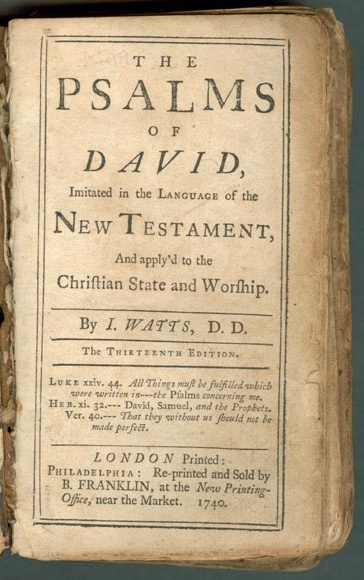
Our Christmas season would hardly seem complete without the singing of Joy to the World, the most joyous of the carols. Yet Isaac Watts, its author, never intended it to be a Christmas carol at all. Rather, it was a part of his Psalms of David Imitated, published in 1719, which contained paraphrases of many of the Psalms in New Testament language.

The story of the hymn, Joy to the World, is the story of the author, Isaac Watts (1675-1748), who is universally acknowledged as “The Father of English Hymnody”. He has earned the title, not because he was first to write English hymns, but because he gave impetus to hymnody and established its place in the worship of the English church.

For over one hundred years, congregational singing had been strictly limited to the Psalms of the Old Testament in poetic form. Many of these rhymed Psalms were so unnatural that Samuel Wesley, father of the famous brothers Charles and John, called them “scandalous doggerel,” and his opinion was shared by many.

The birth of Isaac Watts to a dissenting deacon and the daughter of a Huguenot refugee was followed by fourteen years of persecution and hardships for the entire family. Perhaps this suffering was responsible for Isaac Watts’ ill health, for he grew only to a height of just over five feet and was weak and sickly all his life.

Though weak in body, the boy was strong in mind and spirit and early in life showed promise of poetic capability. After one Sunday morning service, Isaac, then fifteen years old, complained of the atrocious worship in song. One of the deacons challenged him: “Give us something better, young man.” His answer was ready for the evening service and was sung that night in the Independents’ meeting, Southampton, where his father was pastor. Perhaps a hint of things to come was contained in this first verse of Isaac Watts:

Behold the glories of the Lamb Amidst His Father’s throne; Prepare new honors for His name, And songs before unknown.

When Isaac began to preach several years later, his congregation sang the songs that seemed to flow from his pen like a river. In 1707, the accumulation of eighteen years was published under the title, Hymns and Spiritual Songs. The river continued to flow, and in 1719 his “Psalms of David Imitated” was published, not as a new paraphrase of David, but as an imitation of him in New Testament language. It was as though the Psalms burst forth in their fulfillment at last.

watts-sacred_poemsJoy to the World is the “imitation” of the last half of Psalm 98. The author transformed the old Jewish psalm of praise for some historic deliverance into a Christian song of rejoicing for the salvation of God that began to be manifested when the Babe of Bethlehem came “to make his blessing flow far as the curse is found.” This is one of the most joyous hymns in all Christendom because it makes so real what Christ’s birth means to all mankind.

The tune to which the hymn is sung is attributed to George Frederick Handel and bears resemblance to phrases of his great oratorio, Messiah. Notably the first four tones match the beginning of the chorus, “Lift Up Your Heads.”

As we rejoice in the coming to earth of our Savior, we may also be glad for the veritable river of hymns that flowed from the pen of Isaac Watts. His name stands at the head of our most majestic hymns, notably, “When I Survey The Wondrous Cross.” In many hymnals more hymns of Isaac Watts are to be found than of any other single author.

http://www.joy-bringer-ministries.org/hymn1.html

You may also enjoy:
The Christmas Scale
The lost music of the Psalms

More carols with the Piano Guys – and the cellos

The Carol of the Bells

 O Come, O Come Emmanuel

And here are the immensely rich lyrics of this hymn, for your advent contemplation! I’ve included all the verses (though I’m sure I’ve only ever sung 4 or 5 of the 8 included here). Scroll down to the end of the lyrics for more information about the origins and themes of this carols (which is immensely under-rated I fear).

O come, O come, Emmanuel,
And ransom captive Israel,
That mourns in lonely exile here
Until the Son of God appear.

Refrain: Rejoice! Rejoice! Emmanuel shall come to thee, O Israel.

O come, Thou Wisdom from on high,
Who orderest all things mightily;
To us the path of knowledge show,
And teach us in her ways to go.

Refrain

O come, Thou Rod of Jesse, free
Thine own from Satan’s tyranny;
From depths of hell Thy people save,
And give them victory over the grave.

Refrain

O come, Thou Day-spring, come and cheer
Our spirits by Thine advent here;
Disperse the gloomy clouds of night,
And death’s dark shadows put to flight.

Refrain

O come, Thou Key of David, come,
And open wide our heavenly home;
Make safe the way that leads on high,
And close the path to misery.

Refrain

O come, O come, great Lord of might,
Who to Thy tribes on Sinai’s height
In ancient times once gave the law
In cloud and majesty and awe.

Refrain

O come, Thou Root of Jesse’s tree,
An ensign of Thy people be;
Before Thee rulers silent fall;
All peoples on Thy mercy call.

Refrain

O come, Desire of nations, bind
In one the hearts of all mankind;
Bid Thou our sad divisions cease,
And be Thyself our King of Peace.

Refrain

NB: The Words were com­bined from var­i­ous an­ti­phons by an un­known au­thor, pos­si­bly in the 12th Cen­tu­ry (Ve­ni, ve­ni Eman­u­el); trans­lat­ed from La­tin to Eng­lish by John M. Neale, Med­iae­val Hymns, 1851. Neale’s orig­in­al trans­l­a­tion be­gan, “Draw nigh, draw nigh, Em­man­u­el.”

Music: Veni Em­man­u­el, from a 15th Cen­tu­ry pro­cess­ion­al of French Fran­cis­can nuns (the set­ting for the fu­ner­al hymn Libera me); ar­ranged by Thom­as Hel­more in the Hymn­al Not­ed, Part II (Lon­don: 1856) (MI­DI, score).

The lyrics echo a num­ber of pro­phet­ic themes. The ti­tle comes from the well known Isai­ah 7:14: “Be­hold, a vir­gin shall con­ceive, and bear a son, and shall call his name Im­man­u­el.” Im­man­u­el is He­brew for “God with us.” The “Rod of Jesse” refers to Isai­ah 11:1: “There shall come forth a rod out of the stem of Jes­se”; Jesse was the fa­ther of Da­vid, se­cond king of Is­ra­el. “Day-Spring” comes from Za­cha­ri­as, fa­ther of John the Bap­tist, in Luke 1:78: “The day­spring from on high has vis­it­ed us.” “Thou Key of Da­vid” is in Isai­ah 22:22: “The key of the house of Da­vid will I lay up­on his shoul­der,” which in turn re­fers to Isai­ah 9:6 “The gov­ern­ment shall be up­on His shoul­der.”

Christmas celebrates Christ’s victory

This post comes courtesy of The Blazing Center, and is brilliant explanation of what we are celebrating! Merry Christmas!

Jesus is for people who hate Christmas

christmasSometimes I think my heart is two times too small.

Don’t get me wrong, I really do like Christmas. I like getting together with my family to open presents and sit around the tree and watch reruns of Seinfeld and The Andy Griffith Show. I’m happy when it snows on Christmas. I like seeing tastefully decorated houses. Heck, I even like some Christmas music (don’t get me started on “Mary Did You Know?”).

But Christmas often brings out the gloomy side of me as well. I’m reminded of one of my favorite families who, because of cancer, no longer has a dad around the house. I’m reminded of some of my favorite people who, after many years of patiently waiting, are still single. I’m reminded of my sister, who has been dealing with migraine headaches for years without much relief. I’m reminded of my own ongoing battles with intense physical anxiety.

After the tree is down and the wrapping paper put away and the music silenced and the egg nog polished off, all the problems still remain. I think one of the reasons we cling so tightly to Christmas is that it helps us forget about our problems for awhile. For a few, brief days, everything seems as it should be. We long for a white Christmas because the snow covers up all the mud and muck.

My propensity toward Christmas gloom is one of the reasons I am so grateful for Jesus. Not in a “Jesus is the reason for the season,” kind of way, but in a, “Jesus is a holy warrior,” kind of way.

This morning I was reading in Matthew 8-9. In these chapters Jesus cleanses a leper, heals a centurion’s servant, heals Peter’s mother-in-law, calms a storm, drives demons out of two raving madmen, heals a paralytic, raises a girl from the dead, heals two blind men, and heals a man who is unable to speak. In the comments section of The Gospel Transformation Bible it says:

Wherever Jesus goes he brings the reign of God, and where God reigns, the invisible powers of the universe in rebellion against him are banished and left powerless to do anyone ultimate harm…Since believers are united with Christ, they share Christ’s victory over evil.

That, ladies and gentlemen, is the true meaning of Christmas. Wherever Jesus goes he brings the reign of God! Christmas is ultimately about the kingdom of God coming to this sad, broken, sin-marred world. Christmas is ultimately about a baby who would grow into a mighty warrior – a warrior who would crush Satan, undo sadness, defeat death, and ensure that it would be always Christmas and never winter.

Listen closely. For just a moment, tune out the Christmas music and television commercials. Do you hear that slow creaking and cracking noise? It’s the sound of Satan’s skull being slowly crushed underneath the foot of our conquering Savior. Now we suffer. Now we experience cancer and migraines and anxiety and singleness and sadness and loneliness and poverty. Now we are afflicted by sin and Satan and our flesh. But not always.

Ultimately, Christmas should give the most hope to those who hate Christmas. Things won’t always be this way. As it says in 1 John 3:8, “The reason the Son of God appeared was to destroy the works of the devil.” Those are such sweet words. Christmas is a celebration of war! Jesus himself has declared open season on Satan. He came to destroy all the works of the evil one. He came to wipe away tears and heal broken bodies and lift up despondent hearts and drive out fear and destroy loneliness.

If you’re feeling gloomy, take heart. Jesus is for those who hate Christmas.

The beauty of His humble birth

away-in-a-manger-king-size-bed-jesus“Some people tell us that we need to have beautiful homes in order to draw people to Christ. They say that our beautiful home is analogous to God’s beauty…they obviously have forgotten the manger, a squalling infant covered in amniotic fluid and blood, wrapped in coarse rags, and the bleeding and bruised naked man hanging on a cross. It’s his beauty, not our homemaking skills that draws a heart to love and worship.”

Elyse Fitzpatrick

Bethlehem’s Supernatural Star

Star-over-Bethlehem“Where is He who has been born King of the Jews? For we saw His star in the east and have come to worship Him.” (Matthew 2:2) 

John Piper writes: “Over and over the Bible baffles our curiosity about just how certain things happened. How did this “star” get the magi from the east to Jerusalem?

It does not say that it led them or went before them. It only says they saw a star in the east (verse 2), and came to Jerusalem. And how did that star go before them in the little five-mile walk from Jerusalem to Bethlehem as verse 9 says it did? And how did a star stand “over the place where the Child was”?

The answer is: We do not know. There are numerous efforts to explain it in terms of conjunctions of planets or comets or supernovas or miraculous lights. We just don’t know. And I want to exhort you not to become preoccupied with developing theories that are only tentative in the end and have very little spiritual significance.

I risk a generalization to warn you: People who are exercised and preoccupied with such things as how the star worked and how the Red Sea split and how the manna fell and how Jonah survived the fish and how the moon turns to blood are generally people who have what I call a mentality for the marginal. You do not see in them a deep cherishing of the great central things of the gospel — the holiness of God, the ugliness of sin, the helplessness of man, the death of Christ, justification by faith alone, the sanctifying work of the Spirit, the glory of Christ’s return and the final judgment. They always seem to be taking you down a sidetrack with a new article or book. There is little centered rejoicing.

But what is plain concerning this matter of the star is that it is doing something that it cannot do on its own: it is guiding magi to the Son of God to worship him.

There is only one Person in biblical thinking that can be behind that intentionality in the stars — God himself.

So the lesson is plain: God is guiding foreigners to Christ to worship him. And he is doing it by exerting global — probably even universal — influence and power to get it done.

Luke shows God influencing the entire Roman Empire so that the census comes at the exact time to get a virgin to Bethlehem to fulfill prophecy with her delivery. Matthew shows God influencing the stars in the sky to get foreign magi to Bethlehem so that they can worship him.

This is God’s design. He did it then. He is still doing it now. His aim is that the nations — all the nations (Matthew 24:14) — worship his Son.

This is God’s will for everybody in your office at work, and in your neighborhood and in your home. As John 4:23 says, “Such the Father seeks to worship him.”

At the beginning of Matthew we still have a “come-see” pattern. But at the end the pattern is “go-tell.” The magi came and saw. We are to go and tell.

But what is not different is that the purpose of God is the ingathering of the nations to worship his Son. The magnifying of Christ in the white-hot worship of all nations is the reason the world exists.”

(http://solidjoys.desiringgod.org/en/devotionals/bethlehem-s-supernatural-star)

You may also enjoy:
The waterfall, river and reservoir of God’s Grace