How worship murders our self-righteousness

20140428-162940.jpg
This is a post I have been meaning to share from Zac Hicks blog. It is a brilliant argument for persevering in the ‘gathered worship’ of God, even if we have issues with other people or with things not suiting our personal taste . . . Or even when it hurts! Of course ‘Worship’ is much greater than merely the Sunday gathering – it is a whole of life response of thankfulness for Christ’s saving work in us. But if you ever thought gathering together for corporate worship was not all that necessary, think again. God has some special work to do in us there.

“Many of us struggle to see gathered, corporate worship as helpful to our spiritual growth and vitality. And even if we find it helpful, we might lift an eyebrow at anyone who might say that it is instrumental or (dare say it) necessary. The irony for those of us who take lightly the weekly gathering of the people of God is that the spirit which rises up within us that says “I don’t really need this that much” is the very same spirit that worship intendeds to kill. If worship had a Twitter profile, its brief description would have to include “Murderer.” Worship was built by God to be a blood-thirsty attack dog with a keen appetite for something very specific in us. My favorite worship theologian, Jean-Jacques von Allmen, explains:

To declare that [worship] is optional, that it is not necessary to the continuation of God’s work of salvation, is to despise the source of grace. … By worship, if not by worship exclusively, the Church keeps open the wound which the resurrection of Christ and the outpouring of the Spirit have inflicted on the self-righteousness of the world, and in this way too the process of salvation is continued.*

God designed worship to slay our self-righteousness.

We human beings are “bruised by the Fall” (Philip Bliss) in such a way that we are hell-bent self-justification machines. We know no other pattern than to hide our weaknesses and manufacture pseudo-strengths. Our instinct, when accused of wrongdoing, is to deny and defend. Our default, when we do the right thing (no matter how much we say it’s “for the glory of God”) is to pat our spiritual selves on the back and believe that God is more happy with us because of what we’ve done. When the Holy Spirit applied the work of Christ to us, God the Father delivered the mortal wound to the beast of our self-righteousness. But the beast, while bleeding out this side of eternity, is still snarling, clawing, lashing, biting, and lunging. It is this disgusting creature that Paul is talking about in the latter half Romans 7, when he finally cries out, “Wretched man that I am!” This tormenter of souls rises weekly, daily, hourly within us.

But we’re not without hope. God has equipped a warrior to unsheath his gospel-sword every week to deliver another thrust into the thick flesh of our self-righteousness. That warrior is worship.

What von Allmen meant was that worship, rightly done, takes us on a needed weekly journey where we are reminded that we must come to the end of ourselves before we can fully see, appreciate, appropriate, and drink in the gospel. The beginning of worship should cast such a vision of God that we are blinded by His glory and leveled by His perfection. Worship gives us a picture of God’s holiness that is so high and so “other” that we are jarred out of any sense of being able to attain it. During the week, our amnesia begins to set in, and our eyes go blurry, such that the mountain of God’s glory starts looking like a gently-sloped hill. “I can climb that,” we think. (“I can avoid these pet sins for a few days.” “I can please God by being faithful in my devotions and Bible reading.” “I can be a good mom and not lose my temper.” “I can avoid those channels and sites.”) We think, “God must love me more this week, because I’ve been pretty good.”

And worship grabs us by the collar, slaps us in the face, and says, “Wake up, man!” It yells, “You’re far worse than you ever imagined, because, look, look at God!” And, once again, the scales fall off our eyes and the placid, green, hills-are-alive peak you thought you were looking at is really a hulking Himalayan cliff. And there it is: the moment of impossibility, where God’s gracious sword enters the beast yet again. Worship is God’s gracious murderer.

But God is in the business of killing precisely so He can make alive again. However, instead of reviving our self-righteousness, He gives us an alien organism–His very Self, Jesus Christ the Righteous One. This is the moment in worship where, after we have seen God’s glory and confessed our sin, God delivers the word, “There is therefore now no condemnation for those who are in Christ Jesus.” The gospel is good news, indeed.

Worship should be that epic…every week.”

*Jean-Jacques von Allmen, Worship: Its Theology and Practice (New York: Oxford, 1965), 115-116.

Check out this post for some more discussion about church and worship.
Blessings,
Ros

He knows how to make your PIECES fit

worth it allI’m really enjoying WORTH IT ALL, an album from Meredith Andrews (2013). This song (and the clip that goes with it) shows how God uses all the imperfect pieces of our life, our wounds, our brokenness, to fit together perfectly as His child, called to live for his glory. We can rest in him. He knows how to make our pieces fit!

“Pieces”

It’s a complex puzzle you call your life
It’s an uphill climb, it’s a constant fight
And it wears you down
Feeling like you’re alone, like you don’t belong
And you won’t be loved if you don’t measure up
And you wear your scars
Like they’re who you are
Give Him your wounds, your bruised and broken pieces
All your questions, all your secrets
You don’t have to hide who you are
You belong to someone greater
Than all your past mistakes and failures
Rested who He is
He knows how to make your pieces fit
He’s the light on the road when you’re lost in the dark
And He won’t run away if you show your heart
Wants you to believe it
You can taste that freedom
When you give Him your wounds, your bruised and broken pieces
All your questions, all your secrets
You don’t have to hide who you are
You belong to someone greater
Than all your past mistakes and failures
Rested who He is
He knows how to make your pieces fit
You are completely known
You are completely loved
This is where you belong
If you’d like to hear more from Meredith, there is an hour-long special here:
An Evening with Meredith Andrews

Drawing back the curtains on Christ – the role of Song Leaders

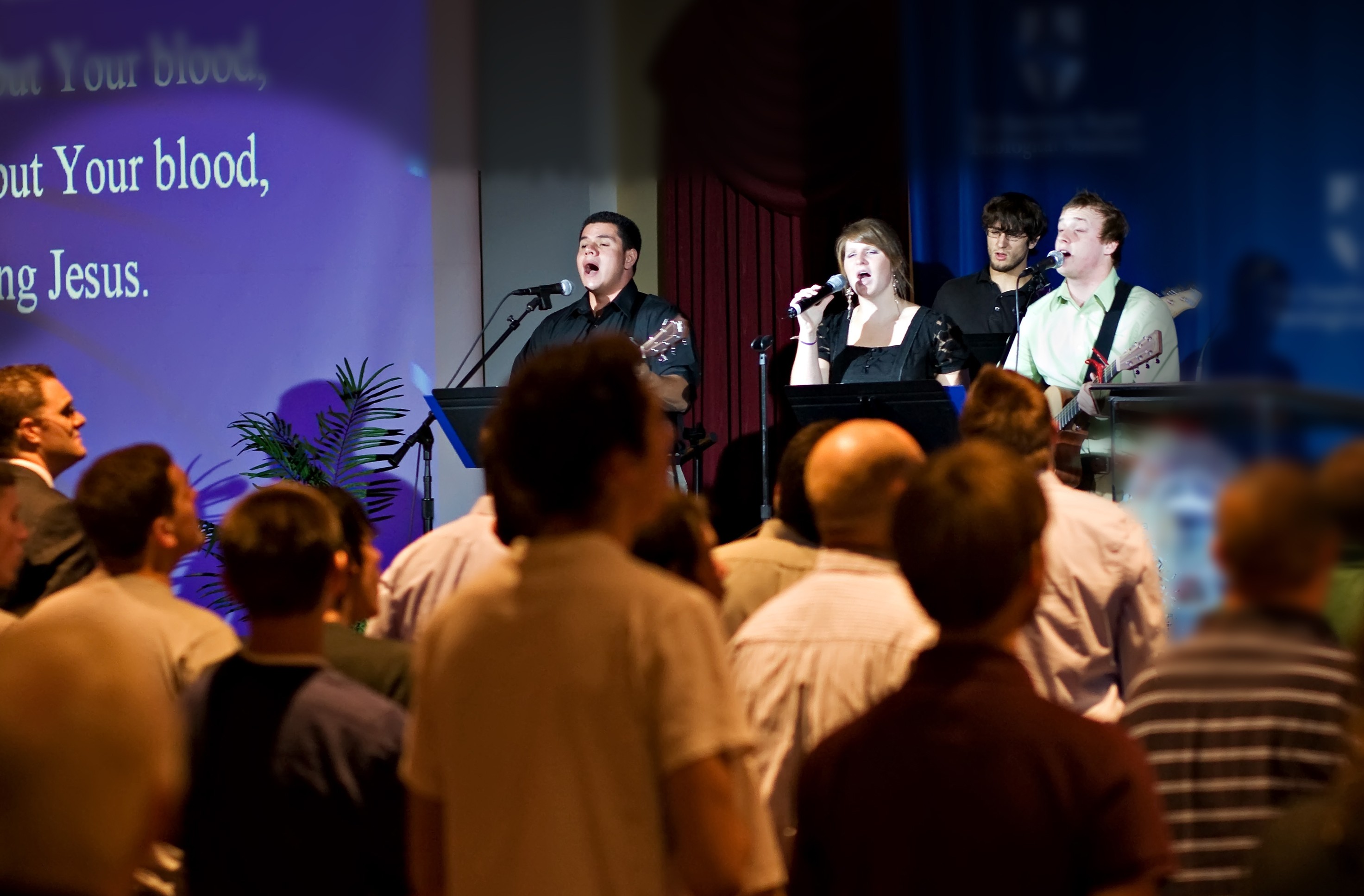
worship-band-chapel-sept-08A week ago I began a discussion on what makes a good song leader and promptly got distracted by the case for “song leaders” rather than worship leaders. (You can read it here: Why I prefer Song leader to Worship Leader.) Whether or not you are happy with my choice of terminology please come with me to consider 12 things that make an effective song leader.

Allow me to preface this list with a few comments. I’ve been working with song leaders and church bands (and serving as a song leader) for about 25 years now. I’ve seen the best and worst examples of what song leading can look like, and I’ve worked through plenty of issues. From what I’ve observed (in myself and others) I know that song leading can lead to all kinds of flattery, self-deceit and bad attitudes about your own importance and Christian life. (These must be confronted as soon as they raise their ugly heads, so be honest with someone you trust.)

To be an effective song leader requires discipline of both the mind and voice. It takes a balancing act of several important elements – especially humility, a desire to serve, vocal ability and confidence. And this does not just apply to when you are on stage! Song leaders must be genuine Christians who see their role as one of service, teaching and encouragement. They must think things through and prepare well. One of the most helpful and guiding pieces of advice I have found for song leaders was given by Charles Spurgeon! Though originally aimed at preachers, he said the challenge was to “draw back the curtains on Christ and get lost in the folds.” What a brilliant reminder that we are not up front for self-glorification, but for Christ!

Bob Kauflin defines the role of the song (‘corporate worship’) leader in a single sentence, like this:
“An effective corporate worship leader, aided and led by the Holy Spirit, skillfully combines biblical truth with music to magnify the worth of God and the redemptive work of Jesus Christ,
thereby motivating the gathered church to join him in proclaiming and cherishing the truth about God and seeking to live all of life for the glory of God.” (
http://www.worshipmatters.com/2006/03/01/what-does-a-worship-leader-do-part-16/)

That’s a pretty good definition, so I’m not going to tamper with it!

But for those wanting a longer list of things that make for effective song leading, here are my 12 points regarding the PERSPECTIVE, PRESENCE and PRACTICAL matters that can help song leaders serve more effectively:

Perspective:
1. See yourself as a “servant leader” who is doing a job to help others, to enable the gathered body of Christ to sing together, to praise God and encourage each other. You are serving the congregation with your voice, with clear and well-tuned singing that is easy to follow (just as you might serve with your hands in vacuuming the auditorium).
2. Keep serving in other ways. Don’t think song leading should be the full extent of your service to God. Be willing to take a break from it if it becomes all-consuming, or totally taking you from other gospel opportunities. (Vacuum the auditorium now and then! And speak the gospel to a friend!)
3. Don’t see yourself as the star of the show, and don’t take your musicians or sound crew for granted. Talk to them and express genuine appreciation! (On the other hand, don’t be blasé about your role. It is important to serve people in this role! And it is important for people to sing together to God and to encourage one another.)

Presence:
4. Your body language and facial expressions are pretty important, because they will be reflected to you by the congregation. If you are looking awkward or nervous or disinterested, they will feel that way too. A smile, particularly with your eyes, while you sing is something you can practice. Mirrors provide useful feedback. Stand evenly on your balls of feet, relax your knees, one foot slightly in front of the other. Keep your shoulders down and relaxed. Be a good example of an engaged and joyful participant in corporate praise to our great God!
5. Clothing choice is a question of not drawing attention to yourself and modesty. (Do I need to elaborate here? Is what your wearing causing some to focus their eyes on the shape of some particular part of you? Or not? Are you trying to show off your good taste and style, your brand names, or get attention? Consider modesty of dress and being less conspicuous than you might otherwise choose.)

Practicalities:
6. Be well practiced, so that you arent missing cues, or stuffing up words and doing things that will draw attention to yourself.
7. Be realistic about your abilities and keep tuning your instrument – get vocal lessons to help iron out any issues. Breathing technique is all important. Learn good technique! If you know you are forcing your voice to sound the way you do, seek some help or you could do damage!
8. Learn basic music theory so you can follow a melody and sing the right rhythms, or hold on to notes for the appropriate length. Learn how to follow repeats, first time endings, 2nd time endings, what ‘D.S al Coda means’ – and more.
9. Sing in a way that is easy to follow – avoiding “opera voice” or solo performer voice, with lots of trills and grace notes and vibrato. This makes it difficult for groups to follow. Use harmonies sparingly as these can get people off track when they are following you. Make sure the dominant voice is not the one doing the harmonies, and keep the harmony under the melody. (Descant lines can be especially distracting, unless it is a known part that many in the church know too – or one you want them to learn.)
10. Hold the microphone close enough so that the sound technician can get good levels (about 2 inches/5cm).  It’s easy to turn you down if too loud, but no way to boost a weak/distant signal. Pull it further away on high notes so you don’t blast the congregation!  If microphones are really new to you, get some time along in your church auditorium and sing, with foldback, to get used to sound of your own voice – because sometimes it can frighten you into singing more quietly (not great for a song leader to do!)
11. Give clear instructions if you are leading the band (both during practice and in the service). Use cues to keep everyone together. Make sure the structure of the song is clear for everyone. Listen to the members of the band, what they are saying in practice, as well as what they are playing.
12. Be on time for band practices – and organise them well ahead of time if that is something you as the singer has to do. Sing the song enough times on your own so that the melody is fully entrenched in your mind. Know the structure of the song as it will be sung at church, which may differ from the recorded version. Be willing to pray for your team and with your team, for their role as musicians in the gathering.

Being a song leader is a great privilege and it can be a great blessing to others as you help Christ’s visible body gather together in songs of praise to our great God. If you are a song leader, keep working at it! I hope these points have been helpful!

You may also like these earlier posts on similar topics:

Sharing the rich, indwelling word (Colossians 3:16)

How to encourage your music team even when you’re not the leader

Working for those moments of Joy

You are a Theologian

My Congregation Barely Sings; How Can I Help?

This article from 9Marks singing congreghas so many great points about helping your congregation sing better together, especially #7 and #16. I think I’m ready to start up a church choir again next year!


My Congregation Barely Sings; How Can I Help?


Why I prefer “song leader” to “worship leader”

grow musicSo I sat down to compile my thoughts in answer to a question someone asked on Facebook: “What makes a good church song leader?”  What should their attitudes and actions be? I was going to make a useful list to share, but soon realised that first I’d better explain why I’m talking about “song leaders” and not “worship leaders”. The latter term is probably the most widely used across the globe to describe those people who sing upfront in church. But is it the most helpful title? I think “song leader” is much better and my reasoning could be pretty significant in shaping the thinking and actions of any “song” or “worship” leader.

For me the term “song leader” is not something new. It has been part of our church culture here* for more than a few decades. Back in the 90’s when (for us) it was a new thing, and a big deal, to have singers upfront leading the congregation, there were a few things impressed on me by our pastor. One was our title: songleader!  Our job was to lead the singing, to help people to praise God together. There were many new songs, and much more syncopation than most hymns demanded. It was easier for a congregation to learn songs and sing together in time if there was a leader. But these singers weren’t leading the worship. Worship is about more than just singing, as this comment from Don Carson explains:

“I would abolish forever the notion of “worship leader”. If you want to have a “song leader” who leads part of the worship, just as the preacher leads part of the worship, that’s fine. But to call the person a “worship leader” takes away the idea that by preaching, teaching, listening to and devouring the Word of God, and applying it to our lives, we are somehow not worshipping God.”
(Don Carson – from Tony Payne interview with D.A.Carson, The Briefing, Issue 232, Matthias Media, 2000)

“Worship” is all of life, 24×7. To see only the singing, or even just the Sunday gathering, as “worship” is to deny what Romans 12:1 calls us to do in giving our whole lives to Christ: “Therefore, I urge you, brothers, in view of God’s mercy, to offer your bodies as living sacrifices, holy and pleasing to God-this is your spiritual act of worship.” Cleaning the toilets, leading a bible study, going to work, encouraging others, praying to God privately, serving coffee, serving your family, controlling your anger – all these are part of our worship of our Lord and Saviour Jesus Christ.

“There can only be one call to worship, and this comes at conversion, when in complete repentance we admit to worshiping falsely, trapped by the inversion and enslaved to false gods before whom we have been dying sacrifices. This call to true worship comes but once, not every Sunday, in spite of the repeated calls to worship that begin most liturgies and orders of worship. These should not be labeled calls to worship but calls to continuation of worship. We do not go to church to worship, but, already at worship, we join our brothers and sisters in continuing those actions that should have been going on – privately, [as families], or even corporately – all week long.” (Harold Best, Music through the eyes of Faith, p.147)

Going further, you could say that Jesus is the only true worship leader. He is the only mediator between God and man, the perfect man who sings God’s praise in our midst. (1 Tim. 2:5; Heb. 2:12) He is our high priest who has offered the perfect sacrifice of Himself to insure our entrance into the holy places. (Heb. 10:19-22)

This is what Jesus is doing now and always in the throne room of heaven, while for us daily life goes on, and Sundays roll by only every seven days. But on those Sundays the “ultimate worship Leader in the gathering, who enables us to know the Father – He tells us the Father’s name – and leader of our song of adoration, is Christ Himself! We aren’t the only ones singing. The Church sings to a singing God. “The Lord your God is in your midst, a mighty one who will save; he will rejoice over you with gladness; he will quiet you by his love; he will exult over you with loud singing.” (Zephaniah 3:17)
(from “Doxology & Theology: How the Gospel forms the Worship leader” by Matt Boswell, 2013)

Jesus is in the presence of the Father and we are in Him. We are in His presence all the time, wrapped up in Christ, united with Him. We don’t need a worship leader to lead us into his presence, or into the feeling of being worshipful. Christ is with us, we are with Him.

“It’s only when we understand his (Christ’s) presence in the church as being the fulfillment of God’s promise in Zephaniah 3:17 to “quiet you with his love” and “rejoice over you with singing” that a crucial aspect of our salvation comes into perspective. Jesus didn’t coldly settle accounts for us. He doesn’t bark us into improving ourselves. He unites us to himself in the glorious communion he has enjoyed for eternity with his heavenly Father. He resides within us to heal the broken places and reflesh our cauterized hearts. He sings us into a new mode of existence.”
(from “With One voice: Discovering Christ’s Song in our Worship” by Reggie Kidd, 2005).

Couple all this with the fact that we collectively are the temple of living stones, the place where the praises of God resound, and you may see why attaching the word ‘worship’ to such a narrow slice of our Christian lives (singing together on Sunday) may not be the best idea to perpetuate. There are so many great reasons to sing together as the body of Christ, as I have written about before (see https://sevennotesofgrace.com/2013/05/07/sharing-the-rich-indwelling-word-colossians-316/). Promise I will get back to that list about song leaders soon, but at least you may now understand my choice of words.

* My church is part of the Presbyterian Church of Queensland, but you will find the term ‘song leader’ commonly used with Sydney Anglicans and some other denominations across Australia. I’d be interested to know if the term is used in the USA (where I know the majority of my lovely readers are from) so please feel free to share your thoughts!

Come and love through me

worth it allFollowing on from some recent posts about love, I would like to share with you a song from Meredith Andrews, a singer I’ve only recently discovered and am really enjoying.  It comes from an album “Worth it All” and expresses a longing for God to work in her life, that he might love through her. Sometimes it is discouraging  to look at the great lack of love in the world, in people and families around us – but really it starts with us choosing to be obedient to God’s great command to love. He is willing and able to love through us, through me! What a privilege!

START WITH ME

You are air to desperate lungs
Water falling on the sand
Silence to an angry storm sight to a blind man
You’re still the God of miracles
So if You’re gonna move again
Then would You move in me move in me

You’re the beat to a broken heart
Bread for a hungry crowd
And one word from Your voice rings out
And the dead throw their grave clothes down
‘Cause You’re still the God of the empty tomb
The One who came to life again
So come alive in me come alive in me
Come alive in me come alive in me yeah

My life is an empty cup
Fill it up fill it up
I want to hear ev’ry rescued heart cry
You’re enough You’re enough
Break what needs breaking
‘Til You’re all we see and start with me
Start with me

Whose arms hold the fatherless
Whose voice do they hear
Who sits with the prisoner
And stands for the one in fear
You’re still the God of what is just
And You’re still the God of love
So would You love through me
Love through me yeah
Come and love through me
Would You love through me yeah

(Bridge)

Your kingdom come
Your will be done
Lord let it be and start with me start with me
Yes Your kingdom come and Your will be done
Oh Lord let it be
Let it start with me start with me yeah
Start with me
Start with me oh

CCLI Song # 6378185 Meredith Andrews | Paul Duncan | Paul Mabury © 2012 Word Music

They will know us By Our Love

HEART CLOTHESLINEThis week I read a wonderful post entitled “Got Love?” from In My Father’s House. It was about the importance of love for others, a way to know if we actually know God, that we belong to Him, that we are his children. Here is a sample:

“Though I speak with the tongues of men and of angels,
but have not love, I have become sounding brass or a clanging cymbal.
And though I have the gift of prophecy,
and understand all mysteries and all knowledge,
and though I have all faith, so that I could remove mountains,
but have not love, I am nothing.
  And though I bestow all my goods to feed the poor,
and though I give my body to be burned,
but have not love, it profits me nothing.” (1 Cor.13:1-3)

Are you a “Spirit-filled person? Going to a vibrant Spirit-filled church? The sick are getting healed, demons cast out? That’s great. Do you have prophecies, glory clouds, visions of the Third Heaven? Awesome. Do you think having and defending correct doctrine is important? Cool. Are you all about social justice? Feeding the poor? Making the world “a better place?” That’s wonderful. Are you willing to die for your faith? Admirable.

But Without God’s love,  spiritual power can blow people up. Without God’s love, all our biblical knowledge and defending the “truth” becomes the source of combative spiritual pride and carnal divisiveness. Without God’s love, social justice turns into nothing more than self-righteous works to make us feel significant, or worse, ease our guilt. Without God’s love, our martyrdom is nothing more than religious zeal. Without God’s unfailing love, we will fail.

How do we measure spiritual maturity?

What if spiritual maturity was not measured by our Bible knowledge, our training, our spiritual gifts, our willingness to serve, our zeal, our charisma, but was totally based on our ability to receive God’s love and give it away?

What if it was based on how well we’ve been able to enlarge our heart (open the “faucet” of our heart) to receive more of this unending ocean of God’s love living inside of us right now? Do you understand that if we don’t know how to open our heart to receive His unconditional love, and give it away unconditionally, we can’t be trusted? . . . ”

It’s certainly a challenging post and worth reading all of it: http://melwild.wordpress.com/2014/03/31/got-love/
It reminded me of the challenge of a song we use at church, BY OUR LOVE by Christy Nockels.
You can listen and read through the lyrics below. I trust you will find it helpful. Here is the chorus:

The time is now, Come Church arise
Love with His hands, See with His eyes
Bind it around you, Let it never leave you,
And they will know us by our love.

BY OUR LOVE

Brothers, let us come together
Walking in the Spirit, there’s much to be done
We will come reaching, out from our comforts
And they will know us by our love

Sisters, we were made for kindness
We can pierce the darkness as He shines through us
We will come reaching, with a song of healing
And they will know us by our love!

The time is now, Come Church arise
Love with His hands, See with His eyes
Bind it around you, Let it never leave you,
And they will know us by our love.

Children, You are hope for justice
Stand firm in the Truth now, set your hearts above
You will be reaching, long after we’re gone
And they will know you by your love!

Song Number 5489329 Author Christy Nockels Copyright 2009 worshiptogether.com Songs

You can look up sheet music here: http://www.worshiptogether.com/songs/songdetail.aspx?iid=1052518

The benefits of singing in the dark – together

Power of WordsOnce I was at a teacher’s conference with around 1000 people, about to sing the hymn WHEN I SURVEY THE WONDROUS CROSS, when the power went off. You might assume this was a disaster. Yet we all sang, even though there were no projected words to follow. And what a difference it made! It forced you to think more about what you were singing, of how the words connected logically together, from one thought to another, from verse to verse, to see the whole gospel message being presented. It was an amazing exercise of where things go “wrong” to the glory of God.

Why am I recalling this unusual event?

Today I read over at CHONGS WORSHIP that their church is intentionally singing without projected or written words (though not all the time). Here is their story, which I must say is quite inspiring!

“Some of you know that at our church we’ve started a year-long project of memorising 10 hymns of the faith. I spent a few weeks getting the music and the hymn books together in preparation. We started our first one (In Christ Alone) at the beginning of March, and on Sunday (while I was worship leading), we sang the entire hymn without the projected words. At the back of my mind I wondered what proportion of the church had been actively trying to memorise each hymn, or if it would be of much benefit.

So I was really encouraged to get this feedback from someone at church (the person has asked to remain anonymous):

“I have to admit – I used to not like In Christ Alone that much. It had become monotonous for me. Well, I would like to let you know that memorising the whole song has brought about a remarkable change. For the first time, I no longer heard the tune, but visually saw the whole song. I can’t quite articulate what I mean, but it was as if I saw the song only in its various parts with the first and last verse being the most obvious. But by memorising the song, I finally saw the whole song and would visualise the song in my mind when singing it.

It made a big difference to the way I sang the song too, whereby I no longer heard the tune, but saw the whole gospel story.

Look forward to memorising the next song.”

Reading between the lines, it sounds like they actually printed and gave out the song words to learn ahead of singing them in church. And I suppose that for visitors you would need to have some printed sheets available. But what an interesting challenge. I might try this! How much better would people “get” the gospel in song if they committed to learning it to sing together, to one another, for the good of one another, as the gathered Body of Christ.


The amazing grace that justifies the ungodly – that’s me!

all of graceToday I was exploring my Olive Tree Bible app (on the ipad) and discovered a library of free books, from Piper to Edwards to Spurgeon and more! The excerpt below comes from Spurgeon’s “All of Grace“.  Though he was writing in the late 1800’s he is direct and bold in his writing – you can’t run and hide. He offers us salvation, by grace, through faith. I trust you will find it an encouragement – a reminder of the grace that saves. (You can find the book free on many places on line as well.)

“If God justifieth the ungodly, then, dear friend, He can justify you. Is not that the very kind of person that you are? If you are unconverted at this moment, it is a very proper description of you; you have lived without God, you have been the reverse of godly; in one word, you have been and are ungodly. Perhaps you have not even attended a place of worship on Sunday, but have lived in disregard of God’s day, and house, and Word- this proves you to have been ungodly. Sadder still, it may be you have even tried to doubt God’s existence, and have gone the length of saying that you did so. You have lived on this fair earth, which is full of the tokens of God’s presence, and all the while you have shut your eyes to the clear evidences of His power and Now, while this is very surprising, I want you to notice how available it makes the gospel to you and to me. If God justifieth the ungodly, then, dear friend, He can justify you. Is not that the very kind of person that you are? If you are unconverted at this moment, it is a very proper description of you; you have lived without God, you have been the reverse of godly; in one word, you have been and are ungodly. Perhaps you have not even attended a place of worship on Sunday, but have lived in disregard of God’s day, and house, and Word- this proves you to have been ungodly. Sadder still, it may be you have even tried to doubt God’s existence, and have gone the length of saying that you did so. You have lived on this fair earth, which is full of the tokens of God’s presence, and all the while you have shut your eyes to the clear evidences of His power and Godhead. You have lived as if there were no God.
Indeed, you would have been very pleased if you could have demonstrated to yourself to a certainty that there was no God whatever. Possibly you have lived a great many years in this way, so that you are now pretty well settled in your ways, and yet God is not in any of them. If you were labeled
UNGODLY
it would as well describe you as if the sea were to be labeled salt water. Would it not?
Possibly you are a person of another sort; you have regularly attended to all the outward forms of religion, and yet you have had no heart in them at all, but have been really ungodly. Though meeting with the people of God, you have never met with God for yourself; you have been in the choir, and yet have not praised the Lord with your heart. You have lived without any love to God in your heart, or regard to his commands in your life. Well, you are just the kind of man to whom this gospel is sent- this gospel which says that God justifieth the ungodly. It is very wonderful, but it is happily available for you. It just suits you. Does it not? How I wish that you would accept it! If you are a sensible man, you will see the remarkable grace of God in providing for such as you are, and you will say to yourself, “Justify the ungodly! Why, then, should not I be justified, and justified at once?”
Now, observe further, that it must be so– that the salvation of God is for those who do not deserve it, and have no preparation for it. It is reasonable that the statement should be put in the Bible; for, dear friend, no others need justifying but those who have no justification of their own. If any of my readers are perfectly righteous, they want no justifying. You feel that you are doing your duty well, and almost putting heaven under an obligation to you. What do you want with a Saviour, or with mercy? What do you want with justification? You will be tired of my book by this time, for it will have no interest to you.
If any of you are giving yourselves such proud airs, listen to me for a little while. You will be lost, as sure as you are alive. You righteous men, whose righteousness is all of your own working, are either deceivers or deceived; for the Scripture cannot lie, and it saith plainly, “There is none righteous, no, not one.” In any case I have no gospel to preach to the self- righteous, no, not a word of it. Jesus Christ himself came not to call the righteous, and I am not going to do what He did not do. If I called you, you would not come, and, therefore, I will not call you, under that character. No, I bid you rather look at that righteousness of yours till you see what a delusion it is. It is not half so substantial as a cobweb. Have done with it! Flee from it! Oh believe that the only persons that can need justification are those who are not in themselves just! They need that something should be done for them to make them just before the judgment seat of God. Depend upon it, the Lord only does that which is needful. Infinite wisdom never attempts that which is unnecessary. Jesus never undertakes that which is superfluous. To make him just who is just is no work for God– that were a labor for a fool; but to make him just who is unjust– that is work for infinite love and mercy. To justify the ungodly– this is a miracle worthy of a God. And for certain it is so.”

The Music Exchange from Richard Simpkin: Pet sounds

It doesn’t matter what instruments you use, but the humility, sensitivity and the servant heart of the player does! I enjoyed the challenge of this post for music directors.

Evangelicals Now's avatarEvangelicals Now

Music ExchangeIt’s strange how some instruments go in and out of favour in church music groups.

Our ears seem to be drawn to the same kind of instrumentation that we are used to hearing in mainstream popular culture. For example, in the 80s and 90s we were used to lots of saxophone: Baker Street (Gerry Rafferty), Careless Whisper (George Michael),Poirot (I mean the signature tune to Poirot, not that Poirot played the saxophone onCareless Whisper). But the sax has now largely disappeared from the pop scene. I’m sure that this is the reason that the sax has also disappeared from featuring on today’s Christian music CDs, leading it to being side-lined in church bands too.

A few strings

At the moment, the only classical orchestral instruments we hear on Christian music CDs produced in the West are a few strings. Everything else is electric or closely tied to…

View original post 571 more words