Four little girls, suffering and God’s perfect peace

4girlsspaffords1You’ve probably heard of Horatio Spafford. You may realise he is the author of the hymn “It Is Well” (When Peace Like a River) and that he suffered the tragic loss of his four daughters before penning those now famous words. But here is a little more background you may not be aware of, along with an interesting question from Tim Keller:

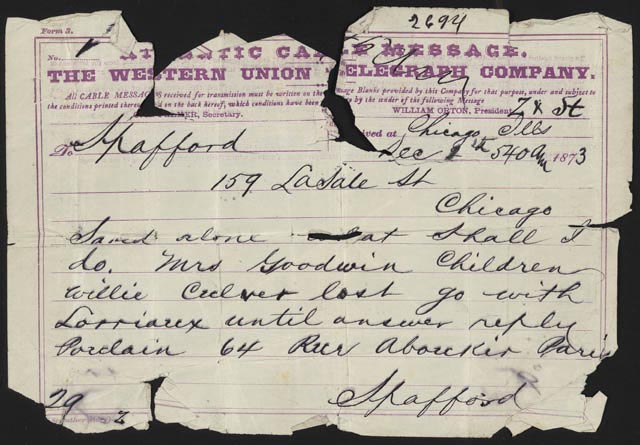
“Horatio Spafford was an American lawyer who lost everything he had in the Chicago fire of 1871. Only two years later, he sent his wife, Anna, and their four daughters on a ship across the Atlantic Ocean to England. The ship hit another ship and began to sink. As it was sinking, Anna got the four little girls together and prayed. The ship went under the water, and they all were scattered into the waves, and all four little girls drowned. Anna was found floating unconscious in the water by a rescue ship. They took her to England, and she cabled Horatio Spafford just two words: “saved alone.”

spaffordWhen Spafford was on the ship on his way to England to bring his wife home, he began to write a hymn – “It is well with my soul… When peace, like a river…” Those are the words he wrote.

Here is what I want you to think about: why would a man dealing with his grief, seeking the peace of God – the peace like a river – spend the entire hymn on Jesus and His work of salvation? And why would he bring up the subject of his own sin at such a time? He wrote:

My sin, oh, though the bliss of this glorious thought!
My sin, not in part but the whole,
Is nailed to the cross, and I bear it no more.
Praise the Lord, praise the Lord, O my soul.

What has that got to do with his four little girls who are dead? Everything!
Do you know why? When things go wrong, one of the ways you lose your peace is that you think maybe you are being punished. But look at the cross! All the punishment fell on Jesus. Another thing you may think is that maybe God doesn’t care. But look at the cross! The Bible gives you a God that says, “I have lost a child too; but not involuntarily – voluntarily, on the cross, for your sake. So that I could bring you into my family.”

In that hymn you can watch a man thinking, thanking and loving himself into the peace of God. It worked for him under those circumstances. It worked for Paul under his circumstances (Phil 4:6-13). It will work for you.

– Timothy Keller, “Walking With God Through Pain and Suffering”, p.311-312

You keep him in perfect peace whose mind is stayed on you, because he trusts in you. (Isaiah 26:3)

You can listen to a new arrangement of IT IS WELL by Todd Fields. Find it here on Spotify (our church songlist for 2014).

Grace enables you to grow up into who you already are

Like many things in the Kingdom, our life in Christ is paradoxical. We’re already complete in Him, yet we’re growing up into Him (Eph.4:13, 15). Both are equally true. And grace transports us from where we are experientially to who we already are in reality.

http://melwild.wordpress.com/2014/10/24/grace-enables-you-to-grow-up-into-who-you-already-are/

Greater is the One living inside of me

mercy welcome‘Cause I hear a voice and He calls me redeemed
When others say I’ll never be enough
And greater is the One living inside of me
Than he who is living in the world

These lines are the chorus of a really lively and encouraging song on the latest Mercy Me album. The song is titled Greater. It explores the fact that the Great One – Jesus Christ himself – lives in us by grace, through faith!  From His perspective we are redeemed, we are fully accepted by Him, with all our guilt and pain. Though there are days we lose the battle, “grace says it doesn’t matter”.  He is living in us and He is greater than the world that would condemn and discourage, and call us fools.  I pray that your joy and strength may be renewed in the Lord as you sing along.  Below you will find the lyric video, the story behind the song and the lyrics themselves. (If you don’t have a copy of the latest Mercy Me Album, this site says it is just 5.99 on iTunes for a limited time: http://mercyme.org/)  Blessings to you!

GREATER (Mercy Me, Album: Welcome to the New)

Bring your tired and bring your shame
Bring your guilt and bring your pain
Don’t you know that’s not your name
You will always be much more to me

Every day I wrestle with the voices
That keep telling me I’m not right
But that’s alright

‘Cause I hear a voice and He calls me redeemed
When others say I’ll never be enough
And greater is the One living inside of me
Than he who is living in the world
In the world, In the world
And greater is the One living inside of me
Than he who is living in the world

Bring your doubts and bring your fears
Bring your hurt and bring your tears
There’ll be no condemnation here
You are holy, righteous and redeemed

Every time I fall
There’ll be those who will call me
A mistake, Well that’s OK

Chorus:

There’ll be days I lose the battle
Grace says that it doesn’t matter
‘Cause the cross already won the war
He’s Greater, He’s Greater

I am learning to run freely
Understanding just how He sees me
And it makes me love Him more and more
He’s Greater, He’s Greater

Songwriters: Barry Graul, Bart Millard, Ben Glover, David Garcia, James Bryson, Jim Bryson, Michael John Scheuchzer, Mike Scheuchzer, Nathan Cochran, Robby Shaffer

You would probably also like this song from the same album: Flawless

The Cross has made you Flawless


Digital insanity

image

This is a brilliant video clip that challenges all those new habits we have formed in the digital age. See what you think.
http://themetapicture.com/if-this-video-doesnt-convince-you/

You may also enjoy:

Is your Smart phone making you dumb?

Musicians spot mistakes more quickly and more accurately than non-musicians – Science – News

I always find it fascinating the way music and musical training affects the brain for good. Here is a recent study which once again shows how God has given us such a great gift in music, that enhances and grows our abilities in many different aspects of our life:

“New research has shown that individuals who play an instrument are more capable at identifying errors and correcting mistakes, and that these benefits apply to amateur musicians as well as professionals.

The study, led by Dr Ines Jentzsch for the University of St Andrews, tested the cognitive abilities of musicians and non-musicians, with the research concluding that learning an instrument could “slow or even prevent” the mental decline associated with aging.

The research, published in the journal Neuropsychologia, draws particular attention to the skills learnt in musical performance. When playing pieces to an audience or to themselves musicians must demonstrate heightened awareness of their actions: continually monitoring their playing through auditory feedback and rapidly adjusting their movements to anticipate possible mistakes.

The psychological and mental benefits of learning to play an instrument have been shown in previous studies, with research highlighting musicians’ improved reaction times and their increased capacity to “inhibit task irrelevant information” (aka, to stay focused).

“[The results] suggest that higher levels of musical training might result in more efficient information processing in general (indicated by faster overall speed across tasks without accuracy tradeoff), and confirms earlier reports indicating a positive link between mental speed and musical ability,” says Dr Jentzsch.

The research is notable in that unlike previous studies it focuses on amateur rather than professional musicians, showing that even “moderate levels of musical activity” were beneficial to cognitive performance.

The study also drew attention to the diminishing support for children to learn to play in schools, noting that “in times of economic hardship, funds for music education are often amongst the first to be cut.”

“This is particularly worrying given both anecdotal and limited research evidence suggesting that music can have strong positive effects on our physical as well as psychological functioning.”

http://www.independent.co.uk/news/science/musicians-spot-mistakes-more-quickly-and-more-accurately-than-nonmusicians-8849068.html

IMG_0193.JPG

Why should I gain from His reward?

8128-ea_fathers_love how deep for us lyrics.pngYes, the Sovereign lord is coming in power. He will rule with a powerful arm. See, he brings his reward with him as he comes. He will feed his flock like a shepherd. He will carry the lambs in his arms, holding them close to his heart. (Isaiah 40:10-11 NLT)

Look, I am coming soon! My reward is with me, and I will give to each person according to what they have done. I am the Alpha and the Omega, the First and the Last, the Beginning and the End. (Revelation 22:12-13)

Sometimes even really great songs can become tired. People just get ‘over’ singing them and the impact and meaning is lost. It’s rare to find a song that endures very long these days! But this song is somehow different: How Deep the Father’s Love for Us (1995)

I remember when I first came across the Stuart Townend song. Its unusual time signature scheme (4/4 and 6/4 in alternate bars) coupled with beautiful poetry declaring the wonder of God’s love really gave the song a certain ‘X’ factor – and won me over! Perhaps for these reasons it has endured as a singable and meaningful song. Though it’s been around for almost two decades I’d say this song can still penetrate any stubborn heart and mind to see the beauty of our salvation afresh! (In case you somehow missed it, the lyrics are down below)

There is such rich theology in this song – but I’d like to focus on one intriguing line in verse 3:  “Why should I gain from His reward? I cannot give an answer. . .”

As we see in the passages above from Isaiah and Revelation, the Messiah, Risen Redeemer King, Jesus Christ turns up to rule bringing his reward with him, a reward which is his own flock of people, saved by His blood. These are the people the Father has given to Jesus, as His reward:
“My Father, who has given them to Me, is greater than all; and no one is able to snatch them out of the Father’s hand.…” (John 10:29)

How incredible that from Jesus’ perspective we are His reward, the people of God, sinners saved by undeserved grace! We cannot give an answer for why Jesus would die for us, for his enemies – we can only look with thankfulness that for the joy set before Him endured the cross, despising the shame, and has sat down at the right hand of the throne of God.” (Hebrews 12:12)
This is Jesus, our redeemer and friend! How deep the love of the Father to send his own Son for us!

HOW DEEP THE FATHER’S LOVE FOR US

How deep the Father’s love for us,
How vast beyond all measure,
That He should give His only Son
To make a wretch His treasure.
How great the pain of searing loss –
The Father turns His face away,
As wounds which mar the Chosen One
Bring many sons to glory.

Behold the man upon a cross,
My sin upon His shoulders;
Ashamed, I hear my mocking voice
Call out among the scoffers.
It was my sin that held Him there
Until it was accomplished;
His dying breath has brought me life –
I know that it is finished.

I will not boast in anything,
No gifts, no power, no wisdom;
But I will boast in Jesus Christ,
His death and resurrection.
Why should I gain from His reward?
I cannot give an answer;
But this I know with all my heart –
His wounds have paid my ransom.

Stuart Townend– See more at: http://www.stuarttownend.co.uk/song/how-deep-the-fathers-love-for-us/#sthash.jX205XY1.dpuf

Here are some links to learn more about the song:

http://www.worshiptogether.com/songs/songdetail.aspx?iid=577430

1 Corinthinans 13…Remixed For Today

Thanks go to the folks at Blazing Center for this insightful application of 1 Corinthians 13:

If I status update with such insight, hilarity, godliness, or profundity, that I get a thousand retweets and likes, yet have not love, I’m a cellphone that won’t stop ringing, or a car alarm at 2 AM.

If I understand every nuance of every complicated doctrine, including eschatology and predestination, and am a constant defender of orthodoxy, and if I am renowned for my ability to communicate truth with passion, but have not love, I’m nothing more than a first grader in the kingdom of God.

If I am a fantastic worship leader, able to lead hundreds of people in passionate worship of God, yet have not love, my skills are worth jack.

If I am a blog warrior, constantly on the attack against those who would distort the faith, yet have not love, I’m that yippy dog next door who won’t stop barking…even at 3 AM.

If I live a life of radical sacrifice, crazy love, and wartime mentality, and sponsor lots of kids through Compassion International, and go on mission trips in “closed countries”, but have not love, I gain nothing.

If I am a great artist, able to capture a snapshot of the glory of God on canvas, or in song, or in prose, or on film, and yet have not love, my creative “genius” is utterly useless to God.

If I preach like Piper or Chandler or Chan or Platt, and yet have not love, I’m nothing more than a squawking parrot who likes to imitate others.

If I read all the books by all the smart theologians, and can quote them off the top of my head, yet have not love, WHO REALLY CARES!!!!

Love is patient and kind; love does not envy or boast; it is not arrogant or rude. It does not insist on its own way; it is not irritable or resentful; it does not rejoice at wrongdoing, but rejoices with the truth. Love bears all things, believes all things, hopes all things, endures all things.

http://www.theblazingcenter.com/2014/09/1-corinthinans-13-remixed-for-today.html?

Should worship be fun?

From the Archives: Should Worship be Fun?People-Laughing

(by Bob Kauflin at Worship matters)
More than once I’ve heard Christians insist that worship should be fun, or act like they had a responsibility to prove that Christians knew how to “party” in church. I’ve always been uncomfortable with that connection, so I started thinking about the place of “fun” in worship, if one even exists. I’m going to address this question by answering it as I posed it, and then considering two other ways it might be phrased.

Should worship be fun? If we take the exhaustive testimony of Scripture, the answer would have to be a resounding NO. “Fun” wouldn’t characterize any of the scenes in the Bible where people encounter God together, at least not the zany, slap-happy, crazy, mindless kind of fun. We’re told to worship God with reverence and awe, for he is a consuming fire (Heb. 12:28-29). To have “fun” one of our primary motives as we gather. Among other things our goals include remembering, rehearsing, and reveling in the gospel, magnifying God’s glory in Christ, spurring one another on to love and good deeds, presenting our petitions before God, and being strengthened by his Word and the communion of the saints. Celebration will certainly be included in that, but there are also times when worshipping God will produce awe, tears of repentance, or a profound silence.

But let me rephrase the question. Can worship be fun? It depends on how we define “fun.”

If “fun” is defined as a lighthearted activity with no purpose or meaning, strictly meant to amuse, then the answer to the question, “Can worship be fun?” must surely be no. When we worship God together, we are not looking to be merely entertained or momentarily distracted from the cares of this world. We’re not seeking to promote a Christian alternative to Saturday Night Live (Sunday Morning Live?). Diversion is not the same as worship. Our joy and gladness are meant to be grounded in and informed by God’s character, nature, and acts.

But when I looked up “fun” on my desktop dictionary, the first meaning was “enjoyable.” If we’re asking, “Can worshipping God be enjoyable?” then surely the answer must be yes. That doesn’t mean Isaiah 6 has no relevance to our meeting together to engage with God. But Isaiah 6 isn’t the only chapter in Scripture that describes how we are to relate to God. There have been countless times that I’ve been leading or singing as part of the congregation and thought, “I love doing this!” Joy floods my soul, and I could legitimately say I’m having “fun!”

It may be similar to what the Israelites experienced in 2 Chronicles 30. They so enjoyed celebrating the Feast of Unleavened Bread for seven days that Hezekiah and the people spontaneously decided to keep the feast for another seven days (2 Chron. 30:22-23)! That must have been some celebration! On another occasion, Ezra and the priests told the people not to mourn or weep because that day was “holy to the Lord” and that the joy of the Lord was their strength (Neh. 8:9-10). Holiness and joy aren’t necessarily exclusive.

When my children were growing up, I wanted them to look forward to singing worship songs, and not see a relationship with God as something that was only serious, sober, and solemn. After all, singing to God is meant to be pleasant (Ps. 135:3; Ps. 147:1). David danced before the Lord with all his might as he brought the ark back to Jerusalem (2 Sam. 6:12-15). The Psalmist was glad when they said to him, “Let us go up to the house of the Lord” (Ps. 122:1). So yes, when defined as enjoyment and not seen as the only aspect of our time together on Sunday morning, worshipping God can be very “fun.” People shouldn’t find our meetings dull or dour. Smiles and even laughter should abound as we consider how kind, merciful, and gracious God has been to us (Ps. 126:2)!

But let me rephrase the question one more time, to broaden the application.

“Should our fun be worship?” Well now the answer must surely be “yes.” We’re told in 1 Cor. 10:31 that whether we eat or drink, or whatever we do, we’re to do it all for the glory of God. Rather than focusing on making our corporate worship fun, maybe we should spend more time making sure our “fun” is worship.

Here are some questions that can lead us in that direction.

  • Do I choose a fun activity because there’s nothing else to do, or because I believe it will in some way cause me to grow in my love for God?
  • When I play games, participate in sports, or pursue a hobby, does my attitude demonstrate the fruit of the Spirit?
  • When I go out with a group of friends, am I seeking just to have fun, or to glorify God through encouraging them, challenging sin, and serving them?
  • Do the activities I consider “fun” increase my affections for God or dilute them?
  • Do I view my free time as belonging to me or to God?

The fun this world offers is unsatisfying, deceptive, and temporary. Let’s not idolize it or imagine it’s God offers nothing better. As Christians, we can enjoy fun activities without believing they’re the root of our happiness. The joy we experience when in worshiping God together is greater than the world will ever know, because the root is knowing our sins have been paid for through the substitutionary sacrifice of Jesus Christ and we worship a risen and reigning Savior.

Our joy is ultimately in God himself. We’d be fools to look for it anywhere else.

For more on this topic, download the following messages from the Sovereign Grace Ministries website:
Worshiping God as the Source of All Secondary Joys by Randy Alcorn
A Biblical Understanding of Leisure by Jeff Purswell

[This is a slightly edited version of a post from Feb. 6, 2007]

Don’t let the Word be strange – the Psalms included

psalms-59-16I had the privilege of leading music at a women’s conference in Brisbane last month, a conference called “Dazzled by Grace”. The speaker was Kathleen Nielson, head of women’s initiatives at the Gospel Coalition (USA). Her focus across three talks was how to read the Psalms in a way that allows us to drink deeply the beauty, poetry and truth they contain.
First she spent some time defining the Psalms, as:
*The beating heart at centre of God’s Word.
*The heart cries of God’s people: the thoughts, prayers and praises of people living in His story and seeking to trust Him through life’s ups and downs.
*Cries from a kingdom, the gathered people living under an earthly king, which points us right to God’s chosen perfect King, Jesus.

In addressing our modern difficulties in reading and appreciating the Psalms, Kathleen pointed to the fact that reading poetry has simply fallen out of practice in our culture. This was a regular practice in families for centuries gone by. They would sit around and listen to poetry, to appreciate the imagery and the repetition it contains. People would even hire poets to recite poetry for their dinner guests, and children would learn much poetry by heart. But now we live in a culture which is saturated not by poetic images, but Instagram, Facebook, Flash chat and the likes. We have trained ourselves through new technology to be addicted to cool graphics and images, through the multiple screens about us. So when it comes to the Psalms, their poetic form has become so foreign, so strange to us, something we are not used to reading.
This must really delight our enemy: “The devil is happy with a people who live on images and sound bites and tweets. He wants words of bible to seem foreign.”

So it is no wonder that we struggle to drink from the riches of the Word if the word is strange to us. How easily our minds can wander when we don’t see the point or the beauty of the poetry. But the more we immerse ourselves in it, the more the words of the Psalms become familiar to us, the more strength and confidence these words will bring to our lives. We must make friends with the imagery, the emotion, the shape, the rise and fall, of the tapestry of the Psalms. And naturally this applies to all of God’s word. We must not let His Word be a stranger to us. God has provided it for our strengthening and joy!

(Finally let me just add that I haven’t forgotten my project, of gathering all the most singable arrangements of hymns for congregational use! These talks highlighted for me the importance of us singing the Psalms together. Thanks for continuing to read along, dear followers. And welcome if you have just joined us! If you would like to spend some more time exploring the Psalms, check out this blog: Singing in Babylon)


Remembering grace – specifically!

prayer2No matter who we are or what circumstances and concerns we have, all of us have to deal with trouble in our lives. This post comes from Paul David Tripp with some great advice for turning our troubles into a time when we can be thankful, when we can remember God’s grace to us in a very specific way – quite a challenge!

“When trouble comes, it’s vital that you talk to yourself. . . no one is more influential in your life than you are because no one talks to you as much as you do. What you say to you in moments of trouble will impact the way you respond.

David was a man well acquainted with trouble. Poor David; if you read the Psalms, he always seems to be in trouble! But in these moments, David was always talking to himself. We saw this in Psalm 27 – “The Lord is my light and my salvation; whom shall I fear? The Lord is the stronghold of my life; of whom shall I be afraid?” (Psalm 27:1)

There’s something else David did in times of trouble that’s very helpful; it’s found in Psalm 4 – “Answer me when I call, O God of my righteousness! You have given me relief when I was in distress. Be gracious to me and hear my prayer!” (Psalm 4:1, ESV, emphasis mine). In the midst of trouble, David remembered the acts of God. Notice how the above phrase is in the past tense – “you have given me relief when I was in distress.” He’s not thanking the Lord for currently relieving his distressing circumstances.

What can we learn from David? In times of trouble, it’s helpful to remember with specificity the past acts of God’s relieving mercy and grace. You and I have such a short-term memory. Because of sin, we’re all about the gratification and pleasure of today. When trouble comes knocking, we get absorbed in the immediate, forgetting what God has delivered us from in the past and what he’s transforming us into for the future.

David speaks gospel sense to his soul: “Remember, this is not new. I’ve experienced trouble in the past and God was good to me then. He remains good to me today, and what I’m facing is not out of his loving and wise rule.”

I would guess that David learned this theological skill from his ancestors. In the Old Testament, God stops the rushing waters of the Jordan River so the nation of Israel can cross on dry land. The Lord tells Joshua to set out 12 memorial stones. Why? “So that all the peoples of the earth may know that the hand of the Lord is mighty.” (Joshua 4:24)

I would encourage you to take notes from Joshua and David. Remember, with specificity, the good things God has done for you. Journal, take a picture, or do whatever else can help you, so when trouble comes knocking, you can say like David, “You have given me relief when I was I distress.”

REFLECTION QUESTIONS:

1. How often do you talk to yourself?
2. Reflect on some of the things you’ve said to yourself in the past week. What were you saying to you?
3. What, or who, are some influences that can shape what you say to you?
4. What are some examples from your life when God has given you relief from distress?
5. How can you create “memorial stones” to remind yourself that the hand of the Lord is mighty?