They will know us By Our Love

HEART CLOTHESLINEThis week I read a wonderful post entitled “Got Love?” from In My Father’s House. It was about the importance of love for others, a way to know if we actually know God, that we belong to Him, that we are his children. Here is a sample:

“Though I speak with the tongues of men and of angels,
but have not love, I have become sounding brass or a clanging cymbal.
And though I have the gift of prophecy,
and understand all mysteries and all knowledge,
and though I have all faith, so that I could remove mountains,
but have not love, I am nothing.
  And though I bestow all my goods to feed the poor,
and though I give my body to be burned,
but have not love, it profits me nothing.” (1 Cor.13:1-3)

Are you a “Spirit-filled person? Going to a vibrant Spirit-filled church? The sick are getting healed, demons cast out? That’s great. Do you have prophecies, glory clouds, visions of the Third Heaven? Awesome. Do you think having and defending correct doctrine is important? Cool. Are you all about social justice? Feeding the poor? Making the world “a better place?” That’s wonderful. Are you willing to die for your faith? Admirable.

But Without God’s love,  spiritual power can blow people up. Without God’s love, all our biblical knowledge and defending the “truth” becomes the source of combative spiritual pride and carnal divisiveness. Without God’s love, social justice turns into nothing more than self-righteous works to make us feel significant, or worse, ease our guilt. Without God’s love, our martyrdom is nothing more than religious zeal. Without God’s unfailing love, we will fail.

How do we measure spiritual maturity?

What if spiritual maturity was not measured by our Bible knowledge, our training, our spiritual gifts, our willingness to serve, our zeal, our charisma, but was totally based on our ability to receive God’s love and give it away?

What if it was based on how well we’ve been able to enlarge our heart (open the “faucet” of our heart) to receive more of this unending ocean of God’s love living inside of us right now? Do you understand that if we don’t know how to open our heart to receive His unconditional love, and give it away unconditionally, we can’t be trusted? . . . ”

It’s certainly a challenging post and worth reading all of it: http://melwild.wordpress.com/2014/03/31/got-love/
It reminded me of the challenge of a song we use at church, BY OUR LOVE by Christy Nockels.
You can listen and read through the lyrics below. I trust you will find it helpful. Here is the chorus:

The time is now, Come Church arise
Love with His hands, See with His eyes
Bind it around you, Let it never leave you,
And they will know us by our love.

BY OUR LOVE

Brothers, let us come together
Walking in the Spirit, there’s much to be done
We will come reaching, out from our comforts
And they will know us by our love

Sisters, we were made for kindness
We can pierce the darkness as He shines through us
We will come reaching, with a song of healing
And they will know us by our love!

The time is now, Come Church arise
Love with His hands, See with His eyes
Bind it around you, Let it never leave you,
And they will know us by our love.

Children, You are hope for justice
Stand firm in the Truth now, set your hearts above
You will be reaching, long after we’re gone
And they will know you by your love!

Song Number 5489329 Author Christy Nockels Copyright 2009 worshiptogether.com Songs

You can look up sheet music here: http://www.worshiptogether.com/songs/songdetail.aspx?iid=1052518

A great way to search for songs

sg-ministries-bannerI’ve recently discovered a great search tool for Sovereign Grace songs at their website. Though I’ve been using Sovereign Grace for many years (as a source of good biblical, singable songs for church) I had not noticed the menu that allows you to search for songs by theme, tempo, key, genre and keyword. It’s especially useful if your church sings many of their songs. But even if you don’t it’s very easy to follow links to the songs, listen to samples and download the music for free. Sometimes even the suggestion of song titles can help point you in the direction of songs you do know (with similar titles).

Here is a link to the search page:
http://www.sovereigngracemusic.org/Songs

Make sure you scroll down when you get to the page. The top half is all about style, but the bottom section has an immense number of themes you can select in your search. I found it best to tick just one or two boxes at a time. (If you choose too many you will get results ‘zero’.)

Here is my shortlist of the most congregation-friendly Sovereign Grace songs:

1. Jesus Thankyou (Pat Sczebel)
2. O Great God (Bob Kauflin)
3. Let Your Kingdom Come (Bob Kauflin)
4. I will Glory in My Redeemer (Steve & Vikki Cook)
5. The Glories of Calvary (Steve & Vikki Cook)
6. O the Deep Deep Love of Jesus ((Bob Kauflin arrangement)
7. Unashamed (Mark Altrogge)
8. Show us Christ (Bob Kauflin & Doug Plank)
9. Through the Precious Blood (Mark Altrogge)
10. Hope has come (Stephen Altrogge)
11. How high and how wide (Mark Altrogge)

Our Church Song list for 2014

spotify ARPC 2014It’s always really helpful when you can get hold of lists of songs other churches are singing – so I’m reciprocating the favour (perhaps in advance). Here is our church songlist for 2014. If you follow the Spotify link, or click the picture, you should be able to find all the songs on our to do list at Acacia Ridge Presbyterian. Below I have included a few key points about each song and some of the stand-out lyrics:

All I have is Christ (Jordan Kauflin, Sovereign Grace – key C).
This is top of the list because we never got to it last year! The song is full of great truth about our redemption in Christ.  The song moves us to know that Christ (who saved us from our “hell-bound race”) is indeed now our only boast. He is all that we can count on in this world! Hallelujah! The song works well with many instruments or just one. Here is verse 3:
Now Lord I would be Yours alone And live so all might see
The strength to follow Your commands could never come from me
O Father use my ransomed life in any way You choose
And let my song forever be ‘My only boast is You!’

It is Well (Todd Fields – Music at North Point)
Some hymn revamps don’t work well, but this one does! The verse melody is exactly the same, and the chorus is new. The monotone melody has been replaced by one that is far more uplifting, and some additional lyrics have the same effect. It creates an effective crescendo. Here is the chorus:
It is well it is well, Through the storm I am held
It is well it is well with my soul
It is well it is well, God has won, Christ prevailed
It is well it is well with my soul

Made Alive (Citizens)
Last year my family came back from a week-long youth camp singing this song. I have already written a post about it here. The great thing is that when you sing this you commit to memory so much scriptural truth (particularly Romans 3:20-12 and Ephesians 2:8-9).
Here is verse 1 and the chorus:
I once was dead in sin, Alone and hopeless,
A child of wrath I walked condemned in darkness,
But your mercy brought new life And in your love and kindness,
Raised me up with Christ and made me righteous.
Chorus:
You have bought me back with the riches of,

Your amazing grace and relentless love.
I’m made alive forever, with you, life forever
By your grace I’m saved, By your grace I’m saved.

Overflowed (Trevor Hodge)
We have been singing this one for a few months already and it has really caught on. It is a lively song with a pretty simple melody (some syncopation, and also some very straight rhythms). But I think the best feature is the carefully crafted chorus, which effectively sums up the glory of forgiveness and grace:
In Christ Your love has overflowed
The debts we owed have been all wiped away
And now the riches of Your grace
Have raised us up to live in Him always
And bring You praise

Praise to the Lord the Almighty (Hymn – Christy Nockels arrangement)
As I have been looking for Psalms to sing, this hymn fits the bill, drawing on Psalm 103.  I’ll use this arrangement as the chord structures are a little simpler and it has a gentler feel, but the melody is the same. There are a few extra Praise Him’s and Hallelujahs (for a chorus of sorts), which could be omitted. Verse 1:
Praise to the Lord the Almighty the King of creation
O my soul praise Him for He is thy health and salvation
All ye who hear now to His temple draw near
Praise Him in glad adoration

The Perfect Wisdom of our God (Getty music – key A)
This song is a gentle prayer, for understanding of God’s wisdom and ways in Creation and in the workings of his sovereign hand in our lives. Here is verse 3:
Oh grant me wisdom from above, To pray for peace and cling to love,
And teach me humbly to receive the sun and rain of Your sovereignty.
Each strand of sorrow has a place within this tapestry of grace;
So through the trials I choose to say: “Your perfect will in your perfect way.”

Read more at http://www.songlyrics.com/keith-and-kristyn-getty/perfect-wisdom-of-our-god-lyrics/#ekHjSB39hg9BPA1q.99

Grace has now appeared (Rob Smith EMU music – key C)
Grace has indeed appeared – in the person of Jesus Christ! This song is quite syncopated, but predictably so, making it singable. It has a catchy opening riff, and a lively tempo. More information here.
My favourite lines of this song come in verse 3:
He has come to dwell within us, Bringing us from death to life,
Giving us the hope of glory, Making us like Christ, Shining forth his light.

Oh the Deep Deep Love (Bob Kauflin – key E)
Some of you may know this hymn by Samuel Trevor Francis, but you should definitely try the beautiful melody and tempo of this tune. I think it suits the lyrics far better than other tunes used in the past. Sheet music here
VERSE 1
Oh the deep, deep love of Jesus
Vast, unmeasured, boundless, free
Rolling as a mighty ocean
In its fullness over me
Underneath me, all around me
Is the current of Your love
Leading onward, leading homeward
To Your glorious rest above

The Glories of Calvary (Steve and Vicki Cook, Sovereign Grace – key F)
This has been one of my favourite, lively, grace focused songs for many years, but I just haven’t got a round to it. I can’t even chose just a small excerpt of the lyrics, so here is verse 1 and chorus. Sheet music here
VERSE 1
Lord, You’re calling me to come and behold the wondrous cross
To explore the depths of grace that came to me at such a cost
Where Your boundless love Conquered my boundless sin
And mercy’s arms were opened wide
CHORUS

My heart is filled with a thousand songs Proclaiming the glories of Calvary
With every breath, Lord how I long to sing of Jesus who died for me
Lord, take me deeper into the glories of Calvary

Unashamed (Mark Altrogge – key G)
This is a older Sovereign Grace song, but it is catchy with a fast tempo. It brings a timeless challenge to be unashamed of Jesus as Lord, since he was not ashamed to bear our disgrace and sin, for our eternal good. Sheet music here
Chorus:
Let me be unashamed, Jesus, to speak Your name
For You were the one who came, The Savior of the world
Let me be unashamed, Jesus, to speak Your name
Let me be bold to claim You as my Lord

The Father’s Embrace/Psalm 27  (Stuart Townend – key A)
This song reaffirms who God is, a God we can trust as he calls us into relationship with him. I have included this one because I’ve enjoyed it personally for about a decade – also because the lyrics are so close to the original Psalm 27 (and as you know I’ve been searching for singable Psalms).  Verse 1:
You are my Anchor, My Light and my Salvation
You are my Refuge, My heart will not fear
Though my foes surround me on every hand
They will stumble and fall while in grace I stand
In my day of trouble You hide me and set me above

Christ is risen Indeed (Keith and Kirstyn Getty – key A)
This song is about the disciples, and we are now his disciples. I especially like verse 3:
Once bound by fear now bold in faith,
They preached the truth and power of grace.
And pouring out their lives they gained
Life, life everlasting.

Read more at http://www.songlyrics.com/keith-and-kristyn-getty/christ-is-risen-he-is-risen-indeed-lyrics/#ClvIvl347Eg4xdvw.99

You can see last year’s list here:
https://sevennotesofgrace.com/2013/02/06/praise-the-lord-new-song-list-ready-for-2013/

Blessings, Ros

Music for Revelation and a fresh vision of the Risen Lord

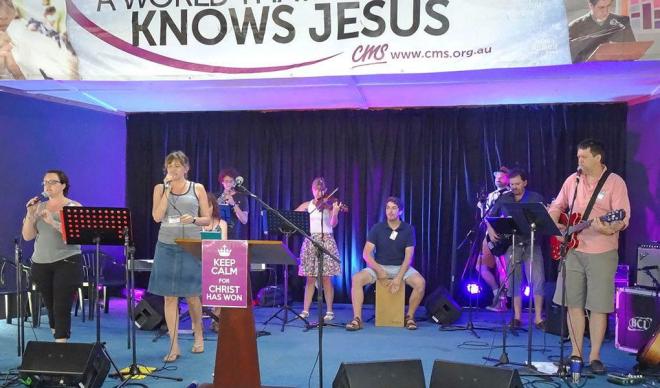
Luke 3:16In the first week of January this year I spent 6 days leading music at a missions conference on top of a mountain in southeast Queensland. The conference was the CMS (Church Missionary Society) Summer School, an annual event for the mission organisation with various guest speakers and missionaries, and about 600 supporters, many of whom are advancing in years (though the younger age brackets are also well represented). The conference theme was ‘Keep Calm for Christ has Won’ with keynote bible talks from Revelation. In fact we covered the whole book in this time! Peter Rodgers, head of CMS Australia, taught us well, showing how Revelation really is a book for us, not written to confuse us but to encourage us, to comfort, strengthen and make us bold for the risen Christ who stands as Victor in the spiritual realm…now! This is the realm revealed in Revelation, the realm of things that must remain unseen until our current heaven and earth are ‘rolled back like a scroll’. Revelation looks behind that heavy backdrop curtain which is the present physical world. It reveals a giant canvas of spiritual realities, of the victory Christ has already won. Far from being a timetable for world history yet to come, the book of Revelation is largely a picture of what has taken place already. (Well, through the teaching we received it made much sense to understand that this is what John has revealed). His letter describes the giant canvas of Christ’s victory. As John takes in this visual revelation his focus zooms in on one area at a time, explaining each different aspect of the battle and the victory. Though people will no doubt continue to discuss and debate the sequence of events, and how many have already occured, we should take comfort in this revelation of the big picture spiritual reality, and not be frightened off by the endless debate which surrounds the book.Christ has won Christ has won the victory, at the Cross. No matter what the spiritual reality behind the scenes looked like at this point in world history, the outcome remains the same.

Probably the most striking vision of the Risen Christ we were confronted with comes in the very first chapter, at which John falls down as though dead!
“I turned around to see the voice that was speaking to me. And when I turned I saw seven golden lampstands, and among the lampstands was someone like a son of man, dressed in a robe reaching down to his feet and with a golden sash around his chest. The hair on his head was white like wool, as white as snow, and his eyes were like blazing fire. His feet were like bronze glowing in a furnace, and his voice was like the sound of rushing waters. In his right hand he held seven stars, and coming out of his mouth was a sharp, double-edged sword. His face was like the sun shining in all its brilliance. When I saw him, I fell at his feet as though dead. Then he placed his right hand on me and said: “Do not be afraid. I am the First and the Last. I am the Living One; I was dead, and now look, I am alive for ever and ever! And I hold the keys of death and Hades.”
Revelation 1:12-18 NIV

This is no defeated carpenter who suffered and died and was forgotten. This is no meek and mild moral teacher. This is the blazing Lion-Lamb who lives and reigns now! He suffered as a sacrifice and conquered over the power of sin and death, once and for all. Now he lives forever. His voice and feet and mouth are more brilliant than the sun, and full of power. This is the risen Lord Jesus, Son of God, Son of Man who would receive the Kingdom and restore people to God.
Why then should we fear if we belong to him and are united with Him by faith, united in His death and resurrection? This is the vision of Christ we must hold on to in our present struggles – struggles much like those the early Christians suffered as they held onto their faith amidst persecution and ridicule. This letter was written (this vision was revealed) as much for their encouragement as ours. Let’s explore it without fear!

There’s so much more I could write about all that I learned from Revelation at the conference, but this vision of the Mighty Risen Saviour stands out most clearly. Here are some of the songs we used at the conference which have strong references to the concepts and words of John’s Revelation. (You might find them useful if you are preaching or singing through a series on the book.)

Come Hear the Angels Sing (Michael Morrow)
We belong to the Day (Michael Morrow)
See Him Coming (Mark Peterson)
Crown Him with Many Crowns (hymn)
See the Man (Trevor Hodge)
It is well (Todd Fields version of this hymn with new chorus: “God has won! Christ prevailed!”)
Let Your Kingdom Come (Sovereign Grace)
Majesty of Heaven (Chris Tomlin)
No other name (Trevor Hodge)
The Power of the Cross (Keith Getty)

CMS2014
Here we are at CMS Conference 2014. Music brings such encouragement!

Ps. If you have been praying for my dad Martin, thanks! Please continue to pray that he will be able to keep absorbing the food he is now eating and gain in strength. We praise God for his recovery so far! Blessings,

Ros

The Story behind the most famous Christmas carol

joy to the wJoy To The World (by Robert D. Kalis)

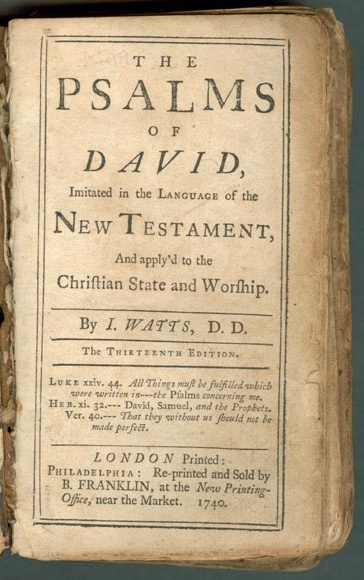
Our Christmas season would hardly seem complete without the singing of Joy to the World, the most joyous of the carols. Yet Isaac Watts, its author, never intended it to be a Christmas carol at all. Rather, it was a part of his Psalms of David Imitated, published in 1719, which contained paraphrases of many of the Psalms in New Testament language.

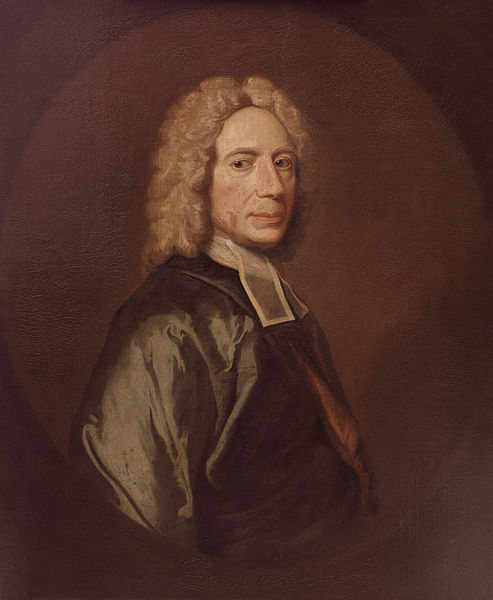
The story of the hymn, Joy to the World, is the story of the author, Isaac Watts (1675-1748), who is universally acknowledged as “The Father of English Hymnody”. He has earned the title, not because he was first to write English hymns, but because he gave impetus to hymnody and established its place in the worship of the English church.

For over one hundred years, congregational singing had been strictly limited to the Psalms of the Old Testament in poetic form. Many of these rhymed Psalms were so unnatural that Samuel Wesley, father of the famous brothers Charles and John, called them “scandalous doggerel,” and his opinion was shared by many.

The birth of Isaac Watts to a dissenting deacon and the daughter of a Huguenot refugee was followed by fourteen years of persecution and hardships for the entire family. Perhaps this suffering was responsible for Isaac Watts’ ill health, for he grew only to a height of just over five feet and was weak and sickly all his life.

Though weak in body, the boy was strong in mind and spirit and early in life showed promise of poetic capability. After one Sunday morning service, Isaac, then fifteen years old, complained of the atrocious worship in song. One of the deacons challenged him: “Give us something better, young man.” His answer was ready for the evening service and was sung that night in the Independents’ meeting, Southampton, where his father was pastor. Perhaps a hint of things to come was contained in this first verse of Isaac Watts:

Behold the glories of the Lamb Amidst His Father’s throne; Prepare new honors for His name, And songs before unknown.

When Isaac began to preach several years later, his congregation sang the songs that seemed to flow from his pen like a river. In 1707, the accumulation of eighteen years was published under the title, Hymns and Spiritual Songs. The river continued to flow, and in 1719 his “Psalms of David Imitated” was published, not as a new paraphrase of David, but as an imitation of him in New Testament language. It was as though the Psalms burst forth in their fulfillment at last.

watts-sacred_poemsJoy to the World is the “imitation” of the last half of Psalm 98. The author transformed the old Jewish psalm of praise for some historic deliverance into a Christian song of rejoicing for the salvation of God that began to be manifested when the Babe of Bethlehem came “to make his blessing flow far as the curse is found.” This is one of the most joyous hymns in all Christendom because it makes so real what Christ’s birth means to all mankind.

The tune to which the hymn is sung is attributed to George Frederick Handel and bears resemblance to phrases of his great oratorio, Messiah. Notably the first four tones match the beginning of the chorus, “Lift Up Your Heads.”

As we rejoice in the coming to earth of our Savior, we may also be glad for the veritable river of hymns that flowed from the pen of Isaac Watts. His name stands at the head of our most majestic hymns, notably, “When I Survey The Wondrous Cross.” In many hymnals more hymns of Isaac Watts are to be found than of any other single author.

http://www.joy-bringer-ministries.org/hymn1.html

You may also enjoy:
The Christmas Scale
The lost music of the Psalms

More carols with the Piano Guys – and the cellos

The Carol of the Bells

 O Come, O Come Emmanuel

And here are the immensely rich lyrics of this hymn, for your advent contemplation! I’ve included all the verses (though I’m sure I’ve only ever sung 4 or 5 of the 8 included here). Scroll down to the end of the lyrics for more information about the origins and themes of this carols (which is immensely under-rated I fear).

O come, O come, Emmanuel,
And ransom captive Israel,
That mourns in lonely exile here
Until the Son of God appear.

Refrain: Rejoice! Rejoice! Emmanuel shall come to thee, O Israel.

O come, Thou Wisdom from on high,
Who orderest all things mightily;
To us the path of knowledge show,
And teach us in her ways to go.

Refrain

O come, Thou Rod of Jesse, free
Thine own from Satan’s tyranny;
From depths of hell Thy people save,
And give them victory over the grave.

Refrain

O come, Thou Day-spring, come and cheer
Our spirits by Thine advent here;
Disperse the gloomy clouds of night,
And death’s dark shadows put to flight.

Refrain

O come, Thou Key of David, come,
And open wide our heavenly home;
Make safe the way that leads on high,
And close the path to misery.

Refrain

O come, O come, great Lord of might,
Who to Thy tribes on Sinai’s height
In ancient times once gave the law
In cloud and majesty and awe.

Refrain

O come, Thou Root of Jesse’s tree,
An ensign of Thy people be;
Before Thee rulers silent fall;
All peoples on Thy mercy call.

Refrain

O come, Desire of nations, bind
In one the hearts of all mankind;
Bid Thou our sad divisions cease,
And be Thyself our King of Peace.

Refrain

NB: The Words were com­bined from var­i­ous an­ti­phons by an un­known au­thor, pos­si­bly in the 12th Cen­tu­ry (Ve­ni, ve­ni Eman­u­el); trans­lat­ed from La­tin to Eng­lish by John M. Neale, Med­iae­val Hymns, 1851. Neale’s orig­in­al trans­l­a­tion be­gan, “Draw nigh, draw nigh, Em­man­u­el.”

Music: Veni Em­man­u­el, from a 15th Cen­tu­ry pro­cess­ion­al of French Fran­cis­can nuns (the set­ting for the fu­ner­al hymn Libera me); ar­ranged by Thom­as Hel­more in the Hymn­al Not­ed, Part II (Lon­don: 1856) (MI­DI, score).

The lyrics echo a num­ber of pro­phet­ic themes. The ti­tle comes from the well known Isai­ah 7:14: “Be­hold, a vir­gin shall con­ceive, and bear a son, and shall call his name Im­man­u­el.” Im­man­u­el is He­brew for “God with us.” The “Rod of Jesse” refers to Isai­ah 11:1: “There shall come forth a rod out of the stem of Jes­se”; Jesse was the fa­ther of Da­vid, se­cond king of Is­ra­el. “Day-Spring” comes from Za­cha­ri­as, fa­ther of John the Bap­tist, in Luke 1:78: “The day­spring from on high has vis­it­ed us.” “Thou Key of Da­vid” is in Isai­ah 22:22: “The key of the house of Da­vid will I lay up­on his shoul­der,” which in turn re­fers to Isai­ah 9:6 “The gov­ern­ment shall be up­on His shoul­der.”

All you ever wanted to know about modern hymns – even writing them!

This post is from a site called MY SONG IN THE NIGHT. which exists to help you express words of worship & testimony through songs & stories. “But each day the Lord pours his unfailing love upon me, and through each night I sing his songs, praying to God who gives me life.”
Psalm 42:8 (New Living Translation) (Looking for info, chord chart and instructional videos for the hymn “My Song In The Night” by Kristen Gilles? Click Here.)

This post has a wealth of information for those keen to understand what it is about hymns that makes them work, makes them singable for a group, and places the word emphasis in the right place. Some great insights. I feel inspired once again to get writing!

Modern Hymnslearn to write, appreciate modern hymns with hymnists Bobby & Kristen Gilles

WHAT ARE MODERN HYMNS?

When people speak of “modern hymns” they usually mean one of two things:

  • Old hymn texts, written by masters like Isaac Watts, Charles Wesley, Anne Steele, John Newton, William Cowper and others, then set to contemporary melodies by the likes of Sandra McCracken and those in worship communities like Indelible Grace, Bifrost Arts, Page CXVI, Cardiphonia or Red Mountain Music. Some of these artists also revise and arrange the original texts, and may add choruses as well.
  • Completely new hymns, written in hymn meter by contemporary hymnodists like Stuart Townend and Keith and Kristyn Getty.

Kristen primarily composes hymn tunes. Bobby primarily writes & arranges texts

Our church Sojourn has recorded albums with songs in the former category (The Water And The Blood, Over The Grave) and the latter (Before The Throne). Some of my songs from these projects in the former category include “Let Your Blood Plead For Me,” “Warrior” and “We Are Changed.” In the latter, “Lead Us Back” and “All I Have Is Yours.” Other songwriting communities who do some of each include Sovereign Grace and Mars Hill (Seattle).

Kristen and I wrote “My Song In The Night,” the theme song of this website, after being inspired by an anonymous American folk hymn text of the same title. We only included two lines from the original, though.

WHAT KIND OF SONGWRITERS NEED TO KNOW ABOUT HYMN-WRITING?

You will benefit from understanding the mechanics of hymn text-writing, including form and meter, if:

  1. You are a writer/musician/tunesmith who arranges old hymn texts, adds choruses to hymn texts, or composes new music for old hymn texts – even if you aren’t altering lyrics (for more on composing new music for hymn texts and other pre-existing lyrics, click here).
  2. You write songs of any kind, style or genre, and want to expand your range and repertoire of songwriting techniques.
  3. You want to write modern hymns – lyric and melody.

TELL ME HOW TO WRITE A HYMN, COMPARED TO HOW TO WRITE OTHER SONGS

A hymn is a poem, set to music at the time of its composing or later (sometimes the music for our most well-known hymns came decades after the lyrics).  In contrast to many modern songs and praise & worship chorus lyrics, hymn text writers typically write their lyrics in fixed “metrical patterns” (syllables and accents per line). The three most common are:

  • Common Meter (alternating lines of eight and six syllables per line (86.86).
  • Long Meter (all lines are eight syllables) (88.88)
  • Short Meter (first, second and fourth lines are six syllables, while the third is eight syllables – 66.86)

This style of writing isn’t exclusive to hymnodists. Some of the best songwriters of modern times utilize hymn meter on occasion:

Bob Dylan uses Common Meter in Lay Down Your Weary Tune:

I gazed down in the river’s mirror
And watched its winding strum
The water smooth ran like a hymn
And like a harp did hum.

* You’ll notice Dylan’s first line contains nine syllables. Dylan is using accentual meter (what Robert Frost called “loose iambic”), which is outside the depth of discussion in this introductory page, but which we’ll discuss in our Songwriting/Hymns Workshop posts.

Leonard Cohen uses Common Meter in A Thousand Kisses Deep:Sir Isaac Watts, poet, Father of English Hymnody

And quiet is the thought of you
The file on you complete
Except what we forgot to do
A thousand kisses deep.

And when Coca Cola’s advertising agency McCann-Erickson created a jingle that would become one of the most memorable ads of all time, their songwriters (Bill Backer, Billy Davis, Roger Cook) of course used Common Meter:

I’d like to teach the world to sing
In perfect harmony
I’d like to buy the world a Coke
And keep it company.

Sing the lyrics to either of these songs, using the tune from “Amazing Grace” or “House Of The Rising Sun.” Or “Alas! And Did My Savior Bleed.” Or the theme song from Gilligan’s Island.

Works, huh? That’s one of the benefits of writing in hymn meter, and is the reason great hymns stand up to modern interpretation by artists like Indelible Grace and Sojourn.  Because of their mathematically precise patterns, composers from nearly any musical background can write new music for these texts, no matter how old.

Aside: Lindsey Blair and I wrote the entire text of our children’s book Our Home Is Like A Little Church in this same meter. I have a blast singing it, Gilligan’s Island style.

No matter the meter, within each line you’ll hear a simple pattern of accented and unaccented syllables.

  • Even-numbered syllables are often accented while the odd are unaccented. We call each of these two-syllable units an iambic foot. (Ex. “Alone”)
  • If the odd syllables are accented while the even are unaccented, we call it trochaic.  (Ex. “Glory”)

A trochaic line:

Lucy in the sky with diamonds (John Lennon/Paul McCartney)

An iambic line:

How sweet the name of Jesus sounds (John Newton)

You can see that although each line is eight syllables (the technical name for that is “tetrameter”) they have a different feel. The trochaic line is forceful and excitable. Iambic lines are stately and loping, reaching their climax at the end.

A QUICK 21ST CENTURY EXAMPLE OF METRICAL VARIATION

One lesser-known reason “In Christ Alone” evokes strong feelings is because Townend and Getty begin each even-numbered line with a strong trochee before sliding back into the stately, prevailing iambic pattern. So the congregation sings a biblical truth on the odd-numbered line, and then begins the next line with a punchy declaration or exclamation:

In CHRIST aLONE who TOOK on FLESH
FULness of GOD in HELPless BABE!
This GIFT of LOVE and RIGHteousNESS
SCORNED by the ONES he CAME to SAVE

Poets write trochaic substitutions in iambic lines to produce the effect of sudden movement or emphasis. This is the most common metrical variation in all of English poetry, used by Milton, Pope, Yeats, Auden, Wordsworth, Keats, Frost and many others.  More on metrical variation in our article “Writers: Why Singers Put The Wrong emPHAsis On The Wrong sylLAble.”

So Songwriters Have To Be Aware Of All These Metrical Terms And Possible Variants?

As Paul Fussell, Jr. wrote in Poetic Meter And Poetic Form (p. 42-43):

… although metrical variations can be displayed by scansion and analyzed dispassionately, when the poet performs them they are largely instinctual, a technique of his art so unconsciously mastered that he seldom pauses formally to debate a metrical alternative. Indeed, many poets whose work can be analyzed metrically according to the traditional foot system would undoubtedly be astonished to hear that they have indulged in anything like “substitution.” The poet composes according to the rhythms which his utterance supplies, and although these rhythms frequently turn out to consist of “base” and “substitute” feet, they do not necessarily begin that way.”

Get our free glossary of hymn meter & form terms here.

MORE COOLNESS IN LEARNING HOW TO WRITE HYMNS

As Keith Getty has said, “The hymn format means you can write songs that average 200 words. The average worship song only has about 40 words, so obviously can’t be as deep in proclamation of biblical truth.”

Maybe only folk ballads and hip hop can approach or exceed hymns in their ability to “go deep” into subject matter (you should check out Shai Linne and Lecrae – believers in Christ who write stunning music for the Church through the medium of hip hop).

Shai Linne at Sojourn

Shai Linne with our pastor Mike Cosper at Sojourn

Some of this may seem confusing, but don’t worry! We’ll go through it all, step-by-step, within the pages of mysonginthenight.com. In no time flat, trochees and iambs will be as familiar to you as water and sky. You’ll be swimming in the deep end of meter with nary a life jacket in sight.

Not only that, we’ll talk metaphor and simile. We’ll speak of dactyls and anapests, alliteration and rhyme. We’ll talk about “the songwriting rules,” including how to know when to break them.  We’ll discuss how to bring strong theology to your writing without making it dull, and how to tell your personal story through song without becoming unmoored from biblical teaching.

So sign up to our posts through email, subscribe through RSS or just visit mysonginthenight.com regularly.  Click on the Songwritng/Hymns category to see everything we post on the subject, and grow as a writer through the many songwriting assignments we’ll give you.

If you feel this page is helpful, we’d be thankful if you would link to it so that others who want to learn how to write modern hymns can find it on your site and in search engine results. For instance, copy-and-paste the URL of this web page into a hyperlink that says something like “To begin learning how to write modern hymns, visit mysonginthenight.com.

Interested in checking out worship communities who are considered part of the modern hymns movement? Our friend Zac Hicks has compiled the most comprehensive list we’re aware of, at his website.

Want to learn more about writing music for old hymn texts or other pre-existing poems and song lyrics? Visit our “How To Compose Tunes For Hymn Texts & Write Music For Other Song Lyrics” page.

And get our free Songwriter’s Glossary Of Poetic And Rhetorical Devices here

http://mysonginthenight.com/songwriting/modern-hymns/

The lost music of the Psalms

As you may know I’ve been thinking about the Psalms lately and wondering if I can track down some singable and contemporary arrangements. It is proving to be a slightly frustrating quest. As this post from In Touch ministries explains, much has been lost in the translation of the Psalms – our English versions simply cannot convey the original lyrical structures, making them difficult to craft into song. But while we must enjoy them more as poetry, the Psalms still provide encouragement for us today. God’s voice still speaks through them, and in them His Spirit works.

Lost in Translation -Though silent, the book of Psalms still resonates.

by Jamie A. Hughes

There are few things worse than sitting in a crowd of laughing people when you don’t get the joke, but that’s exactly what happened to me when I saw the play Cyrano de Bergerac performed in French. The title character is a force of nature, a brash swordsman as well as a gifted musician and poet. However, there’s something else that sets him apart—an enormous nose he describes as “a monument open to the public.” Cyrano feels no one could love him because of his appearance, so he uses his words to win friends and wound enemies. That’s why it’s important to understand exactly what he’s saying if you want to keep up. I had seen the play performed in English several times, but when I heard the rhyming dialogue flowing from the actor’s mouth like a melodic river, I realized I’d never experienced the play the way it was meant to be enjoyed. Then as now, I understand just enough French to follow a basic conversation, but the finer points of the language are lost on me.

I’ve learned that the same is true of Psalms, the prayer book of Israel and what many call the central, beating heart of the Old Testament. The word “psalm” is a derivative of the Greek term psalmos, which means “song,” but these scriptures are read like poetry today rather than sung with accompaniment. The music may be unknown, but the beautiful words retain a certain melodic quality of their own. That’s why the poet Naphtali Herz Imber says, “In [the psalms] one finds the deep heartbreaking tones of a Beethoven . . . the silent, sweet whisper of love’s longing, as well as the wild galloping hallelujahs suggestive of Wagner.”

“Where can I go from Your Spirit? Or where can I flee from Your presence?” wrote David in Psalm 139. “If I ascend into heaven, You are there; if I make my bed in hell, behold, You are there. If I take the wings of the morning, and dwell in the uttermost parts of the sea, even there Your hand shall lead me, and Your right hand shall hold me” (vv. 7-10). We can savor these majestic, encouraging words and know our God is always near, but without the melody, can our hearts ever totally understand what “the man after God’s own heart” was trying to express (1 Sam. 13:14)? I can’t help but wonder if phrases like “ascend into heaven” and “take the wings of the morning” climbed a bright and brilliant scale that lightened the heart and lifted the eyes. I imagine Levitical choirs singing of hell and the “uttermost parts of the sea” in rumbling bass tones, a picture of bleak places painted with sound.

In another psalm, the author uses a simile to describe his yearning for the Lord’s presence: “As the deer pants for the water brooks, so pants my soul for You, O God” (Ps. 42:1). Beautiful verse to be certain, but we can’t fully appreciate it without knowing the melodious sounds of the instrument for which it was crafted.

This is an ache words alone cannot express, but music helps articulate such an emotion effectively. How much better would we understand this prayer if we could participate with our ears as well as our eyes?

Though the psalms are exquisite, we can’t experience them in the same way the people of Israel did. But when we reach our eternal home, perhaps we’ll hear these prayers as songs for the first time and understand what Isaiah meant when he said, “Then the eyes of the blind shall be opened, and the ears of the deaf shall be unstopped. Then the lame shall leap like a deer, and the tongue of the dumb sing” (Ps. 35:5-6). In that moment, we’ll know more fully the extent of God’s goodness, beauty, and delight. And we will rejoice.

As is the case with God’s creations, there will always be more to learn about the psalms. His handiwork is breathtaking in depth and scope, and this is why a scripture mulled over one hundred times can still surprise on the one hundred and first reading. Or why a story that seems insignificant in times of jubilation is the only thing that sustains us when trouble comes. So while there’s no way of knowing exactly how the 150 musical prayers of praise, lament, wisdom, and thanksgiving should sound, we can still read and delight in them—and rejoice in what they (and we) will be one day.

All Scripture quoted is from the New King James Version. 2013 In Touch Ministries, www.intouch.org.

You may also enjoy:
The blessed and God-breathed book                                     Wake up and see the glory
GodBreathed_slide1x_365_y_273steven-curtis-chapman-declaration-lyrics-4a1c

Rising Sun (All Sons and Daughters)

IBR-1113189Here is another song from All Sons and Daughters. Again the lyrics have a beautiful Psalm-like quality. As you may know, I’ve embarked on a quest to find singable contemporary Psalms. Suggestions are most welcome. Enjoy!
(Scroll down for youtube link with lyrics).

Rising Sun

Praise Him all you sinners, Sing oh sing you weary
Oh praise Him all you children of God
We lift high His glory, Shown throughout our stories
We praise Him as the children of God

Our great redeemer, Glorious Savior
Your name is higher than the rising sun
Light of the morning, You shine forever
Your name is higher than the rising sun

Praise His name forever, Speak it loud and clear now
Oh praise Him all you children of God

Our great redeemer, Glorious Savior. . .

Hallelujah, Name above all
Simply to speak Your name is praise
Hallelujah, Now and always
Forever we lift Your name in praise
Hallelujah, Our God, You reign
Simply to speak Your name is praise

Our great redeemer, Glorious Savior. . .

Hallelujah name above all
Hallelujah, Hallelujah

Learn more about the Album Sons & Daughters Live

You may also enjoy:
Great are You, Lord (All Sons & Daughters)                                      The Bible’s Songbook
all sons and daughtersImage created by Sarah Danaher with a Canon EOS 5D MkII

Great are You, Lord (All Sons and Daughters)

GREAT ARE YOU LORD
Written by: Jason Ingram, Leslie Jordan, David Leonard (All Sons & Daughters)all sons and daughters

You give life, You are love
You bring light to the darkness
You give hope, You restore
Every heart that is broken
Great are You, Lord

It’s Your breath in our lungs
So we pour out our praise
We pour out our praise
It’s Your breath in our lungs
So we pour out our praise to You only

You give life, You are love
You bring light to the darkness
You give hope, You restore
Every heart that is broken
Great are You, Lord

All the earth will shout Your praise
Our hearts will cry, these bones will sing
Great are You, Lord

© 2013 Integrity’s Praise! Music/BMI & Integrity’s Alleluia! Music/SESAC (both adm at EMICMGPublishing.com) & Sony/ATV Timber Publishing/West Main Music/Winsor Hill Music/SESAC

You can find the lead sheet for this song on CCLI. (Hope to try it at church! It has a very Psalm-like quality!) Find out more about the album All Sons & Daughters Live. You may also like their song Come to Save us which could be great for a Christmas special.

You may also enjoy:
Why do we sing about wrath?                         Angels long to understand the story of grace
angel starlightning