
As a teacher of English literature, I often point students to explore the significance of a character’s final words, spoken when they exit a text or when the author brings the whole story-world to a conclusion. In these final words we see the essence of each character’s intentions, motives, and – well, how else can I say it – character! These words also crystallise what the author wants us to know or remember about the character, their actions and meaning.
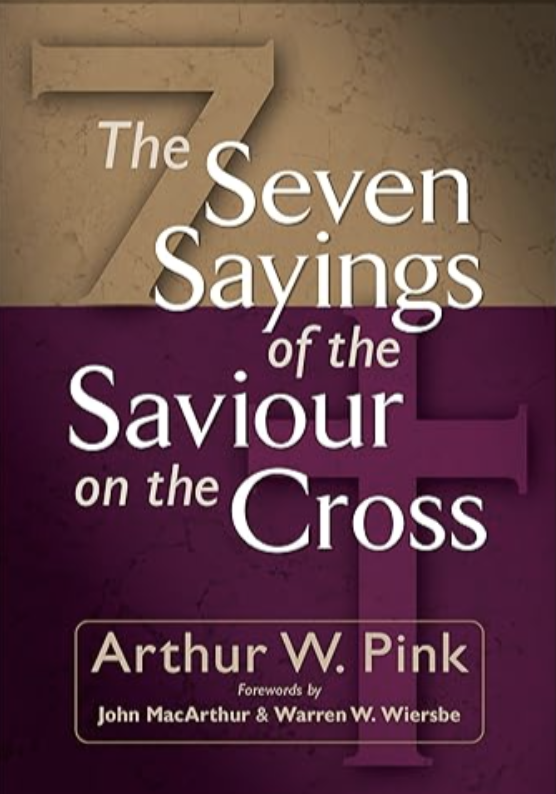
What can we learn then from Jesus’ final words – the words of the Word of Life, the Author and perfector of our Faith? “The Seven Sayings of the Saviour on the Cross” is a book by Arthur W. Pink which has been waiting on my desk for some time. It seems like this Easter week is a perfect time to make actually reading it a priority. At the end of each chapter, I’ll offer you some insights on the significance of Jesus’ final words, which reveal his heart, mind, and purpose. Stay with me if you want to know more, but can’t see yourself reading the whole book.
Before we begin to explore Jesus’ words more deeply, let me remind you of the key facts of Jesus’ crucifixion. This summary is provided by Charles Swindoll:
Jesus of Nazareth said He would “suffer . . . be killed, and be raised up on the third day” (Matt. 16:21). Betrayed by Judas, He was seized, placed under arrest, pushed hurriedly through several trials (all of them illegal), and declared guilty . . . first of “blasphemy,” next of “treason” (Luke 22:70–23:24). Alone and forsaken, He endured the torture of scourging, the humiliation of insults and mockery, and the agony of that walk to Golgotha (Mark 15:15–22). The horrors of crucifixion followed, leaving Him suspended for six excruciating hours . . . the last three of which were spent in eerie darkness that “fell over the whole land” (Mark 15:33). By three o’clock that afternoon He uttered His final words. “Father, into Your hands I commit My spirit” (Luke 23:46). Then . . . He died (Matt. 27:50; Mark 15:37; Luke 23:46; John 19:30).
(NB. I also recommend Swindoll’s “The Darkness and the Dawn” as another great read for Easter. It will give you a much insight into the last 24 hours of Jesus’ life.)
- Words of Forgiveness
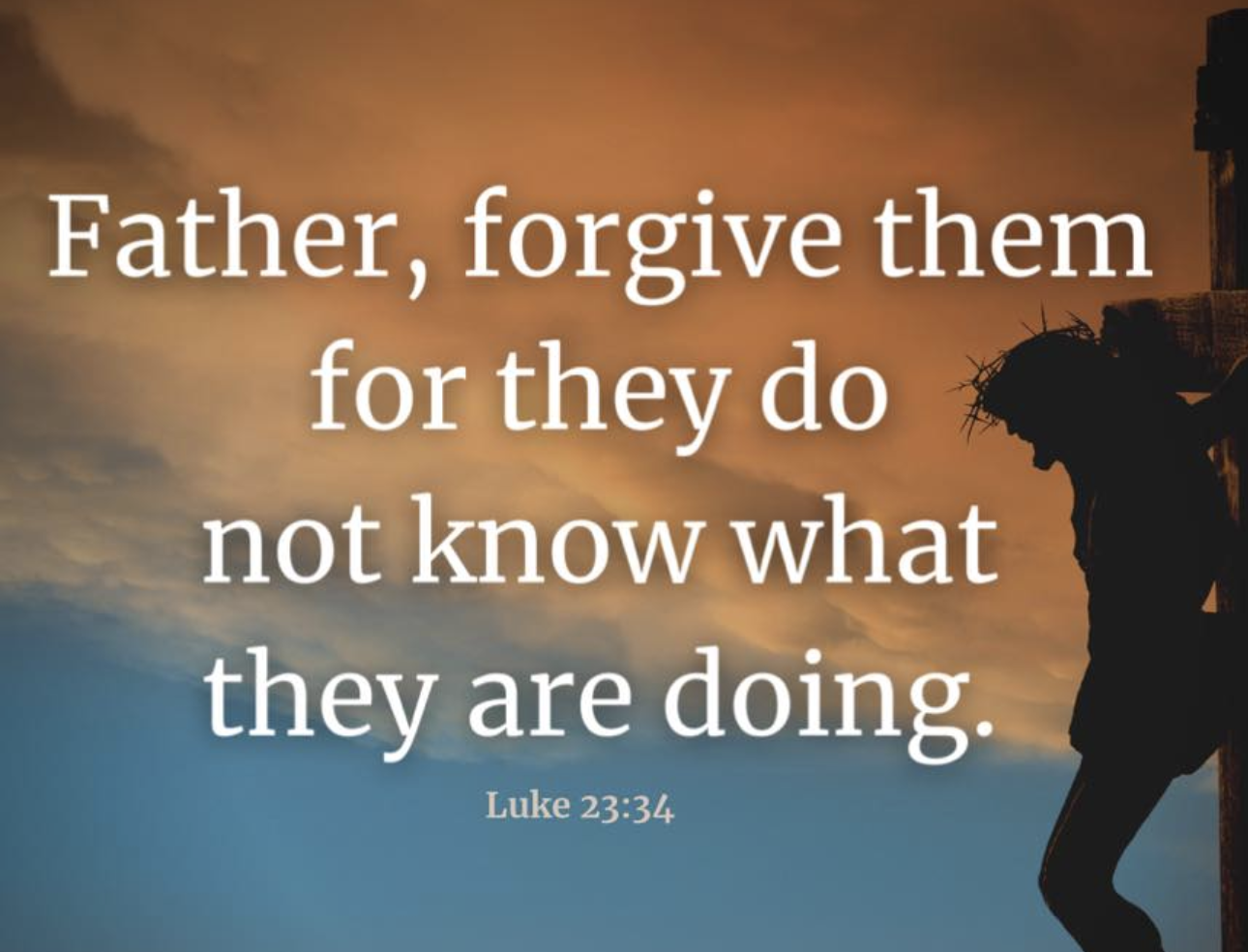
“Jesus said, “Father, forgive them, for they do not know what they are doing.”
Luke 23:34 (NIV)
These first “last” words, also translated more poetically as “they know not what they do”, are probably the most famous words associated with Jesus’ crucifixion. They sum up his compassion and humility, and emphasise just how undeserving he is of such punishment at the hands of sin-blinded humans. In this moment, Jesus is praying for his enemies, both those who are inflicting this ultimate form of Roman torture and those who have forsaken him and fled. Jesus prays for forgiveness from the Father, for all who acted in wilful ignorance. He prays for these people (people just like us) on their behalf, that the Father might forgive them.
Here are 4 most important things to know about this first phrase, when Jesus prays “Father, forgive them, they know not what they do.”
1. A Prophecy Fulfilled: The book of Isaiah foretold that the promised Saviour would make “intercession for the transgressors”. In these complex terms we find the significance of Jesus’ gracious prayer at the time of the crucifixion. Intercession means the act of intervening or praying on behalf of others; in this case, the ‘others’ are transgressors – criminals or offenders – who break laws or moral principles. Now read Isaiah 53 again, or at least verse 12: “. . . He poured out his life unto death and was numbered with the transgressors. For he bore the sin of many and made intercession for the transgressors.” In the words ‘Father forgive them‘, Jesus prays for all those who have rejected and beaten him, who mocked and spat on him. He pleads for his crucifiers and asks on their behalf for forgiveness. Jesus’ prayer fulfills this role of the promised Messiah. (All of Isaiah 53 points to Jesus’ death (hundreds of years later) with pinpoint accuracy. Please spend some time there.)
2. The Blindness of the Human Heart: “They know not what they do” does not mean these people didn’t know the facts of the crucifixion and their role in it. They are fully aware of the impact of their cries to “crucify him” and how they delight in the spectacle of his mocking trial, torture, and death. But they do not know the enormity of their crime against the Son of God. It is what they are doing that they don’t know. They are rejecting the promised Saviour. Yet Pink says they should have known. “From the start of Jesus’ ministry, His was a life on which was stamped the Father’s approval: ‘This is my beloved Son, in whom I am well pleased’.” Pink laments that this tragic rejection of Jesus continues to be repeated across time and place: “Sinner, little you know what you are doing in neglecting God’s great salvation. You little know how awful is the sin of slighting the Christ of God and spurning the invitations of his mercy” (p.26). May God reveal the truth of Christ in the lives of all who continue to deny Him.
3. Christ Identifies with His people: In asking “Father, forgive them,” Jesus reveals how much he identifies with the humans whose sin he carries. This is the only time when Jesus requests that His Father bestow forgiveness. Prior to this, Jesus himself is the one forgiving the sins of multiple people (often with simultaneous healing). To forgive sin is a divine prerogative and that is why Jesus must call on the Father instead to forgive. When Jesus is raised from earth, hanging on the Cross as the Son of Man, he has given up his divine position. He has “become” sin for us, taking our place as one of us and carrying the weight of our sin. He pleads with the Father to forgive those whose sins he has taken as his own.
4. Jesus’ Prayer is fulfilled: Jesus’ request that the Father “forgive them” is fulfilled just over a month later with the astonishing conversion of 3000 souls on the Day of Pentecost. This connection is made clear by the Apostle Peter in Acts 3: 17-20:
17 “Now, fellow Israelites, I know that you acted in ignorance, as did your leaders. 18 But this is how God fulfilled what he had foretold through all the prophets, saying that his Messiah would suffer. 19 Repent, then, and turn to God, so that your sins may be wiped out, that times of refreshing may come from the Lord, 20 and that he may send the Messiah, who has been appointed for you—even Jesus.” Pink sees this as a direct and perfect fulfilment of Jesus’ prayer: “it was not Peter’s eloquence that was the cause, but the Saviour’s prayer” (p.21) which turned these once ignorant people to Him and won their salvation.
In summary, Pink says that “in praying for His enemies, not only did Christ set before us a perfect example of how we should treat those who wrong and hate us, he also taught us never to regard any as beyond the reach of prayer. If Christ prayed for His murderers, then surely we have encouragement to pray now for the very chief of sinners! Christian reader, never lose hope” (p.20).
Let’s rejoice that Jesus’ prayer continues to be answered. According to the World Christian Encyclopedia, around 2.7 million people convert to Christianity from other religions each year, which is about 7500 people per day! The Encyclopedia also notes that Christianity is “the religion with the largest net gain in population through religious conversions.” In an article about the unexpected surge of Global Christianity (2024), Frontier Partners International reports that “Christianity is not only growing in numbers but is also expanding geographically.”
Let’s continue to pray that Jesus’ prayer would be fulfilled this Easter – that forgiveness may be won and souls redeemed to new life in Him. Catch you again on Day 2. You may like to think ahead and consider the significance for yourself. Luke 23:42-43
And here is a song which I think sums up much of the compassion of the dying Saviour who seeks forgiveness for us on our behalf: “Glorious Day” by Casting Crowns:
https://youtu.be/2ntwGWzdCwc?si=8PhGFJj4cj2RKg2y
(This series draws on the structure and ideas in “The Seven Sayings of the Saviour on the Cross” by Arthur W. Pink, 1984, Baker Book House. Direct quotations are indicated. AI was NOT used in the creation of this Blog post.)
 sevennotesofgrace