“The Same Love” is calling

From the very beginning, the Creator has been calling to us, drawing us into relationship with Him. He has shown us His love, again and again through human history. The Cross is the pinnacle of the call. He still calls today. We must repond to the loving call of God.
This is a great song by Paul Baloche, with a really creative video to go with it.
Enjoy. (It is the title track of his 2012 album by the same name).


THE SAME LOVE
You choose the humble and raise them high
You choose the weak and make them strong
You heal our brokenness inside
And give us life

The same love that set the captives free
The same love that opened eyes to see
Is calling us all by name
You are calling us all by name
The same God that spread the heavens wide
The same God that was crucified
Is calling us all by name
You are calling us all by name

You take the faithless one aside
And speak the words “You are mine”
You call the cynic and the proud
Come to me now
The same love that set the captives free
The same love that opened eyes to see
Is calling us all by name
You are calling us all by name
The same God that spread the heavens wide
The same God that was crucified
Is calling us all by name
You are calling us all by name

Oh oh…

You’re calling You’re calling
You’re calling us to the cross

New songs say ‘God is doing something now’!

music_is_nature__silhouette_by_sammy3773-1Sometimes change can make us very uncomfortable. It can make us feel totally out of control, it can rob us of things to which we feel entitled. Let’s explore this for a moment in terms of church music.
We Christians develop a real attachment to the songs of our faith. They become associated with the ups and downs we have been through, or the exciting time of our youth, or the time we first came to faith. When we sing them the songs instantly conjure the emotions of those times. This is why some people just can’t sing songs from the funerals of dearly departed friends and family, without being overwhelmed by sadness.

So should we learn new hymns and spiritual songs, especially when such change can cause great angst?  I had a conversation with a lovely friend over the weekend who was frustrated with a lack of interest for changing and updating the songs they sing in their church. Many of her congregation are still attached to the ‘Scripture in Song’ repertoire which became popular in the 70s and 80s. The musical style of these choruses hark back to this era . . . and make some people really cringe!

I have found a great rationale for new songs from Rick Warren, author of the “Purpose Driven Church” (1995). If you study church history you’ll discover that every genuine revival has always been accompanied by new music. New songs say ‘God is doing something here and now, not just a hundred years ago’. Every generation needs new songs to express its faith“.

Another great insight comes from a Presbyterian minister Rowland Lowther (2002). He says that his favourite Christian song is “When I survey the Wondrous Cross”, to the old hymn tune, . . . but for the sake of the Gospel I would be willing to change the musical style so that those wonderful lyrics could impact on the next generation. . . What matters to me more is not that I be moved, but those in the next generation has those wonderful old lyrics to a music format that can lift their spirits to worship the same living God that the writer of this hymn worshipped hundreds of years ago”.

Great point. I think it also comes down to the concept of “renewing our minds”. By hearing the gospel explained by new people, in new and fresh ways, our understanding of God and the gospel of His grace is strengthened and deepened. That has got to be a good thing.

You may also like:

12 Principles for Church Singing                                       New Songs we have been singing
praise him picFamily Singing

The Grace that breaks in and saves

“The Bible’s purpose is not so much to show you how to live a good life. The Bible’s purpose is to show you how God’s grace breaks into your life against your will and saves you from the sin and brokenness that otherwise you would never be able to overcome….Religion is ‘if you obey then you will be accepted.’ But the Gospel is ‘if you are absolutely accepted, and sure that you are accepted, only then will you ever begin to obey’. Those are two utterly different things. Every page of the Bible shows the difference.”
Tim Keller.

Faith in Jesus’ powerful name (Acts 3:16)

Here in Acts we continue our journey through the “Three Sixteens” – Peter and John have just gone up to the temple to pray. Peter commands a beggar, lame from birth, to get up and “in the name of Jesus Christ of Nazareth, walk.” Literally Peter means a continuous action ‘be walking‘. He grabs him by the right hand to raise him up. “The power was Christ’s but the hand was Peter’s” (John Stott 1990). This healed beggar then famously goes “walking and leaping and praising God!” He becomes the living embodiment of the Messianic age, predicted in Isaiah 35:6, Then will the lame leap like a deer.

The result of all this is another hugely important 3:16 verse:
“By faith in the name of Jesus, this man whom you see and know was made strong. It is Jesus’ name and the faith that comes through him that has completely healed him, as you can all see.(Acts 3:16)

Peter explains to those in the temple courts that this healing reveals Jesus is the Christ, the Messiah. He is the promised suffering Servant who brings healing to all the nations. Peter’s own “power or godliness” did not heal the man. It was the power of the risen Lord Jesus. Peter tells the Jews that though they acted in ignorance and killed the “author of life“, this is howGod fulfilled what he had foretold through all the prophets, saying that his Christ would suffer (verse 18).

This miracle, performed “in the name of Jesus”, brings physical healing and a great testimony. Peter wants them to repent and receive the promised Messiah who can bring them healing, promised healing that is so much more than physical.
“I will give you a new heart and put a new spirit in you; I will remove from you your heart of stone and give you a heart of flesh. And I will put my Spirit in you and move you to follow my decrees and be careful to keep my laws.” (Ezekiel 36:26-27)
“I will put my law in their minds and write it on their hearts. I will be their God, and they will be my people.” (Jeremiah 31:33)

Peter has received the Spirit of the risen Christ, and in Jesus’ name alone can Peter heal.  In Jesus’ name we can be healed from our sinful separation from God. He has offered to give us a new heart, a heart transplant. Our sick, dead, un-beating, stony hearts can be replaced. This is the healing we all need to receive – in Jesus’ powerful name.

Finally, here is the link to Chris Tomlin ‘s take on “The Name of Jesus” which he describes as “a saving place to run, a hope unshakeable . . . there is power in Your name, in the name of Jesus there is life and healing, chains are broken in Your name”.

2010 worshiptogether.com Songs / sixsteps Music 

“My Hope” in God’s grace

same loveFor many years I have been a church music junkie (still am). I spend lots of time seeking out great new songs to inspire the local church. Paul Baloche is one writer who usually delivers great songs about great bible truths and the great love of our Saviour.

This one is a fairly recently release, the song “My Hope”. We have taught it at our church; actually it became a sort of theme song to a sermon series on Deuteronomy. The song speaks of the guidance and the faithfulness of God, how through every test His GRACE is with us. Amen to that. Our God is not fickle or changing. That’s why we can hold on to Him. I’m really looking forward to teaching about 600 women this new song at a Women’s conference (called GROW) in Brisbane early next month. I hope you enjoy the song too.

“My Hope” from the album The Same Love, Paul Baloche 2012
Nothing will change if all the plans I make go wrong
Your love stays the same
Your light will guide me through it all
I’m hanging on, I’m leaning in to You

Nothing can reach the end of all Your faithfulness
Your grace is with me through every shadow every test
I’m hanging on, I’m leaning in to You

I don’t know where You’ll take me
But I know You’re always good

My hope is built on nothing less
Than Your great love, Your righteousness
I will not walk another way
I trust Your heart, I trust Your Name
I’m holding on, I’m holding on to You

You are my Rock when storms are raging all around
You shelter me God
I’m safe with You on solid ground
I’m hanging on, I’m leaning in to You

I don’t know where You’ll take me
But I know You’re always good

My hope is built on nothing less than Your great love, Your righteousness,
I will not walk another way, I trust Your heart, I trust Your Name
I’m holding on, I’m holding on to You

CCLI Song # 5882177  Alyssa Mellinger | Ed Kerr | Paul Baloche | Sheila Rabe
© 2010 kerrtunes Integrity Worship Music (Admin. by Crossroad Distributors Pty. Ltd.)

You may also like:
I will boast in the Lord my God                                                                More Great grace songs
Image created by Sarah Danaher with a Canon EOS 5D MkIIadvent


You are our Song from Age to Age

“. . . Though tears now veil our eyes
Your steadfast love, our perfect hope
Our eyes are fixed on grace
We have no doubt You’ll lead us home
To finally see Your face”

These words are found in verse 3 of a new song by Sovereign Grace music, “Our Song from Age to Age”. I first heard it last Thursday night in Brisbane at an event hosted by Qld Theological College, where Don Carson shared an amazing vision of the “Future of Christianity” (from Revelation 21-22) with around 1500 people.

For me this song highlights GRACE, the thing we fix our eyes on as Christians, the GRACE by which we are saved. (See Ephesians 2:8-10). This is the only thing worth singing about and has been since . . . forever!

The first grace-filled song recorded in the Bible (though most probably not the first song uttered on this topic!) comes from Moses and Miriam in Exodus 15. Here are a few choice lines:

“I will sing to the Lord, for he has triumphed gloriously; he has hurled both horse and rider into the sea.
The Lord is my strength and my song; he has given me victory. . .
Who is like you among the gods, O Lord—  glorious in holiness, awesome in splendor, performing great wonders?
You raised your right hand, and the earth swallowed our enemies.
With your unfailing love you lead the people you have redeemed.
In your might, you guide them to your sacred home.”

This great rescue is pure grace. Yet so is music! So is praising God! It is a healing balm for the soul.
God has created us with the desire to praise Him and strangely, we feel most satisfied in ourselves when we are doing just that. Though sin deceives us into thinking we will feel our best when proudly singing our own praises, that will make us feel worse. Really, how long could we praise ourselves before we ran into something we would rather not sing about?
We must praise Him, not just with our mouths but with all our heart, our attitudes, our actions, our thoughts. Even if we could praise Him fully or perfectly, there would still be more to praise Him for, with the grace of each new day and into eternity! As creative image bearers of our Father, we should never run out of fresh ways to “declare the praises of him who called you out of darkness into his wonderful light. Once you were not a people, but now you are the people of God; once you had not received mercy, but now you have received mercy.” (1 Peter 2:9-10)
If you have found great grace in praising God, whether by yourself, or when gathered with his people, I would love to hear your comments.

Here is the link to listen to the song “Our Song from Age to Age” written by Joel Sczebel 2012.

And if you are someone who enjoys discovering great praise and worship songs for today’s church, then spend a bit of time exploring the Sovereign Grace site:  www.sovereigngracemusic.org . They graciously allow you to download their lyrics and sheet music for free! (Click on the STORE tab). These are inspiring and singable songs, full of bible/gospel truth. Enjoy!

Oh and if you want to know more about Don Carson, I’m sure you can figure out how to google him. Also check out a great website of his resources: thegospelcoalition.org

Sharing the perspicuity of God’s gracious Word

Bible-28Perspicuity – I just love that word!
Before we go any further I should probably tell you what it means, shouldn’t I? It means “the quality of being perspicuous, of being clearly expressed and easily understood”. The word “Perspex” (which is a clear acrylic substitute for glass) is a close relative. If something is as “clear as glass” you can see through it!
Now for the sake of being “perspicuous” I better get to my main point: God’s Word is perspicuous, but many of us are unconvinced!
Years of sitting through bible studies and sermons can make us doubt the perspicuity of the bible, and our own ability to read and understand it. We think we must always rely on theologically trained people to explain the Bible to us. And so . . . we don’t read it, or we read with fear or reluctance. (Nb. I still love theologically trained people who teach the Word well.)
One great way to come back to the perspicuity to the bible is to read it with someone else, and this is what I was thinking about when I first came across the word a few months ago. I was preparing a presentation on One-2-One bible reading for a women’s breakfast. D. Broughton Knox (Moore College Principal 1959-1985) said regarding the perspicuity of the bible, that “the Bible is comprehensible, and its interpretation does not depend on experts or even authoritative interpreters“. Another theologian would like us to remember a similar point: “In evangelism, in edification, nothing can beat opening the text of the Bible and reading what God Himself has actually said. Christians need only have confidence in God’s word and a basic skill in reading it with others” (Phillip Jensen, Dean of Sydney, Anglican Church).

Through preparing and delivering my talk I now realise it is no easy task convincing people they can read the bible informally, understand it and be strengthened by it. Yet I have found this to be true by nearly all who will dare try it, including myself. So will you dare? If you are feeling flat or stuck or stifled or at a standstill in your growth as a Christian, or if you simply want to “let His Word dwell in you richly” (Colossians 3:16) then try it. All you need is a friend, a bible book (and pencil), and an hour a week, over whatever period of time you choose. Around 15-20 verses is enough to share each week; just pick up where you left off the next time you meet.

WHAT TO DO:
Read through the text aloud once, silently once, and then grab a pencil to mark up your text.
Identify 3 things: questions, “lightbulbs” (main points) and “arrows” (application points, things to apply and act on). I use little symbols for each of these. Once you’ve both marked your text with a pencil, simply share and discuss each of your questions, lightbulbs and arrows.

THINGS TO REMEMBER:
1. The purpose of reading together is to read and question the text together; the huge benefits come through the conversation, the dialogue you have around the text. Over time you will have talked your way through and in and around a whole book of the bible. You WILL remember the message of that book much better. . .and you will have deepened your friendship in the Lord! Bonus!
2. You don’t have to have all the answers or be an expert. It is best not to use study bibles as that can prevent you from thinking and really listening to the text. (That said, it is sometimes useful to look at intro notes before you start a book, just to clarify the context, date and author of a book. If burning or totally difficult issues/questions come out of your discussion look it up during the week and report back. I’ve found this isn’t required often at all).
3. No preparation! Don’t read ahead or study a passage so you can appear wiser/a better Christian! Trust that God can and will speak though His Word and that you will be able to discuss and understand it.
4. It’s good to use 2 different translations (if you can cope with that, like NIV and ESV and NLT) as you will get a greater grasp of the passage this way. A different translation sometimes help clarify the intended message.
5. Silence is okay! In fact, it’s great! Encourage thinking time. Make this clear to your reading partner at the start.
6. Pray at the start and end of your time together.

Enjoy the gracious gift of God’s perspicuous Word in your own language, and the opportunity to read it in freedom!

“God had every reader of Holy Scripture in mind at the time of its ‘exhalation’. This means not only that God’s Word is inspired and universally applicable, but also that, in it, God is speaking presently to every particular reader (or hearer) of His Word.”
(Peter Blowes, 2011, “Reading the Bible”, Matthias Minizine)

You may also like these posts:

From the Gospel Coalition: 7 Arrows for Bible Reading

The Blessed and God-breathed book (2 Timothy 3:16)GodBreathed_slide1x_365_y_273

 

Mark 3:16 – The Twelve are chosen!

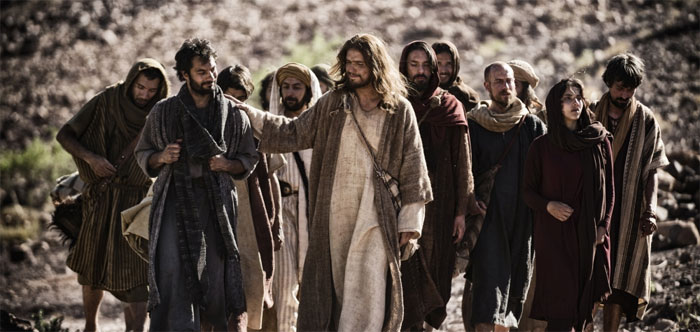
the-bible-jesus-and-disciplesWelcome to my second post in the Three Sixteens series. In chapter three of Mark’s Gospel, verse 16 lands at the moment where Jesus has chosen those who will eventually be his apostles, his special representatives charged with the task of calling people to repentence and faith. Now I would call that a significant moment!

Mark 3:13-19: “Afterward Jesus went up on a mountain and called out the ones he wanted to go with him. And they came to him. Then he appointed twelve of them and called them his apostles. . . These are the twelve he chose: Simon (whom he named Peter), James and John (the sons of Zebedee, but Jesus nicknamed them “Sons of Thunder”), Andrew, Philip, Bartholomew, Matthew, Thomas, James (son of Alphaeus), Thaddaeus, Simon (the zealot), Judas Iscariot (who later betrayed him).”

These disciples are taught directly by Christ in plain language (not just in parables, as spoken to the crowds). They accompany him in his ministry travels for three years (equivalent to a university degree!) and are given the authority to cast out demons and preach salvation in His name. I can’t help thinking how ill-equipped for the task they probably felt!

These young men were plucked from the normality of their lives, their homes, their work, their possessions – to face scorn and hardship. They followed the Man who had no home so that many might have an eternal home with him! These men gained an intimate knowledge of the One through whom all things were made, the Creator of the Universe, but at the same time they were often confused by his teachings and rebuked by him for their lack of faith.

These young men would become eyewitnesses to Jesus’ resurrection, preachers of his gospel, and in turn they would share his sufferings. Indeed most were martyred during the early church era for the sake of the glorious gospel message: salvation in Jesus name. Really you could say they were martyred for us, that we might believe and become His disciples. Their deaths are such a powerful testimony to the truth of Jesus and the reality of salvation in Him.

Two millennia later, how do we show that we too are disciples of Christ?
“Your love for one another will prove to the world that you are my disciples.”
John 13:35 (NLT)

Remember that old song from the 70s/80s?
A new commandment
I give unto you
That you love one another
  As I have loved you,
That you love one another
  As I have loved you.
    By this shall all men
    Know you are My disciples
    If you have love one to another.

Just as these disciples were the start of a movement which would sweep the world bringing many souls into the Kingdom, so too we can offer our lives as his disciples. May the Lord start with me, start in me, to accomplish his purposes in this place. Listen to how Meredith Andrew sings of this willingness: Start with Me