6/7 Victory (The Significance of Jesus’ Final Words on the Cross)

When he had received the drink, Jesus said, “It is finished.” With that, he bowed his head and gave up his spirit.” John 19:30

Though I didn’t complete this series before Easter Sunday, it seems fitting that the remaining two ‘sayings’ of Christ on the Cross are victorious words of completion and restoration. It is within the power of these final two sayings that we live and breathe, where life eternal begins. We are His because His work is finished. We can have complete confidence that Jesus is now restored to the Father, the living, Risen King who conquered death and sin.

Pink explains the power of these words:
“‘It is finished.’ This was not the despairing cry of a helpless martyr; it was not an expression of satisfaction that the termination of his sufferings was now reached; it was not the last gasp of a worn out life. No, rather it was the declaration on the part of the divine Redeemer that all for which He came from heaven to earth to do was now done; that all that was needed to reveal the full character of God had now been accomplished; that all that was required by the law before sinners could be saved had now been performed: that the full price of our redemption had been paid” (Pink, p.110).

As we have looked at in the previous five posts, Jesus’ death was no accident. It was a purposeful and loving rescue plan which culminated in the Cross – the design of a loving Father. In this moment close to death, Jesus sees that he has “finished” or made complete all these:

  1. Hundred of prophecies about his saving work, by his death.
  2. His sufferings.
  3. The goal of His incarnation (coming to earth inhabiting a human body and dying as a man).
  4. The atonement (the reconciliation of God and man, sins taken away, sin debt paid).
  5. The removal of our sins, which stands between God and us (Christ took them into the desolate land where God was not).
  6. The Law’s requirements.
  7. The destruction of Satan’s power.

Pink then asks us the most important question: “reader, do you believe it? Or are you trying to add to the finished work of Christ to secure the favour of God?” (p.125). Let’s take some time to reflect on this before we leave Easter celebrations. May we know that our own efforts are as filthy rags. It is Christ’s righteousness that matters.

“All that a holy God requires has been done. Nothing is left for the sinner to add. . . His finished work is the ground of all our hopes” (p. 121)

May the Lord show us where we are trying to bring our own “righteousness” to Him (and others), instead of depending on Christ’s finished work. This song from the Passion (2019) well sums up all that Christ has “finished” for us. What amazing grace!

See you soon for the final post. (Please like or subscribe below.)
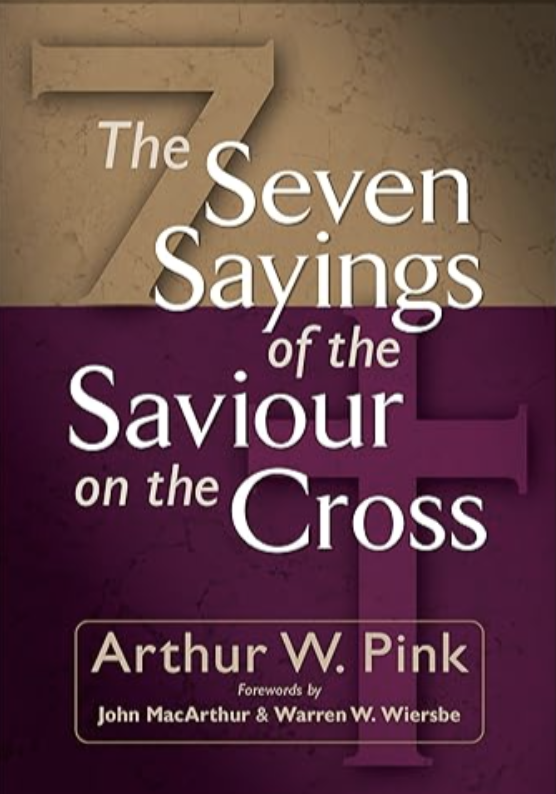
This series draws on the structure and ideas in “The Seven Sayings of the Saviour on the Cross” by Arthur W. Pink, 1984, Baker Book House. Direct quotations are indicated. AI was NOT used in the creation of this Blog post.

Main image credit: https://www.betheltempletwinfalls.org/devotionals/2020/4/10/it-is-finished

5/7: Suffering (The Significance of Jesus’ Final Words on the Cross)


If you have just joined me for this series exploring Jesus’ final words on the Cross, please see my previous posts (links below). Jesus’ words speak of salvation and forgiveness, revealing His great compassion. They also show his great anguish in being separated from the Father by our sin. But, most importantly, his words reveal who He is and what He is doing.

Today we look at the fifth and very short statement Jesus makes: “I thirst” (John 19:28). These words, spoken close to death after three hours of darkness (and six hours on the Cross), express physical suffering. But his actual thirst is not the only reason for saying them, as the surrounding verses reveal: “Later, knowing that everything had now been finished, and so that Scripture would be fulfilled, Jesus said, ‘I am thirsty.’”(NIV)

Jesus’ Humanity

As theologian Charles Spurgeon explains, there are multiple physical reasons for Jesus’ thirst: ” . . . [it] was caused, perhaps, in part by the loss of blood, and by the fever created by the irritation caused by his four grievous wounds. The nails were fastened in the most sensitive parts of the body . . . The extreme tension produced a burning feverishness. It was pain that dried his mouth and made it like an oven, till he declared, in the language of the twenty-second psalm, “My tongue cleaveth to my jaws. (Charles Spurgeon Sermon 1409.)

Pink believes that “I thirst” was not an appeal for pity, nor a request to alleviate his sufferings: “It gave expression to the intensity of the agonies He was undergoing” (p.98). At this point, Jesus thirsts both physically and spiritually, separated from the Father, longing to be reunited with Him. “His thirst was the effect of the agony of His soul in the fierce heat of God’s wrath. It told of the drought of the land where the living God is not” (p.98).

The Messiah who fulfils Scripture

Jesus expressed both the desire and knowledge that Scripture must be fulfilled. His phrase “I thirst” is the specific fulfilment of Psalm 69:21 (one of the many Messianic Psalms – we are just scratching the surface!). Jesus knew the predictions of previous verses were already fulfilled. For example, he had:
* sunk in the “deep mire”
* been hated “without a cause”
* borne reproach and shame
* become a stranger to his brothers
* cried to God in His distress
Nothing remained except the offer of gall and vinegar. For this reason, Jesus says, “I thirst”. Pink sees Christ’s deep reverence for both the Scriptures and his role as our Saviour, who must bow to the authority of the Father’s word in both life and death. “He hung on the cross for six hours and passed through unparalleled suffering, yet is His mind clear and His memory unimpaired. . . He remembers there is one prophetic Scripture unaccomplished. He overlooked nothing. What a proof is this that He was divinely superior to all circumstances!” (p.100).

Jesus, our Saviour, thirsts on the Cross to fulfil his role as the promised Messiah. He is obedient to His Father and to Scripture, to the drink the cup of wrath that we deserve. And though he thirsts on the Cross, he offers us “living water”. We need never thirst again.

These words from John 4 bring us this assurance: Jesus answered, “Everyone who drinks this water will be thirsty again, but whoever drinks the water I give them will never thirst. Indeed, the water I give them will become in them a spring of water welling up to eternal life.” This the power of Christ’s death for us!

See you for #6, Christ’s words from John 19:30: When he had received the drink, Jesus said, “It is finished.” With that, he bowed his head and gave up his spirit.”

Please also enjoy this beautiful modern Easter Hymn (2005) written by Keith Getty and Stuart Townend

This series draws on the structure and ideas in “The Seven Sayings of the Saviour on the Cross” by Arthur W. Pink, 1984, Baker Book House. Direct quotations are indicated. AI was NOT used in the creation of this Blog post.

Main image credit: https://resurrectionopc.org/i-thirst/

What we’re singing this Easter

Today a good friend asked me what songs were on our music roster for next weekend. It then struck me that it might be a useful list to share more widely. Here it is. I’d love to hear what your church is singing . . . and where in the world you are. Please comment!

GOOD FRIDAY

Glories of Calvary (Sovereign Grace)

Man of Sorrows (Hillsong)

Behold the Lamb (Getty)

The Power of the Cross (Getty)

EASTER SUNDAY

The Father’s Love (Sovereign Grace)

Christ is Risen, He is Risen Indeed (Getty)

Grace has now appeared (EMU)

How deep the Father’s Love (Townend)

Here is the Spotify playlist